

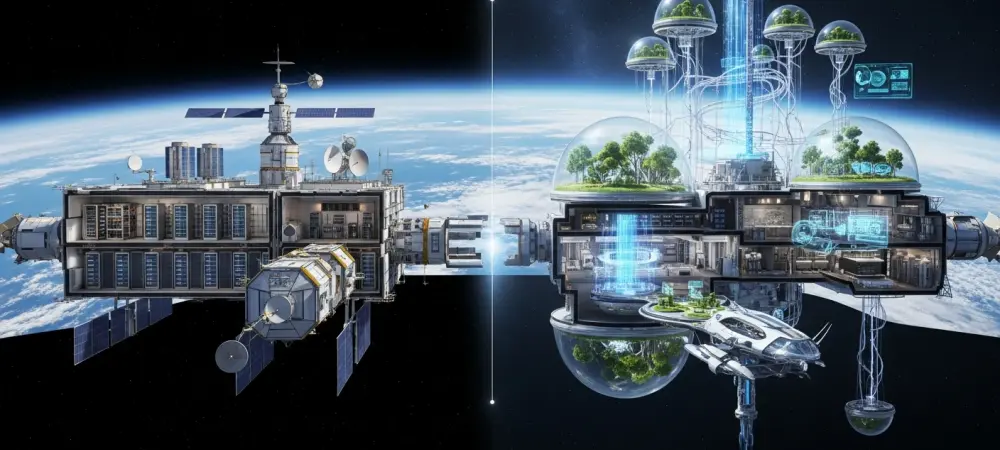
Bridging the Gap: Sci-Fi Dreams and Terrestrial Realities
The relentless expansion of digital infrastructure is driving global tech giants to look beyond terrestrial borders toward the infinite vacuum of orbit. As Earth-based facilities face rising land costs and energy restrictions, the concept of a “galactic cloud” has transitioned from speculative fiction to a serious market analysis. This exploration weighs ambitious marketing claims against the unforgiving laws of physics to determine if space-based processing is a viable near-term prospect.
The Evolution: From Signal Relays to Orbital Processing
Historically, hardware in space served primarily as low-power communication relays. However, the commercialization of low Earth orbit and falling launch costs have changed the narrative in 2026. This shift marks a transition from viewing space as a transmission medium to a destination for high-performance computing. Understanding these historical industry shifts is vital for gauging whether the current market can support the scale required for true orbital data centers.
Deconstructing the Hurdles: Engineering the Galactic Cloud
The Gigawatt Scale: Solving the Solar Energy Deficit
The energy requirements for an industrial-scale data center are staggering, often reaching a gigawatt. Supporting such a load in space would necessitate solar arrays 10,000 times larger than those on the International Space Station. Constructing a power plant the size of 5,000 football fields in orbit creates logistical complexities that currently outweigh the benefits of moving off-planet.
Hardening the Hardware: Shielding Against Cosmic Interference
Silicon hardware remains highly vulnerable to cosmic gamma radiation, which causes “bit-flipping” and data corruption. While space-hardened chips exist, they lag behind terrestrial performance and carry exorbitant price tags. Balancing high-speed processing with the necessity for heavy radiation shielding remains a core conflict for current engineering teams.
The Vacuum Paradox: Overcoming Severe Thermal Obstacles
A common misconception suggests that the cold of space makes cooling easy. In reality, the lack of an atmosphere makes traditional conduction and convection impossible. Heat must be dissipated through infrared radiation, requiring massive fins that are difficult to position. This thermal management hurdle adds significant mass and complexity to any proposed orbital facility.
Navigating the Future: Trends in Logistics and Regulation
Emerging trends suggest a move toward “space-edge” computing for satellite-to-satellite communication. As terrestrial regulations on water and land use tighten, the economic incentive for modular, small-scale orbital processing grows. Predictions indicate that while hyperscale centers remain distant, specialized micro-centers for low-latency tasks are likely to emerge in the coming years.
Strategic Considerations: Managing Next-Generation Infrastructure
For IT professionals, the primary takeaway is that commercial application remains a long-term goal. Current best practices involve optimizing terrestrial green energy rather than banking on celestial solutions. Organizations should monitor space-hardened edge computing developments, as these smaller innovations will eventually provide the foundation for larger orbital projects.
Final Verdict: Balancing Ambition With Physical Constraints
The analysis demonstrated that orbital centers occupied a precarious middle ground between immediate reality and distant fiction. Leaders focused on modularity and decentralized edge nodes rather than massive singular hubs. The shift toward specialized orbital hardware provided the necessary bridge, ensuring that the cloud eventually expanded beyond its terrestrial anchors toward a more resilient, space-integrated future.