

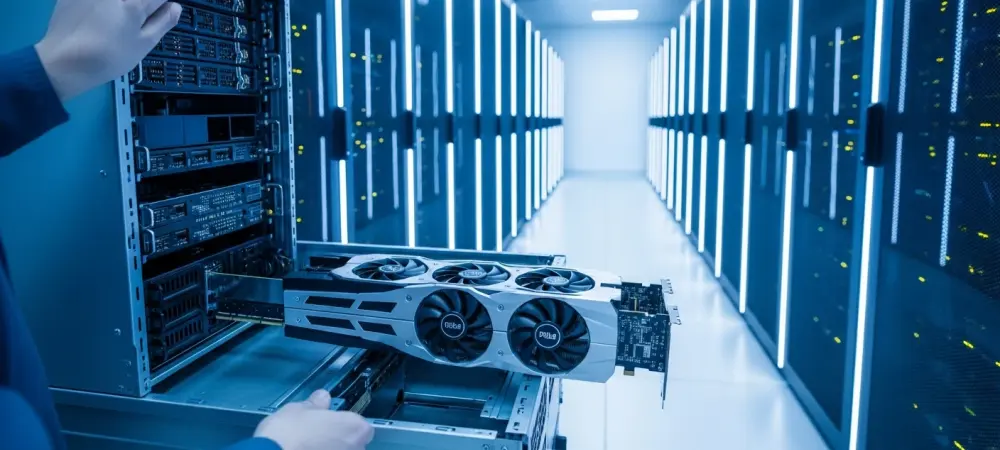
The relentless surge of agentic artificial intelligence has forced modern corporations to confront a harsh reality: the traditional cloud-centric computing model is rapidly becoming an unsustainable drain on capital and operational flexibility. Many enterprises today find themselves trapped in a costly paradox where scaling their internal AI capabilities threatens to erase the very profit margins those technologies were intended to generate. While the new era of autonomous agents promises revolutionary gains in productivity, the specialized hardware required to run them often necessitates a complete data center overhaul that most organizations simply cannot afford. The arrival of the AMD Instinct MI350P PCIe GPU suggests a different path forward by offering a high-compute solution that fits into the servers businesses already own. This shift could mark the end of the “cloud-only” mindset for high-performance inference, allowing companies to reclaim control over their computational costs without sacrificing the speed of innovation.
Moving Beyond the High Cost of Cloud-Based Intelligence
The financial burden of maintaining advanced AI models in the cloud has become a primary concern for Chief Information Officers who must balance performance with fiscal responsibility. Every token generated by a remote large language model adds to a mounting operational expense that fluctuates based on user demand and provider pricing tiers. This unpredictability makes long-term budgeting nearly impossible for high-growth firms. By transitioning to a local hardware model, enterprises can transform these variable costs into a one-time capital investment. The MI350P was designed specifically to facilitate this transition, providing the raw power needed for heavy inference tasks while remaining compatible with standard enterprise hardware.
Furthermore, the move away from the cloud addresses critical concerns regarding data sovereignty and latency. When processing occurs locally on specialized PCIe cards, sensitive corporate data never leaves the internal network, reducing the risk of exposure and ensuring compliance with tightening global privacy regulations. In contrast to the lag often experienced with remote API calls, on-premises accelerators provide the near-instantaneous response times required for real-time agentic workflows. Reclaiming control over the hardware layer does more than just save money; it provides a foundation for a more secure and responsive digital infrastructure.
Why the Infrastructure Gap Is Stalling AI Adoption
The primary barrier to enterprise AI scaling is not a lack of interest, but a lack of physical compatibility between modern accelerators and legacy data centers. Modern high-end AI chips typically require specialized liquid cooling systems and massive power draws, forcing companies to choose between astronomical cloud bills or multi-million dollar “greenfield” projects. For a mid-sized enterprise, the jump from standard CPU-based workloads to heavy AI modeling is often too steep to justify. This has created a significant gap between experimental AI prototypes and full-scale production environments that can handle thousands of concurrent users.
Organizations need a way to integrate advanced AI throughput into legacy environments, making the transition to local AI both logistically feasible and financially sustainable. However, most available high-performance chips are sold as part of pre-integrated, high-density server blocks that require specific rack dimensions and power phases. By offering a card that works within the constraints of standard air-cooled server racks, the industry can finally bridge the gap between initial AI curiosity and long-term operational success.
The Anatomy of a Drop-In AI Powerhouse
The MI350P addresses physical scaling barriers by utilizing a dual-slot, air-cooled PCIe form factor, which allows it to integrate directly into existing server racks without custom plumbing or electrical upgrades. Despite this “standard” design, the card delivers leadership-class performance with an estimated 2,299 TFLOPS, reaching up to 4,600 peak TFLOPS at MXFP4 precision. This technical prowess is supported by 144GB of HBM3E memory and a 4TB/s transfer rate, specifically engineered to eliminate data bottlenecks during Retrieval-Augmented Generation (RAG) and high-speed inference.
By supporting lower-precision formats like MXFP6 and MXFP4, the hardware enables higher throughput and more efficient model implementations. This allows a single air-cooled server to handle workloads that previously required specialized, high-density clusters. The use of advanced precision formats means that enterprises can pack more intelligence into every watt of power consumed. This technical strategy ensures that even a standard data center can compete with the performance metrics of hyperscale cloud providers, provided the right silicon is in the slots.
Strategic Findings on Open Ecosystems and Operational Impact
Research into the AMD enterprise AI stack highlights a significant shift toward “software fluidity,” where organizations prioritize code sovereignty over proprietary vendor lock-in. Unlike competitors that bundle hardware with expensive, mandatory software licenses, AMD provides its reference stack—including the Kubernetes GPU Operator and native PyTorch support—at no additional cost. Expert analysis suggests that this open-source approach, combined with the MI350P’s ability to leverage existing power grids, creates a much faster path to return on investment. By moving inference on-premises, companies replaced unpredictable “per-token” cloud billing with a fixed capital expenditure, making it easier to budget for long-term growth and high-volume user traffic. The transition was further smoothed by the ROCm software environment, which allowed developers to migrate their existing CUDA-based codebases with minimal friction. This transparency in the software layer ensured that IT teams could maintain full control over their deployment pipelines without being forced into a specific vendor’s ecosystem for the life of the hardware.
Framework for Scaling On-Premises Inference
To successfully transition from cloud-dependent AI to a scalable local infrastructure using the MI350P, organizations followed a structured deployment framework that maximized their existing resources. First, they identified high-volume inference and RAG workloads that incurred the highest recurring cloud costs and prioritized them for migration. Second, they assessed existing server racks for dual-slot PCIe availability and verified that current air-cooling systems supported the thermal output of up to eight cards per server. This assessment ensured that the hardware could be deployed immediately without waiting for facility renovations.
Third, these organizations leveraged the AMD Kubernetes GPU Operator to automate the lifecycle management of these resources, ensuring they integrated seamlessly with existing containerized workflows. Finally, they prioritized models that utilized MXFP4 and MXFP6 precision to maximize the GPU’s efficiency, effectively doubling the throughput compared to standard formats. These strategic steps allowed enterprises to build a resilient, local AI capability that functioned as a reliable extension of their core business operations. The shift toward on-premises hardware ultimately proved that a balanced approach to compute—one that values both peak performance and physical practicality—was the key to unlocking sustainable AI growth across the corporate world.