

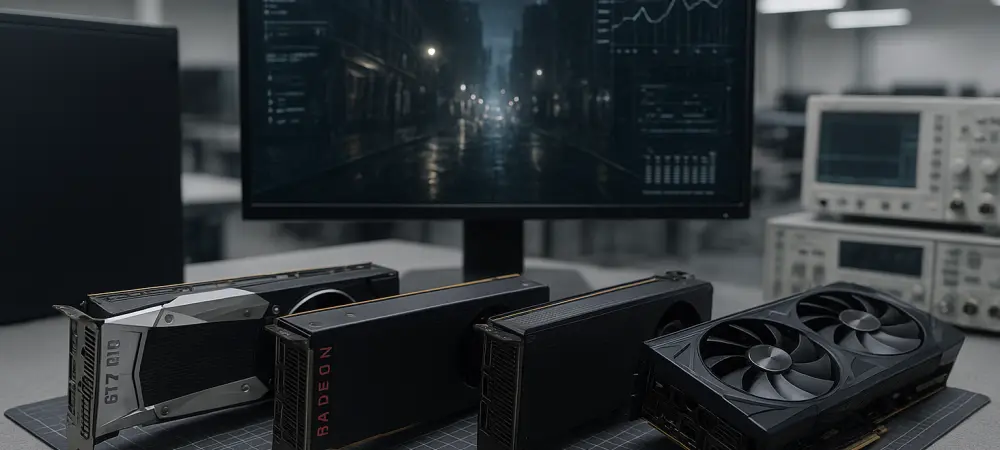
Testing at 1440p reveals a steep performance wall where even veteran cards like the GTX 1080 or RX Vega 56 struggle to maintain consistent frame rates without significant upscaling assistance. This reality serves as a sobering reminder of the technological chasm that has widened as the industry shifts toward more sophisticated game engines. The release of The Sinking City 2 by Frogwares has become a focal point for enthusiasts who still cling to hardware that once defined the high-end market but now finds itself in the legacy category. While the game promises a return to the haunting, Lovecraftian streets of Arkham with unprecedented visual fidelity, the transition to Unreal Engine 5 brings a host of technical demands that challenge the limits of older silicon. This analysis seeks to bridge the gap between developer-provided specifications and real-world results, examining how the title performs across a range of older components that are increasingly being pushed to their breaking point by modern rendering pipelines. The difficulty of optimizing such a massive, atmosphere-heavy title for hardware that predates the ray-tracing era cannot be overstated, yet it remains an essential endeavor for maintaining a broad player base in 2026.
Architectural Shift: Integrating Unreal Engine 5 Features
Moving to Unreal Engine 5 is a double-edged sword for developers looking to push the boundaries of environmental storytelling. This engine offers unprecedented visual fidelity through tools like Nanite for virtualized geometry and Lumen for dynamic global illumination, which are pivotal in creating the oppressive, water-logged atmosphere required for a cosmic horror experience. However, these features are notoriously taxing on hardware that lacks hardware-accelerated ray tracing or high-bandwidth memory. For players using legacy equipment, the inclusion of these technologies often translates to a massive overhead that older GPUs were never designed to handle. The reliance on virtualized geometry allows for incredible environmental detail, but without modern architecture to process the massive amounts of data efficiently, older cards frequently experience bottlenecks that manifest as inconsistent frame delivery and increased latency. The challenge lies in utilizing these advanced lighting and geometry systems without making the game inaccessible to those who have not upgraded their systems in several years.
To address these significant hurdles, the developers implemented an aggressive graphics pipeline strategy that prioritizes atmosphere over raw technological complexity when legacy hardware is detected. Instead of simply disabling the engine’s core features, which would strip the game of its signature gloomy aesthetic, they utilized a series of hybrid settings designed to mimic high-end effects with less demanding techniques. On older hardware, the game intelligently scales back real-time global lighting calculations in favor of more traditional shadow maps and baked environment data. This approach allows the game to maintain its dark, foggy appearance while avoiding the total collapse in frame rates that usually occurs when Lumen is forced to run on non-RTX hardware. This tactical retreat from purely dynamic lighting ensures that the artistic vision of the sunken city remains intact, even if the underlying technology is shifting to a more conservative processing model to accommodate older GPUs.
Strategic Engineering: Advanced Optimization for Older Hardware
One of the most significant bottlenecks for older graphics cards in modern gaming is the limited amount of Video RAM available for high-resolution textures and complex geometry. To combat this limitation, the developers redesigned the texture and geometry loading system by partitioning the city into compact, independent zones that load and unload based on player proximity. This zone-based unloading prevents the engine from attempting to hold too much data in memory at once, which is a critical necessity for cards with 8 GB of VRAM or less. This granular approach to asset management ensures that the most detailed textures are always where the player is looking, while the rest of the world exists in a highly compressed state that does not strain the hardware’s limited bandwidth.
Additionally, the game focuses on CPU efficiency and clever shader-based visual tricks to maintain a high level of immersion without the associated costs. Artificial intelligence behavior for monsters and background characters is strictly distance-optimized, meaning that entities located far from the player update their logic and animation cycles less frequently to save precious processing power. Rather than using expensive, real-time physics simulations for the game’s constant rain and thick fog, the developers employed highly optimized particle systems that rely on pre-calculated movements. This preserves the visual density of the water-logged environment and the sense of dread it inspires while minimizing the computing power required from the GPU. These optimizations demonstrate a commitment to making the game playable on a wider variety of systems, proving that sophisticated software engineering can often overcome the limitations of aging physical components.
Hardware Benchmarks: Graphics Card Performance and Resolution Tiers
The benchmark results provide a clear and somewhat demanding picture of what players can expect at different hardware levels when navigating the flooded streets of the game. At 1080p, achieving a baseline of 25 frames per second in native mode requires at least a GeForce GTX 1070, which was once the gold standard for mid-range gaming but is now relegated to entry-level status. However, for a more stable and visually pleasing experience, the GTX 1660 SUPER is recommended as the true minimum for consistent playability at this resolution. When upscaling technologies like FSR or XeSS are turned on, the entry bar drops significantly, allowing older and less powerful cards like the GTX 1060 to reach playable averages. This highlights the vital role that temporal upscaling plays in the modern ecosystem, acting as a lifeline for hardware that would otherwise be unable to render modern geometry at acceptable speeds. At 1440p, legacy hardware faces a much steeper climb that many components simply cannot summit without extreme compromises. This resolution proves to be a significant struggle for older components, where a GTX 1080 is the bare minimum required to maintain a basic 25 frame-per-second average, often dipping during intense combat or heavy weather effects. To hit a smooth and competitive 60 frames per second at this resolution, users need to be at the higher end of the legacy spectrum, utilizing cards like the RTX 2080 Ti or the RX 6700 XT. Even with these relatively powerful legacy cards, achieving high frame rates often necessitates the use of aggressive temporal scaling modes, which can introduce slight shimmering or ghosting in the dense fog. The data suggests that while 1080p is still very much accessible for the majority of players, 1440p has become the new frontier where older hardware begins to show its age most prominently.
System Dynamics: Memory Management and CPU Scaling
The benchmarks reveal an interesting and somewhat unexpected relationship between Video RAM and general system RAM that players with older systems must account for. In The Sinking City 2, when a graphics card has low memory, the system compensates by leaning more heavily on the general system RAM to store overflow assets. On cards with only 6 GB of VRAM, the game can pull nearly 18 GB of system RAM to keep the engine running smoothly during transitions between city districts. This indicates that having 32 GB of system memory is a much safer bet for those running older graphics cards, as it provides a necessary buffer to prevent crashes or severe slowdowns during high-intensity scenes. For those still using 16 GB of system RAM, the risk of micro-stuttering increases significantly when the VRAM limit is reached, making a memory upgrade one of the most cost-effective ways to improve the experience on an older build.
Regarding processors, the game is remarkably accessible as long as the player is not targeting extremely high frame rates that would likely be bottlenecked by the GPU anyway. While older entry-level chips like the Ryzen 3 1200 can maintain basic playability and keep the game from crashing, reaching a steady 60 frames per second requires more robust legacy chips like the Core i9-9900K. The Unreal Engine 5 implementation here is well-optimized for multi-core setups, reaching its peak efficiency at approximately 12 threads. This means that older 4-core processors may struggle in dense urban areas where the engine must track numerous NPCs and complex environmental interactions simultaneously. Players using these older quad-core chips may notice significant frame drops in the city center, suggesting that thread count has become just as important as clock speed in the current technological landscape.
Technical Foundations: Mandatory Storage and Platform Requirements
One non-negotiable aspect of the system requirements that players must respect is the storage medium used for installation. The developers have set a strict requirement for 70 GB of SSD space because the engine relies on the constant, high-speed streaming of high-quality assets to maintain visual consistency. Attempting to run the game on a traditional mechanical hard drive would likely result in severe hitches, long loading times, and broken textures that ruin the experience regardless of the graphics card’s raw power. The move toward SSDs as a baseline requirement is a direct result of how modern engines handle data, moving away from large, pre-loaded chunks of information in favor of a continuous stream. This shift ensures that the game can maintain its detailed world without the need for frequent loading screens, but it effectively marks the end of the line for mechanical drives in the realm of high-end gaming. Furthermore, the game requires a 64-bit version of Windows 11 and utilizes the DirectX 12 API exclusively to manage its complex rendering tasks. While this is standard for modern engine titles, it may exclude users who have stayed on much older operating systems for compatibility or personal preference reasons. This requirement ensures that the game can utilize modern data handling techniques and advanced shader models, which are essential for maintaining performance on the older hardware the game aims to support. By standardizing on a modern API, the developers were able to implement more efficient communication between the CPU and GPU, which is particularly beneficial for legacy systems that need every bit of optimization possible. Ultimately, these platform requirements represent the baseline necessary to ensure that the game functions as intended, providing a stable foundation for the cosmic horror that awaits within the city limits.
Strategic Pathways: Evaluating Hardware Longevity and Upgrades
The performance testing of this title showed that the era of relying solely on raw GPU power for modern gaming has largely concluded for those on older platforms. Benchmarks indicated that software-based solutions, particularly temporal upscaling and sophisticated memory management, were the primary factors allowing legacy cards to remain viable in a high-fidelity environment. Owners of hardware such as the GTX 10-series or early RTX cards found that their experience depended heavily on the availability of system-side resources, like expanded RAM and high-speed storage. It became clear through extensive testing that the bottleneck in modern titles has shifted from a single component to the interplay between VRAM, system memory, and storage throughput. For players looking to extend the life of their current builds, the data suggested that prioritizing an upgrade to 32 GB of RAM and ensuring a high-performance SSD provided more immediate stability than a marginal GPU upgrade.
Moving forward, the results from these tests offered a roadmap for navigating the increasingly demanding requirements of modern game engines. The transition to advanced rendering pipelines required a shift in how players optimized their settings, with a greater emphasis on balancing resolution scaling against native clarity. It was observed that maintaining a consistent frame rate on legacy hardware necessitated a move away from 1440p targets in favor of 1080p with high-quality upscaling, which preserved the intended aesthetic while keeping performance within playable margins. Future considerations for those on aging hardware must include an evaluation of API support and driver longevity, as the reliance on DirectX 12 and Windows 11 became a firm requirement for modern stability. These insights allowed users to make informed decisions about their hardware budgets, focusing on specific bottlenecks that, when addressed, significantly prolonged the usability of their legacy systems in an increasingly demanding technological landscape.