

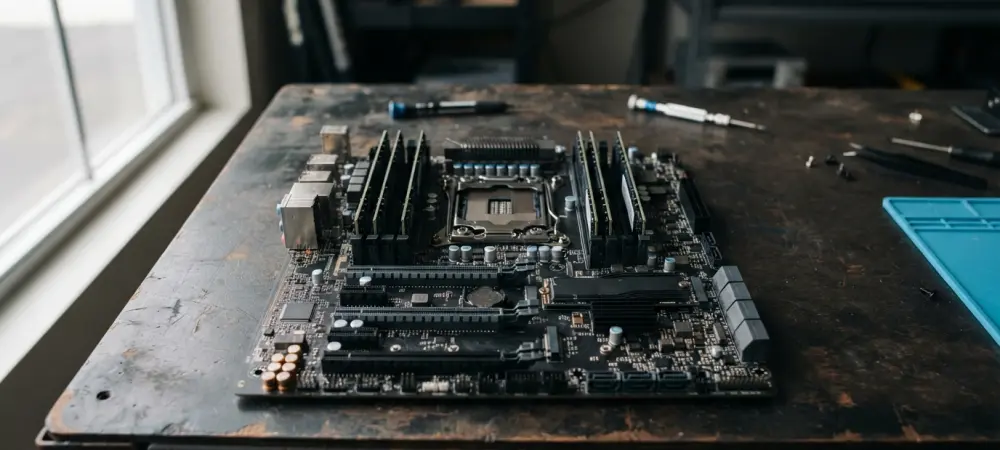
Modern enterprise server rooms frequently face a silent financial crisis where high-performance memory modules consume nearly ninety percent of total hardware procurement budgets. This disproportionate expenditure stems from the rigid physical limitations of traditional Dynamic Random Access Memory, which has long served as a strict gatekeeper for system performance. While storage capacities for solid-state drives have surged, the price per gigabyte for DRAM remains high, forcing organizations into expensive hardware cycles just to keep pace with expanding datasets.
AMD Mext represents a departure from this cycle by reimagining the relationship between volatile memory and high-speed flash storage. By treating the SSD as an extension of the system RAM, the software bridges a historical performance gap that previously rendered storage-based memory expansion too sluggish for production environments. This shift allows infrastructure managers to move beyond traditional hardware limits, effectively decoupling memory capacity from the physical number of DIMM slots available on a motherboard.
The Multi-Million Dollar Memory Bottleneck: Breaking the DRAM Monopoly
The economic strain of modern AI workloads has reached a breaking point, as neural networks and massive databases demand memory footprints that exceed standard configurations. Scaling a data center today requires more than just raw power; it necessitates a sophisticated approach to cost management. Legacy solutions like traditional swap files or simple paging mechanisms proved insufficient because they lacked the intelligence to handle the high-throughput requirements of modern software stacks. Intelligent tiering has moved from a theoretical convenience to an urgent necessity for large-scale operations. Without a way to manage data placement dynamically, servers often leave expensive DRAM underutilized with “cold” data while critical tasks compete for remaining space. The industry required a solution that could differentiate between vital instructions and idle background information, ensuring that every dollar spent on silicon translates directly into operational efficiency.
Why Memory Costs Dictate Data Center Scaling: The AI Economic Strain
At the center of this innovation is a suite of AI models derived from transformer architectures designed for predictive data tiering. These algorithms do not simply respond to memory misses; they proactively anticipate which data pages an application will require by analyzing access patterns in real time. This movement of infrequently accessed memory pages to flash storage happens seamlessly, eliminating the latency spikes that usually plague non-DRAM memory configurations.
Performance efficiency is maintained through high-velocity training conducted directly on Epyc processor cores. Unlike traditional machine learning tasks that require dedicated GPU hardware, these optimizations are trained in less than one second, allowing the system to adapt to shifting workloads without introducing significant overhead. Benchmarking results in Apache Spark environments showed the system maintained ninety-nine percent of its original speed, proving that intelligent orchestration can mimic the behavior of physical DRAM.
The Mechanics of Mext AI Orchestration: Predictive Data Tiering
Documented field results from 145 active server systems have validated the economic impact of this software-defined approach. By avoiding unnecessary hardware purchases, early adopters achieved over five million dollars in capital savings while maintaining robust performance across diverse enterprise workloads. These metrics demonstrate that software-led memory management is a viable alternative to the perpetual strategy of purchasing more RAM that has dominated the industry for decades.
Workload scalability remains a primary focus for engineers evaluating the floor of performance reduction. In complex electronic design tool tests, systems provided eighty percent of standard throughput even when physical DRAM was reduced to only a quarter of its usual size. This resilience toward high-capacity flash integration suggests that for most enterprise tasks, the trade-off between slight latency increases and massive cost reductions is overwhelmingly favorable for the bottom line.
Validated Savings and Field Performance Metrics: Documenting Field Results
Implementing Mext requires a strategic analysis of existing infrastructure using specialized analytics tools like RAM View. This application allows administrators to visualize memory usage patterns for specific workloads, identifying which processes are suitable for tiering and which require persistent DRAM residency. By determining the ideal ratio of DRAM to SSD storage, companies optimized their hardware configurations to match actual usage rather than theoretical peaks.
Navigating the implementation process involved coordinating with hardware partners and managing virtualized constraints. While the software integrated smoothly with AMD Epyc architecture, licensing through partners like HPE ensured that enterprise support remained consistent across the fleet. Administrators also balanced CPU overhead by allocating dedicated cores for virtual machine instances, which minimized performance penalties during peak operational windows.
Implementing Mext: Strategies for Data Center Optimization
The transition to AI-managed memory structures offered a practical resolution to the escalating costs of enterprise computing. Organizations that adopted these predictive tiering strategies realized significant budgetary flexibility, allowing them to redirect capital toward other critical infrastructure projects. As data demands grew, the ability to utilize high-capacity flash storage as a viable memory extension became a cornerstone of modern server strategy. Future developments looked toward even deeper integration between silicon and software to further erase the distinction between storage and active memory.