

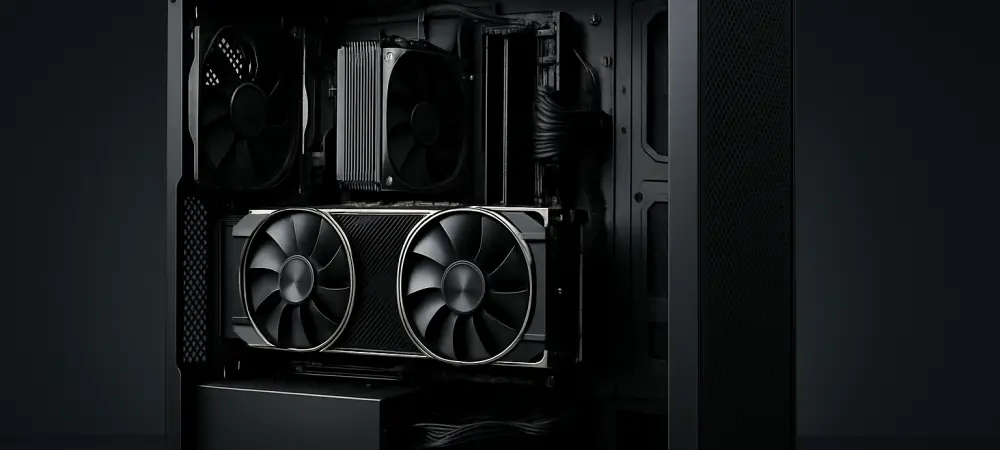
Most modern computer cases lack the internal clearance and airflow required to prevent a dual-GPU system from reaching dangerous operating temperatures. The technical barrier to entry for a multi-GPU system remains high, even as software compatibility has vastly improved over the last few years. Historically, mixing hardware from “Team Red” and “Team Green” was considered a recipe for system instability, yet current desktop environments have evolved to a point where running an AMD and an NVIDIA card side-by-side is technically feasible without driver conflicts. Achieving a stable setup requires more than just plugging in cards; it demands specific hardware prerequisites and a clear understanding of how the operating system handles drivers to ensure that the different architectures do not fight for control over resources. Windows now manages these diverse profiles with grace, but the physical reality of cramming two high-end components into one chassis presents major thermal hurdles for builders.
Specialized Performance: Offloading Frame Generation
One of the few remaining reasons a gamer might mix brands is to exploit niche software workarounds like offloading frame generation. In this scenario, a powerful primary NVIDIA card handles the core rendering of a game, while a secondary AMD card is dedicated to generating extra frames via applications like Lossless Scaling. Interestingly, tests in 2026 have shown that using an AMD card for this specific task can result in lower latency than some native solutions. This allows the primary card to focus entirely on visual quality while the secondary unit smooths out the motion, creating a rare moment of synergy between manufacturers. By connecting the display directly to the secondary GPU, the primary card is freed from the overhead of frame interpolation, which is particularly beneficial in CPU-bound scenarios. This setup reveals a surprising performance trend where “Team Red” hardware complements an NVIDIA-based rendering pipeline quite effectively for enthusiast users.
The shift toward this hybrid approach stems from the fact that modern games are increasingly dependent on AI-driven frame synthesis to maintain high refresh rates. While NVIDIA’s DLSS technology is industry-leading, its proprietary nature sometimes limits flexibility in multi-GPU environments. AMD’s open-source initiatives, conversely, have provided tools that function across various hardware stacks. When these two worlds collide, enthusiasts find that the specialized focus of each card leads to a more responsive feel. For instance, using an AMD card for frame generation can result in latency as low as 11 milliseconds in certain optimized titles, which is more responsive than standard implementations on older hardware. However, this level of optimization requires a deep dive into third-party software settings and a willingness to troubleshoot synchronization errors between display drivers, making it a pursuit for the dedicated hobbyist seeking the highest possible performance.
Physical Challenges: Thermal and Mechanical Constraints
Managing the heat generated by two high-performance GPUs is the greatest deterrent for enthusiasts. When two cards are stacked in a standard case, the bottom card often blocks the air intake fans of the top card, leading to rapid thermal throttling. To prevent hardware from overheating, builders frequently have to invest in expensive solutions such as PCIe riser cables for vertical mounting or custom liquid cooling loops. By the time the necessary money and effort have been spent to keep a dual-GPU system cool and powered, the cost often exceeds that of simply buying a single, top-tier graphics card. Additionally, the electrical demands are substantial. To account for the combined power draw and the sudden energy spikes common in high-end cards, a power supply of at least 1000W is necessary for modern stability. Without a robust electrical foundation, the system will likely experience sudden crashes the moment both GPUs are pushed toward their maximum operating potential.
The mechanical strain on the motherboard is another factor that cannot be overlooked in these builds. Modern graphics cards have grown significantly in size and weight, often occupying four expansion slots. Placing two of these behemoths in a single chassis puts immense pressure on the PCIe slots, requiring heavy-duty support brackets to prevent “GPU sag” or permanent damage to the PCB. Furthermore, the era of combining GPUs to boost raw gaming performance through technologies like SLI or CrossFire is effectively over. Modern game engines are rarely coded to utilize more than one graphics processor simultaneously, meaning a second card will often sit idle during gameplay unless specifically assigned to background tasks. The latency involved in moving data between separate cards over the PCIe bus creates a bottleneck that cancels out theoretical gains, leading to diminishing returns for those purely focused on traditional frame rates.
Strategic Implementation: Professional Productivity and Beyond
While the benefits for gaming are slim, mixing AMD and NVIDIA GPUs remains highly advantageous for professional and creative applications. Software used for 3D rendering, such as Blender or Redshift, can often distribute tasks across multiple GPUs regardless of their brand, drastically reducing render times in a way that games cannot. Similarly, those working with Artificial Intelligence or Large Language Models benefit from the increased total VRAM that multiple cards provide. For professionals who need to run virtual machines with dedicated hardware pass-through, having two different GPUs allows for a clean separation of resources that a single card cannot provide. This allows for a Linux-based workstation to utilize one card for its primary display while passing the second card through to a Windows-based virtual machine for specialized software tasks, ensuring peak performance in a sandboxed and secure environment for high-stakes development or design work.
The decision to mix GPU brands was ultimately driven by specific project requirements rather than a general desire for higher gaming benchmarks. Professionals evaluated their software suites to ensure multi-adapter support was present before investing in additional hardware. Those who succeeded in this endeavor prioritized massive cases with high-static-pressure fans and platinum-rated power supplies to mitigate the inherent risks of thermal runaway. As software-driven frame generation became more vendor-agnostic in 2026 and beyond, the need for secondary hardware for the average user largely diminished. Future builds favored single-card efficiency, yet the mixed-GPU experimentalist paved the way for flexible driver ecosystems. Users who required both CUDA cores for development and AMD’s specific display technologies found that with the right configuration, a dual-brand system provided a unique and powerful workspace that a single-vendor solution simply failed to match in versatility.