

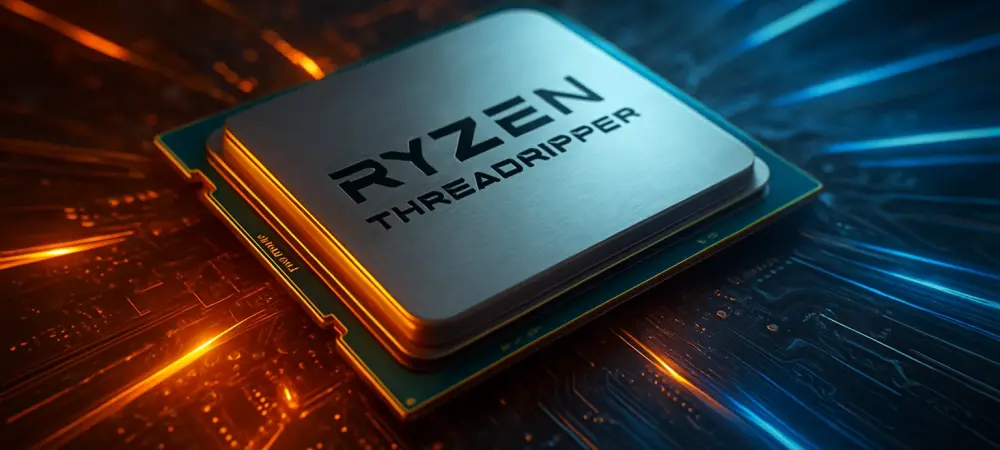
Imagine a world where high-end desktop computing no longer demands a fortune, yet delivers the raw power needed for the most intensive tasks like 3D rendering or video editing. AMD has stepped into this arena with its Ryzen Threadripper 9000 HEDT series, a lineup designed to bridge the gap between professional-grade hardware and enthusiast affordability. This review dives deep into what makes these CPUs a game-changer for power users who crave performance without the premium price tag of workstation solutions.
Technical Deep Dive into Features and Specs
Zen 5 Architecture: The Core of Innovation
At the heart of the Ryzen Threadripper 9000 HEDT series lies AMD’s Zen 5 architecture, a significant step forward in processing efficiency and power. This design enhances instructions per cycle, delivering notable gains over previous iterations, particularly in multi-threaded workloads. Such advancements ensure that tasks like complex simulations or heavy multitasking are handled with unprecedented speed.
Beyond raw speed, Zen 5 optimizes power consumption, a critical factor for users running systems under constant load. This balance of performance and efficiency positions the series as a formidable option for those tackling high-end computing challenges. The architecture’s focus on scalability also hints at its adaptability for future software demands.
Model Variants and Hardware Highlights
The lineup includes three distinct models tailored to varying needs: the flagship 9980X with 64 cores, the mid-tier 9970X boasting 32 cores, and the entry-level 9960X with 24 cores. Boost clocks reach up to 5.4 GHz, paired with massive L3 cache capacities of up to 256 MB, ensuring rapid data access for intensive applications. Support for 4-channel DDR5-6400 memory, with capacities up to 1 TB, further amplifies their capability.
Compatibility with TRX50 motherboards unlocks up to 80 PCIe 5.0 lanes, offering vast expansion potential for cutting-edge GPUs and storage solutions. Overclocking features cater specifically to enthusiasts eager to push hardware limits, making these CPUs a playground for performance tuning. This combination of specs underscores AMD’s intent to dominate the high-end desktop space.
Performance Analysis and Market Positioning
Benchmarking Against Industry Rivals
Performance metrics reveal the Ryzen Threadripper 9000 HEDT series as a titan in its class, with the 9980X claiming up to 108% better performance than Intel’s 60-core Xeon W9-3595X in multi-threaded scenarios. Similarly, the 9970X outperforms Intel’s 44-core Xeon W9-3575X by as much as 137%, showcasing AMD’s prowess in raw computing strength. These figures highlight a clear edge in tasks demanding high core counts.
Such benchmarks position AMD as a leader for users prioritizing processing power over brand loyalty. The ability to handle professional-grade workloads at a fraction of the cost of competing solutions reshapes expectations in the high-end desktop market. This competitive advantage is particularly evident in environments where every second of computation matters.
Comparison with the PRO Series
Unlike the Ryzen Threadripper PRO 9000 WX-Series, which targets workstation users with up to 96 cores and 8-channel memory support, the HEDT lineup focuses on affordability and flexibility. Priced significantly lower, with models ranging from $1,499 to $4,999, these CPUs sacrifice some advanced I/O features for overclocking potential and accessible entry points. This strategic differentiation caters to a distinct audience of enthusiasts.
The HEDT series thus serves as a middle ground, offering substantial power without the specialized features of PRO models that command prices up to $11,699. AMD’s dual-market approach ensures that both professional and hobbyist needs are met without overlap. This clear segmentation enhances the appeal of the HEDT CPUs for budget-conscious power users.
Pricing, Availability, and Practical Impact
Cost Structure and Market Access
Launched on July 31st, the Ryzen Threadripper 9000 HEDT CPUs are priced to disrupt, with the 9960X at $1,499, the 9970X at $2,499, and the top-tier 9980X at $4,999. These figures stand in stark contrast to the PRO series’ broader range, making high-performance computing more attainable for a wider audience. AMD’s pricing strategy reflects a commitment to democratizing cutting-edge technology.
Availability across major retailers ensures that enthusiasts and professionals alike can access these CPUs without delay. This accessibility, combined with competitive pricing, challenges the notion that top-tier performance must come at an exorbitant cost. It also signals AMD’s intent to capture a significant share of the high-end desktop segment.
Real-World Applications for Diverse Users
The practical applications of this series span a wide range of fields, from content creation to gaming and beyond. Video editors and 3D artists benefit immensely from high core counts, which drastically reduce rendering times. Even gamers seeking future-proof systems find value in the ability to handle both gameplay and streaming seamlessly.
Unique scenarios, such as running multiple virtual machines or compiling massive codebases, showcase the advantage of overclocking and robust memory support. For users who demand performance on a budget, these CPUs offer a compelling solution without compromising on capability. This versatility makes them a standout choice across varied use cases.
Challenges and Future Considerations
Market Hurdles and Limitations
Despite its strengths, the Ryzen Threadripper 9000 HEDT series faces challenges, including stiff competition from Intel’s Xeon lineup, which may still hold appeal for certain enterprise environments. Additionally, the limited I/O capabilities compared to the PRO series could deter users requiring extensive connectivity for specialized workloads. These constraints highlight areas where AMD must continue to innovate.
High motherboard costs associated with TRX50 compatibility also pose a barrier to entry for some potential buyers. Consumer awareness of the HEDT segment’s value proposition remains another hurdle, as many may gravitate toward more familiar mainstream options. AMD’s efforts to balance cost and features will be critical in overcoming these obstacles.
Long-Term Prospects for HEDT Evolution
Looking ahead, the future of AMD’s HEDT lineup appears promising, with potential advancements in core counts and memory bandwidth on the horizon. Architectural refinements over the coming years, from now to 2027, could further solidify its dominance in performance-per-dollar metrics. Such developments would keep the series relevant amid rapidly evolving tech demands.
AMD’s trajectory suggests a sustained focus on empowering enthusiasts while challenging competitors to match its value. The long-term impact on the high-performance CPU market may redefine how power users approach system builds. Continued innovation will likely ensure that HEDT remains a cornerstone of accessible, high-end computing.
Final Verdict and Next Steps
Reflecting on the comprehensive evaluation, the Ryzen Threadripper 9000 HEDT series carves out a remarkable niche by blending exceptional performance with affordability. It stands as a testament to AMD’s ability to cater to enthusiasts who demand power without the prohibitive costs of workstation-grade hardware. The benchmarks and real-world applications underscore its transformative potential in the high-end desktop arena.
For those considering an upgrade or new build, the immediate step is to assess specific workload needs against the series’ strengths in multi-threaded performance and overclocking. Exploring compatible TRX50 motherboards and planning for future scalability emerges as practical actions to maximize investment. AMD’s offering paves the way for broader discussions on how high-performance computing can evolve to become even more inclusive in the years that follow.