

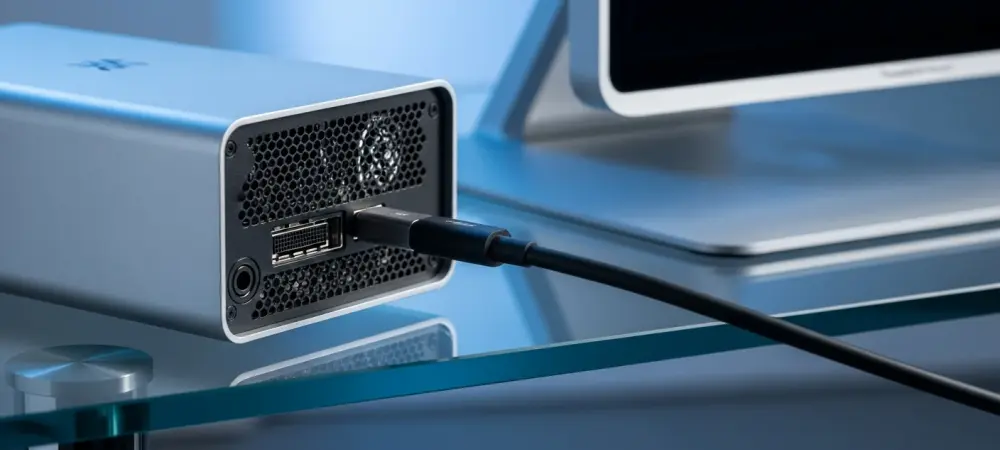
The architectural wall separating Nvidia’s high-performance Blackwell GPUs from the power-efficient ecosystem of Apple Silicon has finally been breached by a sophisticated open-source driver solution. Building on the technical momentum of 2026, developers at Tiny Corp have unveiled a project known as TinyGPU, which serves as a signed kernel extension designed to facilitate a direct communication path between external Nvidia hardware and the macOS environment. This development is particularly notable because it bypasses the long-standing absence of official CUDA support that has plagued the platform since hardware partnerships dissolved in the late 2010s. By utilizing the high-speed data transfer capabilities of Thunderbolt and USB4, this driver allows a modern Mac Mini or MacBook Pro to recognize and utilize the raw computational power of the RTX 5090 without compromising system integrity. For professional users, this represents a major paradigm shift in how local workstation power is managed.
Technical Validation: Assessing Performance and Bandwidth Constraints
Recent benchmark testing conducted on a Mac Mini equipped with the M4 Pro chip provides a granular look at how this integration performs under real-world artificial intelligence workloads. While the RTX 5090 is capable of extreme speeds, the current iteration of the TinyGPU driver reveals a significant disparity between raw hardware potential and actual throughput. During tests using the Llama 3.1 8B model, the setup achieved an impressive time to first token, indicating that the latency for initial responses is remarkably low and highly responsive compared to native Metal implementations. However, the sustained processing speed reached only 7.48 tokens per second, a figure that trails behind what the internal Apple GPU can achieve when optimized for macOS. This performance ceiling is primarily attributed to kernel-level inefficiencies where the driver currently manages only 33GB/s of data bandwidth. This is a staggering drop from the 1.8TB/s theoretical maximum the Blackwell architecture offers on native Windows or Linux machines.
Strategic Outlook: The Path toward Seamless Hardware Interoperability
The successful implementation of the TinyGPU driver established a critical infrastructure that essentially proved the viability of heterogeneous computing on modern Apple hardware. Engineers successfully resolved the complex challenges associated with memory management and compiler pipelines, allowing the RTX 5090 to function as a legitimate AI accelerator. For organizations currently invested in the Apple ecosystem but requiring Nvidia-specific features, the focus transitioned from basic connectivity toward refined software optimization. Future developments necessitated a deeper integration with the macOS memory controller to unlock the bandwidth potential of external GPUs via the USB4 standard. Developers were encouraged to begin prototyping cross-platform workflows that leveraged this newfound flexibility. This breakthrough effectively lowered the barrier to entry for high-end machine learning tasks on the Mac, providing a roadmap for third-party hardware to supplement native silicon. The result was a more versatile computing environment where proprietary hardware limitations no longer strictly defined the boundaries of professional productivity and research.