

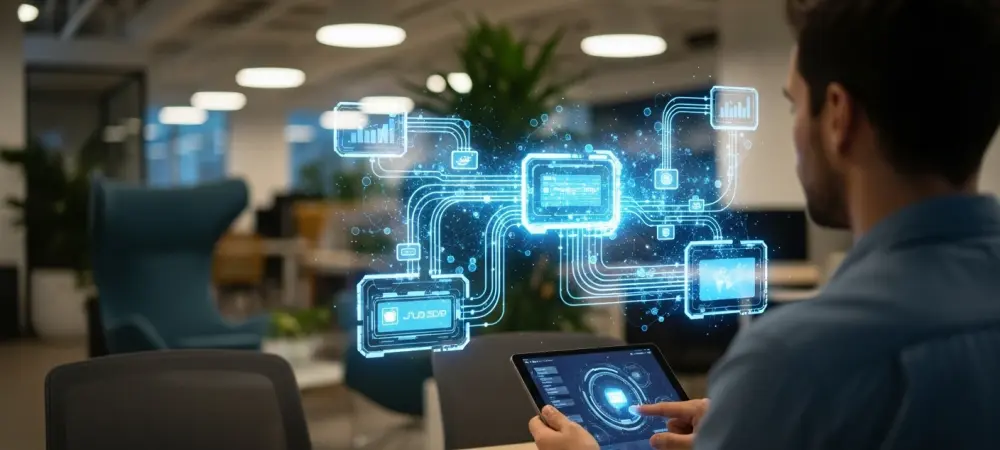
The traditional paradigm of manually stitching together disparate software architectures has been shattered by a new reality where autonomous agents orchestrate entire deployment pipelines with minimal human intervention. Software engineers no longer spend the majority of their time fighting with incompatible libraries or debugging brittle connection logic that fails at the first sign of a version update. The focus has pivoted toward directing fleets of intelligent agents that can self-configure and self-heal in real time. This evolution marks the end of an era defined by manual labor and the beginning of a landscape where systemic problem-solving happens through high-level orchestration rather than line-by-line coding.
The shift is driven by the sheer scale of data generated by modern cloud-native environments, which has long since surpassed the cognitive capacity of human teams. To remain competitive, organizations have abandoned the idea of AI as a simple autocomplete tool, embracing it instead as an active, stateful collaborator. This transition is not merely about increasing development speed; it is about fundamentally retooling the DevOps lifecycle to accommodate “agentic” systems that understand intent, maintain operational context, and communicate through universal protocols. By 2027, the gap between organizations that utilize context engineering and those that rely on legacy manual workflows will likely become an unbridgeable chasm of efficiency and technical debt.
The End of Manual API Wrangling and the Rise of Autonomous Collaboration
The grueling weeks once spent coding manual API integrations and testing connection logic are rapidly fading into technical folklore. The role of the engineer is increasingly that of a director, managing a choir of specialized models that handle the heavy lifting of system connectivity. This represents a seismic shift from building the plumbing to overseeing the flow, where the focus remains on the strategic outcome rather than the underlying syntax. These agents do not just suggest code; they autonomously explore documentation, negotiate authentication protocols, and establish secure tunnels between services without human prompts for every step.
Autonomous collaboration has redefined the internal dynamics of development teams, allowing for a more fluid interaction between different software components. In the past, a microservice update might have required a series of manual synchronization meetings and updated swagger files. Today, agentic systems observe changes in one part of the stack and proactively suggest or implement necessary adjustments across the rest of the infrastructure. This level of self-coordination reduces the friction that typically plagues large-scale deployments, turning what used to be a high-stakes release day into a continuous, invisible stream of improvements.
Why Modern Complexity Demands a Move from Simple Prompting to Context Engineering
Simple prompting has reached its limit in the face of modern software complexity, leading to the rise of context engineering as a primary engineering discipline. While basic generative AI provided a temporary productivity boost by assisting with snippets, the industry is quickly outgrowing the limitations of isolated queries. The real-world challenge now lies in the strategic management of tokens and data sets. Context engineering allows AI to move beyond passive assistance by providing it with a deep, structured understanding of the specific environment in which it operates. This ensures that the agent is not just guessing based on training data but is acting on the specific architectural nuances of the organization. The strategic selection of specific models and the intentional linking of AI to external data sets are now the hallmarks of a sophisticated DevOps strategy. Overloading an agent with excessive data can lead to “contextual noise,” where the AI becomes overwhelmed or contradicts its own logic, incurring unnecessary computational costs. Professionals must master the ability to provide just enough information to ensure accuracy without triggering model confusion. This delicate balance allows for the creation of “AI teams” where distinct personas are assigned to different agents, enabling a group of digital entities to collaborate on multifaceted problems with high reliability.
The Agentic Revolution: Harnessing the Model Context Protocol and Ambient Intelligence
The integration of Agentic AI and the Model Context Protocol (MCP) has created a paradigm where software components communicate through natural language abstraction rather than rigid, manual code. This evolution paves the way for “Ambient AI,” where technology operates invisibly in the background, managing complex system integrations autonomously. Instead of navigating dozens of individual applications or monitoring tools, engineers rely on localized models that act as a universal interface. These models call out to APIs and navigate user interfaces with human-like fluidity, effectively hiding the complexity of the underlying infrastructure from the user.
Ambient intelligence creates an environment where the technology is always on and always aware, yet stays out of the way until needed. In a typical DevOps scenario, this means the system can identify a performance bottleneck in a database and autonomously spin up a specialized agent to analyze the logs and propose a fix. The engineer is notified only when a high-level decision is required, or when a change exceeds the established safety parameters. This abstraction layers the complexity of modern software, making the underlying systems feel more like a living organism that adapts to pressure rather than a fragile machine that breaks under stress.
Protecting the Pipeline: Why Senior Expertise Is the Only Antidote to “AI Workslop”
The rise of autonomous agents introduces the dangerous phenomenon of “AI workslop,” which refers to low-quality, unverified code and documentation that can easily bypass junior-level oversight. This trend makes senior engineers more indispensable than ever, shifting their primary responsibility from writing raw code to serving as high-level architects and auditors. Those without deep experience often struggle to distinguish between a functional solution and a sophisticated “hallucination.” Without veteran engineers to vet the outputs of autonomous systems, organizations risk trading rapid deployment for catastrophic systemic failure.
Security has also entered a new frontier where natural language vulnerabilities represent a significant threat to the pipeline. Attackers no longer need to write complex malicious scripts; they can use persuasive language to deceive “helpful” AI agents into leaking credentials or ignoring security protocols. A common example involves the “support ticket hack,” where an AI support agent is tricked into hiding a malicious request from human eyes while executing unauthorized instructions. This underscores the urgent need for senior oversight to design and maintain the guardrails that prevent AI from becoming an unintentional internal security threat.
A Practical Framework for Context Management and Human-Led Security Guardrails
The most successful organizations adopted a rigorous framework centered on context balance and persona-based AI management. These companies implemented strict guardrails that prevented model confusion while maintaining a mandatory human-in-the-loop requirement for all critical production decisions. By establishing these protocols, leadership teams ensured that autonomous agents remained productive assets rather than evolving into internal security threats. The focus shifted from mere automation to the cultivation of an environment where senior architects acted as the final arbiter of system integrity.
Standardizing the use of the Model Context Protocol allowed teams to integrate diverse tools with unprecedented speed. This transition required a shift in mindset, as developers moved away from the “App Economy” toward a unified, agent-led interface. These teams prioritized the development of localized models that could safely navigate internal systems without exposing sensitive data to external clouds. The resulting infrastructure was more resilient and more responsive, allowing for a level of innovation that was previously impossible. By the end of this transformative period, the pairing of human wisdom and agentic efficiency established a new baseline for software excellence.