

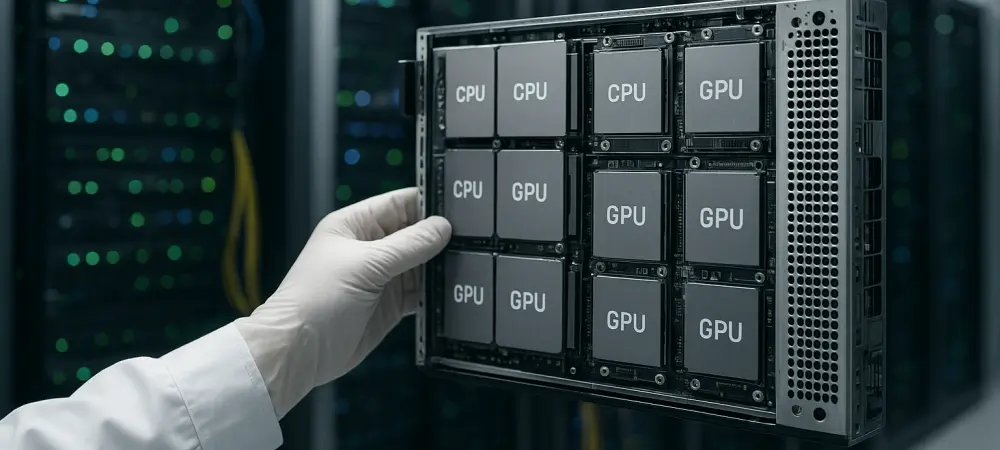
Deep within the humming aisles of hyper-scale data centers, the most sophisticated chips on the planet are experiencing an identity crisis that few predicted when the AI boom first accelerated. For years, the industry operated under a singular obsession: securing enough high-end Graphics Processing Units (GPUs) to satisfy the insatiable hunger of Large Language Models (LLMs). But as 2026 progresses, a quiet but profound shift in silicon demand has revealed a new structural vulnerability. The era of the passive chatbot is coming to an end, replaced by autonomous agents that do more than generate text; they navigate the web, execute complex code, and manage multi-step professional workflows. This transition has exposed a startling technical reality where the super-powered GPUs doing the “thinking” are increasingly sitting idle, forced to wait for the “old-fashioned” Central Processing Unit (CPU) to finish the “doing.” This emerging infrastructure strain, often referred to as the “CPU crunch,” represents a fundamental shift in how artificial intelligence is built and deployed. While GPUs excel at the massive, parallel calculations required to predict the next word in a sentence, they are fundamentally unsuited for the messy, sequential tasks that define agentic behavior. As enterprises move from simple query-and-response interactions toward complex loops of autonomous execution, the processor hierarchy is being turned on its head. The importance of this narrative cannot be overstated; it is the reason why major cloud providers are suddenly scrambling for server capacity and why the world’s leading chipmakers are fundamentally redesigning their architectures.
The Shift from Thinking to Doing: The Rise of Autonomous Agents
The initial wave of the AI revolution was defined by models that were essentially high-functioning mirrors, reflecting information back to the user in a conversational format. However, the current landscape is dominated by agentic AI, which functions as a digital worker capable of independent decision-making. These agents do not just talk about a task; they “spawn” sub-agents to handle specific technical requirements, such as searching a database or editing a configuration file. This multiplication of active workloads has placed a different kind of pressure on the underlying hardware, shifting the focus from raw inference speed to the efficiency of the entire execution loop.
As these systems take on more autonomy, the workload has evolved from a straight line of reasoning into a convoluted web of action and feedback. Every time an agent decides to interact with an external software tool, it moves outside the comfort zone of the GPU. The model might “think” of an answer in milliseconds, but if it needs to open a file, parse a log, or call an external API, the request must be handed off to the CPU. In this new paradigm, the GPU is no longer the sole star of the show; it is a specialist that must wait for the generalist CPU to clear the path for the next round of reasoning.
Why the Processor Hierarchy Is Being Upended: Logic over Math
The foundational mathematics of AI inference are beautifully parallel, which is why the industry spent the last few years fixated on GPU clusters. Large Language Models rely on matrix multiplication, a task that can be split into thousands of tiny, simultaneous operations. In contrast, the “agentic” part of AI relies on sequential logic and branching paths—the classic “if-then” scenarios that define traditional software. When an agent encounters an error in a line of code it just wrote, it must follow a logic-heavy path to diagnose and fix the issue, a process that relies on the high clock speeds and sophisticated branch prediction of a modern CPU.
This shift matters because it changes the definition of high-performance AI hardware. We are moving away from a world where the only metric that mattered was Teraflops of matrix math. In the world of agentic AI, the ability to manage system interrupts, handle I/O operations, and navigate file systems is becoming the primary speed regulator. Because GPUs are fundamentally incapable of handling these sequential, system-level tasks efficiently, the Central Processing Unit has been thrust back into the center of the architectural conversation, reclaiming its role as the primary orchestrator of the machine.
The Architectural Anatomy: Understanding the Agentic Pipeline
To understand why the CPU is under such immense pressure, one must look at the multi-stage pipeline of an agentic workflow. Research from hardware leaders like AMD suggests that the actual “intelligence” part of the process is only a small fraction of the total operation. In a typical eight-stage pipeline, only a single stage—the model inference itself—happens on the GPU. The other seven stages are handled entirely by the CPU, including the critical tasks of parsing the model’s intent, selecting the correct software tool, and processing the results to be fed back into the next cycle of thought.
A primary technical chokepoint in this pipeline is the process of tokenization. Before an AI can process information, text must be converted into integer IDs, a process involving data-dependent sequential string manipulation. As agents handle larger datasets and longer context windows, the CPU must work overtime to re-tokenize new information constantly. Recent studies from institutions like Georgia Tech and Intel indicate that increasing CPU core counts can reduce latency for these tasks by up to seven times. Furthermore, the rise of safety guardrails adds a persistent, “always-on” load. Rule-based systems and intent-analysis models, which act as supervisors for autonomous agents, are almost always routed to the CPU to avoid the high latency and cost associated with GPU processing.
Industry Expert Perspectives: Market Realities of the CPU Crunch
The technical shift is already manifesting as a global resource struggle, with major technology players sounding the alarm. Amazon Web Services recently issued internal mandates to conserve CPU cycles after being caught off guard by unprecedented wait times for server capacity. This is a stark reversal from the early days of the AI boom, when CPUs were often viewed as secondary components. Market reports currently show that high-end server CPUs from Intel and AMD are largely sold out, a phenomenon previously reserved only for the most advanced AI accelerators.
Even NVIDIA, the undisputed king of the GPU market, has acknowledged this new reality through its product roadmap. Their latest platforms, such as the Vera Rubin architecture, now integrate dedicated ARM-based CPUs like the “Vera” chip. This design acknowledgment proves that even the most powerful GPU clusters cannot function efficiently without a specialized, high-performance CPU to manage the agentic logic that feeds the model. The industry has reached a consensus: the bottleneck has moved, and the future of AI infrastructure depends on a hybrid approach where the CPU is no longer a neglected host but a vital partner in the reasoning process.
Strategies for Mitigating the CPU Bottleneck: Future-Proofing the Data Center
For developers and enterprises looking to scale agentic AI throughout 2027 and 2028, relying on raw hardware power is no longer a viable long-term strategy. Strategic software optimizations are required to balance the workload across the silicon and eliminate “dead time” where one processor waits for the other. Current research into heterogeneous scheduling focuses on synchronizing CPU and GPU activity more tightly, which has already demonstrated the potential to cut end-to-end latency by nearly half. By improving the scheduling of these tasks, developers can ensure that the entire pipeline moves at the speed of the fastest component rather than being held back by the slowest. Enterprises must also rethink their procurement strategies, shifting from a pure focus on GPU clusters to investing in high-core-count CPU environments. Since agentic AI frequently “spawns” multiple sub-agents, the ability to manage millions of simultaneous threads is becoming more critical than the raw FLOPs of a single accelerator. Additionally, the use of “helper” models—tiny, sub-1-billion parameter models that run directly on the CPU—can act as a triage system. These small models handle initial intent analysis and pre-processing, ensuring that the expensive and energy-hungry GPU is only engaged when complex reasoning is truly required, thereby preserving resources and reducing the overall system footprint.
The industry eventually realized that the path toward true autonomy was not paved with matrix math alone. Engineers shifted their focus toward balanced architectures, ensuring that the heavy lifting of reasoning was met with equally robust execution capabilities. Organizations that recognized the bottleneck early and pivoted toward heterogeneous compute strategies were able to bypass the latency traps that initially threatened to stall the autonomy revolution. By recalibrating the relationship between the CPU and the GPU, the tech sector successfully turned a looming crisis into a new standard for efficient, high-performance AI deployment. This evolution ensured that the next generation of digital agents possessed the necessary processing power to act, not just think.