

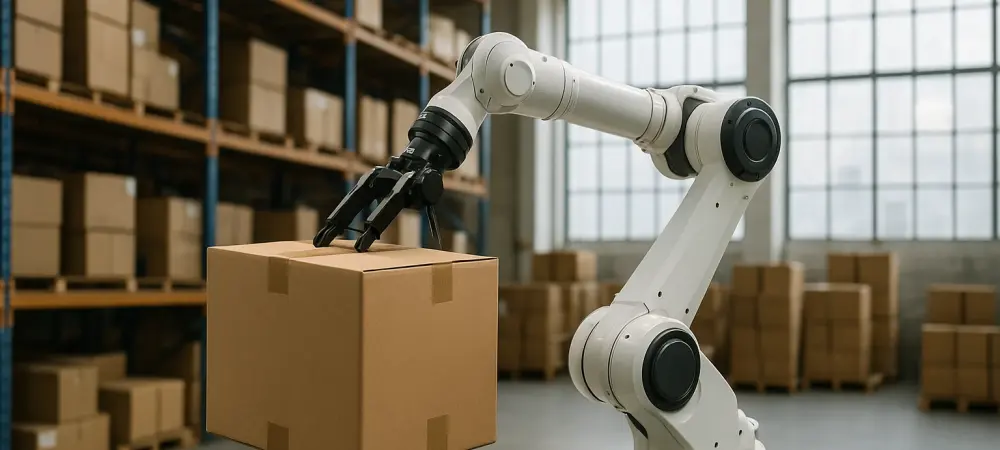
The vibrant and complex landscape of industrial automation is undergoing a profound metamorphosis as traditional robotics evolves into truly cognizant physical intelligence. For decades, the factory floor was dominated by machines that were powerful yet essentially blind, executing repetitive motions with no awareness of the shifting world around them. This era of “dumb” automation is rapidly concluding as the Universal Robots Gen 7 platform introduces a paradigm where robots do not just follow a path, but perceive and react with human-like intuition. By embedding processing power directly into the robotic skeleton, this system marks the definitive arrival of Physical AI in the mainstream manufacturing sector.
The End of the “Dumb” Industrial Arm
For generations, industrial arms were essentially high-speed puppets—powerful and precise, yet completely oblivious to their surroundings. If a part was slightly out of place or an unexpected obstacle appeared, the entire process failed, leading to costly downtime and mechanical damage. The Gen 7 platform changes this dynamic entirely by moving away from rigid, static pre-programming toward a system that behaves like a living entity. This shift allows the cobot to gain what can be described as a nervous system, enabling it to perceive, reason, and react to the physical world with a level of dexterity previously reserved for human operators.
This evolution signifies more than a mere hardware refresh; it represents the moment the robot develops true spatial awareness. Instead of just stopping when an error occurs, the machine can now adjust its trajectory or force application in real-time. By integrating advanced sensors and local intelligence, the arm learns to handle variability that would have paralyzed its predecessors. This transformation effectively ends the reliance on perfectly structured environments, allowing automation to thrive in the chaotic, high-speed reality of a modern production line.
Bridging the Gap Between Software Intelligence and Tactile Execution
As artificial intelligence models become increasingly sophisticated, the primary bottleneck in global automation has shifted from “thinking” to “doing.” While large language models can process vast amounts of digital data, Physical AI requires a specialized bridge where high-bandwidth software meets rugged hardware. The Gen 7 platform arrives at a critical juncture in 2026, where labor shortages and the demand for high-mix, low-volume production are forcing companies to seek robots that can be deployed in hours rather than weeks. Universal Robots is solving the disconnect between digital intelligence and physical labor by treating the robot as a single, unified cognitive asset.
The challenge of modern manufacturing often lies in the friction between abstract software commands and the gritty reality of the shop floor. By providing a hardware platform that can keep pace with rapid AI developments, the gap between the digital twin and the physical arm is finally closing. This synergy allows manufacturers to leverage massive datasets for predictive motion planning, ensuring that every movement is optimized for speed, safety, and energy efficiency. Consequently, the robot becomes an extension of the enterprise’s digital brain, rather than a disconnected tool.
The Technological Architecture of Gen 7
The Gen 7 platform is built on a trinity of hardware, processing power, and open-source software designed to remove the mechanical friction typically associated with advanced automation. The new g-Series models, including the UR10g and UR17g, prioritize a clean and seamless integration by utilizing a specialized tool flange that routes data and power internally. This design choice eliminates the “spaghetti” of external cables that often snagged or limited movement in earlier vision-based systems. By internalizing these pathways, the robot can feed high-bandwidth sensor data back to its core without mechanical interference or risk of hardware failure. At the heart of this system is the CB7 Core controller, a local brain designed for intensive edge computing. This unit provides a 40% boost in computational performance while actually shrinking the hardware footprint by 30%. This extra headroom is vital for running complex vision algorithms and motion-planning AI locally, reducing the need for expensive external industrial PCs and minimizing the latency that can hinder real-time reactions. By processing information at the source, the robot maintains a high level of responsiveness that is essential for collaborative environments where safety and speed must coexist.
Software serves as the vital link in this revolution through the PolyScope X operating system. By utilizing an open-platform approach and ROS2, Universal Robots has created an ecosystem where developers can plug in third-party AI applications as easily as installing an app on a smartphone. This flexibility is supported by a network of over 20 industry partners, enabling tasks like autonomous palletizing or 3D bin-picking to be integrated natively. This modularity ensures that the platform remains future-proof, allowing users to update the robot’s capabilities as new AI models become available without replacing the physical hardware.
Industry Insights: Moving From Tools to Teammates
Expert consensus suggests that the all-in-one approach of Gen 7 is a game-changer for native integration across the sector. Leading partners such as Inbolt have noted that by allowing vision systems to run directly on the UR controller, the setup time for complex tasks is being slashed from weeks to mere hours. Furthermore, the move toward internal force-torque sensing gives these robots a genuine sense of touch. Instead of just following a coordinate, the robot can now feel if a bolt is cross-threading or if a delicate component is seated correctly, mimicking the tactile feedback a human technician relies on.
This transition from a tool to a teammate is further enhanced by the ergonomics of the interface. The TP7 Core teach pendant and the SP7 Smart Panel on the tool flange allow operators to interact with the machine in a more natural, intuitive manner. By enabling touch-to-teach workflows, companies can repurpose their workforce toward higher-value tasks while the robot handles the precision-heavy labor. This collaborative relationship increases overall factory throughput and job satisfaction, as the machine takes on the most grueling and repetitive aspects of the production cycle.
Strategies for Implementing Physical AI in the Factory
To leverage the full potential of the Gen 7 platform, manufacturers should prioritize a transition to touch-to-teach workflows that empower floor operators. By utilizing the freedrive functionality and the smart panel interface, non-specialized workers can reprogram the robot for new product lines in minutes. This democratization of programming reduces the reliance on external consultants and allows for a more agile response to market demands. Implementing these user-friendly interfaces ensures that the technology remains accessible to those who understand the production process best. Furthermore, leveraging edge-AI for real-time quality control transforms the robot from a simple transport device into an active inspector. By mounting AI-driven cameras directly to the AI-ready flange, the robot can perform 360-degree quality checks while simultaneously moving parts between stations. It is also vital to prioritize cybersecurity and safety standards, such as IEC 62443-4-1 ML3, to protect the factory floor from digital intrusions. These strategies collectively ensure that the deployment of Physical AI is not only efficient but also secure and scalable within a modern industrial environment.
Stakeholders who embraced the Gen 7 ecosystem prioritized the rapid deployment of tactile automation to offset labor instability. They looked toward edge-computing solutions that reduced their reliance on cumbersome external infrastructure. It was noted that companies successfully transitioned by integrating native vision systems directly into the robot’s controller. These organizations established a framework for continuous improvement, ensuring that the intersection of physical labor and digital intelligence remained a cornerstone of their operational success. The transition finalized the shift from static machines to intuitive robotic partners.