

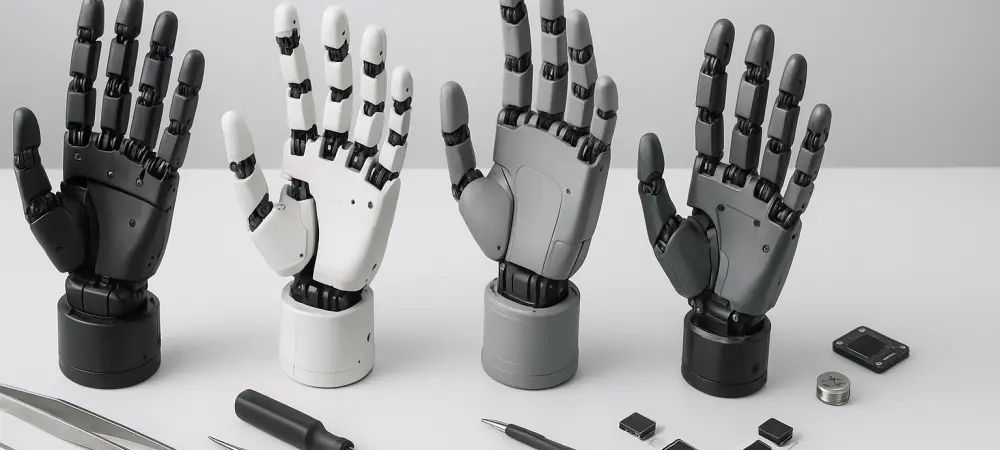
The Surge of Chinese Hardware in the Humanoid Era
The robotics industry has reached a pivotal junction where science fiction meets industrial reality, and at the center of this transformation is the “dexterous hand.” As of early 2026, the global market for these sophisticated end-effectors—the components that allow robots to grasp, feel, and manipulate objects—has seen an unprecedented shift in power. China has emerged as the undisputed leader in the production and shipment of humanoid hands, leveraging a component-first strategy that has fundamentally altered the competitive landscape. This article explores how China secured nearly total market dominance, the divergent strategies between Eastern and Western firms, and why the battle for the brain of the robot may eventually overshadow the hardware itself.
The current economic landscape suggests that dexterity is no longer a luxury for specialized research but a baseline requirement for the next generation of automation. By focusing on the physical interface between the robot and the world, Chinese manufacturers have positioned themselves as the primary architects of the humanoid form. This dominance is not merely about raw numbers; it reflects a sophisticated understanding of how hardware becomes a commodity in a rapidly scaling market. As global demand for general-purpose robots accelerates from 2026 to 2030, the ability to produce reliable, high-fidelity hands at scale will dictate which platforms succeed and which remain confined to the laboratory.
Historical Context and the Industrialization of Dexterity
The journey toward human-like robotic manipulation was once confined to high-budget academic labs and space agencies. Historically, creating a hand with the necessary degrees of freedom (DOF) to mimic human movement was prohibitively expensive and mechanically fragile. However, the mid-2020s marked a turning point as the global robotics supply chain matured. China’s ascent in this sector did not happen in a vacuum; it was built upon decades of investment in consumer electronics manufacturing and specialized industrial components like motors, reducers, and sensors.
By applying the same mass-production techniques used for smartphones to robotics, Chinese firms transitioned the dexterous hand from a bespoke laboratory curiosity into a standardized industrial commodity. This shift has allowed the industry to move past the era of one-off prototypes into a phase of rapid, global scaling. The consolidation of high-precision actuator production within specific industrial clusters has drastically reduced the cost of entry for robotics startups, effectively outsourcing the hardest mechanical problems to a specialized Chinese supply base.
The Bifurcation of Global Robotics Strategy
The Chinese Model: Modular Commodity and Scale
Chinese dominance is underscored by a staggering statistic: in the first half of 2026, Chinese firms accounted for 96% of all humanoid hand shipments globally. This was achieved through a strategy of modularity. Unlike Western competitors who often keep their hardware designs proprietary, Chinese suppliers sell their hands off the shelf. This approach allows robotics startups worldwide to bypass the grueling R&D phase of hand development and focus on other aspects of their builds. By treating the hand as a standalone component, China has created an ecosystem where speed and volume are the primary drivers. This localization of the entire supply chain—from the micro-actuators in the finger joints to the tactile sensors in the fingertips—gives Chinese manufacturers a speed advantage that allows them to iterate and refine hardware faster than any other region.
The Western Emphasis: Proprietary Integration
In contrast, Western technology firms, particularly those in North America like Figure AI, view the robotic hand not as a part to be sold, but as a vital piece of intellectual property. The Western market share, though currently small at 4%, is growing as companies prioritize the tight integration of hardware and software. In this model, the hand is a closely guarded secret, custom-designed to work seamlessly with the robot’s internal AI models. This in-house philosophy is driven by the belief that true dexterity requires a level of synergy between the physical sensors and the digital brain that cannot be achieved with generic, off-the-shelf parts. While this slows down initial production, it aims to create a superior, highly specialized machine capable of more complex tasks than its mass-produced counterparts.
Reliability: The Shift Toward Fit-for-Purpose Engineering
A significant trend emerging in early 2026 is the move away from chasing the highest possible degrees of freedom. For years, the industry benchmark was to match or exceed the 22 degrees of freedom found in a human hand. However, as robots move from labs to factory floors, specification inflation is being replaced by fit-for-purpose engineering. Many industrial tasks do not require a full range of human-like motion; they require reliability, lower weight, and cost-effectiveness. Consequently, the market is seeing a rise in more robust, 6-DOF designs that are easier to maintain and less prone to mechanical failure. This shift suggests that the future of the market lies in specialization—creating hands tailored for specific environments, whether it be heavy lifting in a warehouse or delicate interaction in a healthcare setting.
Emerging Trends and the Geopolitics of Automation
The future of the humanoid market is increasingly shaped by geopolitical friction and technological breakthroughs in artificial intelligence. The restrictions on certain robotic components in Western markets have created a bifurcated global landscape. While Chinese vendors are supported by domestic subsidies and a vast internal market, Western firms are navigating a path defined by venture capital and the need to solve specific commercial problems. Furthermore, the evolution of Vision-Language-Action (VLA) models is set to redefine what hardware is capable of. As these brains become more sophisticated, the demand for hardware that can provide high-fidelity force feedback will grow, potentially shifting the advantage back toward Western firms that have focused on high-end, sensor-rich integration.
Strategic Takeaways for the Robotics Ecosystem
For businesses and investors, the current state of the market offers clear lessons. First, hardware commoditization is inevitable; for those looking to build robots quickly, the Chinese supply chain remains the most efficient path. However, for those aiming for long-term differentiation, the value lies in the software-hardware synergy—the ability of the robot to use its hands intelligently rather than just moving them. Professionals in the field should focus on application-driven design, prioritizing durability and specific task performance over raw mechanical complexity. As the industry matures, the winning entities will be those who can bridge the gap between China’s manufacturing prowess and the West’s sophisticated AI integration.
A Race Between the Brain and the Body
The global market for humanoid robot hands reflected a fascinating dichotomy between Eastern volume and Western integration. China’s 96% market share stood as a testament to its unparalleled manufacturing ecosystem and its successful strategy of commoditizing complex hardware. Yet, as the industry moved toward autonomous decision-making and delicate environmental interaction, the physical hand remained only one part of the equation. While China dominated the body of the humanoid robot, the brain emerged as the ultimate frontier for innovation. The long-term significance of this competition resided not just in who built the most hands, but in who taught those hands to navigate the complexities of the human world with true intelligence and grace. Moving forward, the focus shifted toward high-fidelity sensory feedback and the seamless fusion of tactile data with advanced neural networks. The industry recognized that hardware dominance provided the foundation, but the true value was found in the mastery of autonomous manipulation. Professionals began prioritizing durability and task-specific efficiency over sheer mechanical complexity. In the end, the race for robotics supremacy demanded a balance between mass production and specialized, intelligent execution.