

Dominic Jainy is a seasoned IT professional with a profound understanding of how emerging technologies like artificial intelligence and high-performance hardware reshape the consumer landscape. His expertise in machine learning and blockchain gives him a unique perspective on the computational demands of modern mobile devices. Today, we discuss the rapid evolution of smartphone technology, specifically focusing on how manufacturers balance extreme hardware upgrades with the economic and engineering realities of the current market.
With flagship cycles beginning to overlap, how do manufacturers maintain sales momentum for current models when next-generation rumors start circulating? Could you walk us through the strategic timing required to prevent upcoming hardware leaks from overshadowing the launch of final high-end iterations in an existing series?
The dance between current inventory and future hype is a delicate one that requires manufacturers to pivot their marketing from pure specs to immediate lifestyle value. When leaks about a next-generation device surface—like the 2nm chipset rumors hitting just as the Find X9 Ultra and X9s prepare for launch—brands must double down on the reliability and availability of the hardware currently in stores. They often use aggressive software support promises or exclusive bundles to keep the 3nm Dimensity 9500 models attractive to those who need a phone today. Strategically, manufacturers try to control the narrative by focusing on the “Ultra” iterations of the current line, positioning them as the peak of refined technology that is tangible and ready to use. By the time the rumors of the Find X10 series become a roar, the current series has usually reached its peak sales volume, allowing the transition to feel like a natural evolution rather than a sudden disruption.
Scaling up to an 8,000mAh battery represents a massive leap in power capacity for a standard 6.59-inch device. What specific engineering trade-offs are required to house such a large cell, and what metrics should users expect regarding the total weight and heat management of the handset?
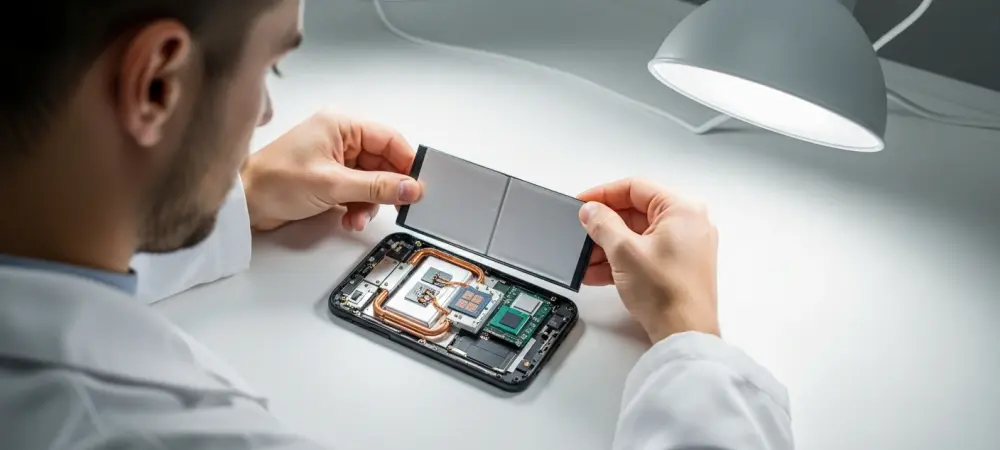
Moving from the 7,025mAh silicon-carbon battery in the Find X9 to a massive 8,000mAh unit in a 6.59-inch frame is a feat of extreme spatial optimization. To fit such a large cell without turning the phone into a brick, engineers must utilize high-density silicon-carbon chemistry which provides more energy in a thinner profile than traditional lithium-ion. However, the sheer physical volume of an 8,000mAh battery still threatens to push the device’s weight significantly higher, potentially making it feel denser in the hand. Heat management becomes the primary hurdle here; charging such a large capacity at speeds like 80W wired or 50W wireless generates immense thermal energy that requires advanced vapor chambers to dissipate. Users should expect a slightly thicker chassis to accommodate these cooling layers, ensuring the 1.5K OLED screen doesn’t suffer from thermal throttling during heavy use.
Transitioning to dual 200-megapixel rear sensors and exploring 1:1 square selfie cameras marks a major shift in mobile optics. What are the technical advantages of using these high-resolution sensors for daily photography, and how does this hardware impact the complexity of the software-based image processing pipeline?
The jump to dual 200-megapixel sensors, including a massive 1/1.3-inch periscope telephoto, allows for an incredible level of “sensor cropping” where users can zoom in significantly without losing the crispness of the original image. By capturing 200 million pixels, the hardware provides a raw data set that allows for superior light gathering through pixel-binning, which is essential for night-time photography. On the front, a 1:1 square sensor—similar to the tech seen in competing center-stage features—simplifies the process of tracking a subject’s face and keeping them centered during video calls. This influx of data puts a heavy burden on the ISP (Image Signal Processor), requiring millions of calculations per second to manage noise reduction and HDR blending in real-time. Without a powerful chipset to handle this pipeline, the shutter lag would be noticeable, but with 200-megapixel hardware, the result is a professional-grade image that traditional sensors simply cannot replicate.
Implementing unannounced 2nm chipsets alongside LPDDR6 RAM creates a very expensive bill of materials. How can a brand justify these component costs to the consumer, and what specific performance benchmarks or battery efficiency gains must be achieved to make such a significant investment worthwhile?
The shift from 3nm to an unannounced 2nm Dimensity 9600 chipset represents a generational leap in transistor density that justifies its high cost through sheer efficiency. When you pair this with LPDDR6 RAM and UFS 5.0 storage, you are looking at a component cost that tipsters suggest is nearly equal to the chipset itself, making it a very premium investment. For a consumer to feel this value, the device needs to show a double-digit percentage increase in power efficiency, allowing that 8,000mAh battery to last three days instead of two. We are looking for benchmarks that show zero lag in 1.5K gaming and instantaneous data transfer speeds that make 4K video editing feel as fast as scrolling through a social feed. Essentially, the brand justifies the price by selling “future-proofing,” promising a device that will remain blazing fast for five or six years rather than the typical two.
Integrating built-in magnets for wireless charging accessories and phone stands is a notable design shift. What are the primary hurdles in shielding sensitive internal components from these magnetic fields, and how does this feature change the step-by-step way users interact with their device ecosystem?
Incorporating built-in magnets requires meticulous shielding to ensure that the magnetic field doesn’t interfere with the optical image stabilization of the 200-megapixel cameras or the accuracy of the internal compass and GPS. Engineers must use specialized materials like Mu-metal or thin ferrite sheets to redirect magnetic flux away from sensitive electronics while maintaining a strong enough pull for accessories. For the user, this changes the daily interaction from a “plug and align” routine to a “snap and go” experience where the phone effortlessly finds its sweet spot on a wireless charger or car mount. This creates a more cohesive ecosystem where the phone acts as a hub, clicking onto stands or external batteries with a satisfying tactile click. It removes the friction of cables and poorly aligned charging pads, making the technology feel more like an invisible assistant and less like a piece of hardware that needs constant maintenance.
What is your forecast for the Oppo Find X10?
I believe the Oppo Find X10 will be remembered as the device that finally ended “range anxiety” for flagship users by normalizing the 8,000mAh battery standard. While the 2nm chipset and LPDDR6 RAM will make it a performance titan, its true legacy will be how it manages to fit professional-grade 200-megapixel optics into a standard 6.59-inch form factor without compromising on ergonomics. We are looking at a transition where “standard” models no longer feel like compromises, but rather high-performance tools that happen to be more compact than their “Pro Max” siblings. This series will likely set the benchmark for the next three years of mobile engineering, forcing competitors to choose between increasing their battery capacities or falling behind in the endurance race.