

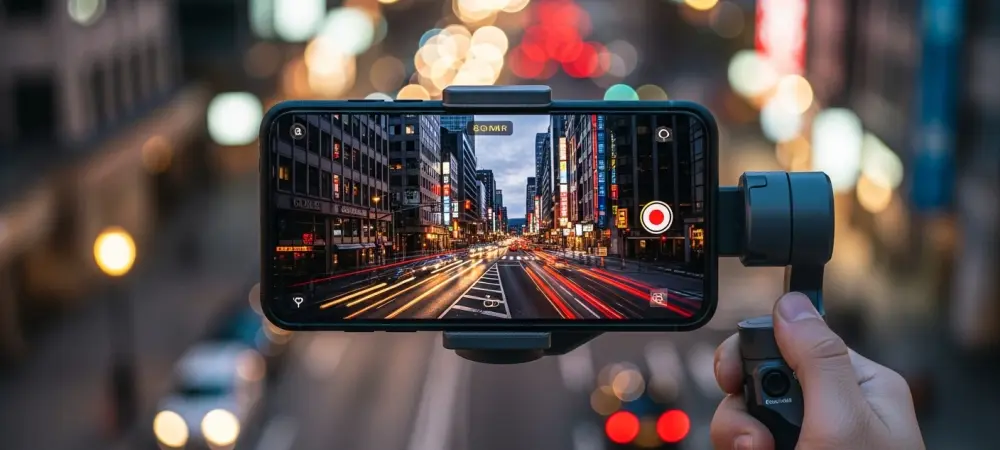
We’re diving deep into the fierce battleground of flagship smartphone cameras, where giants like Xiaomi and Samsung are pushing the boundaries of what a pocket-sized device can do. Today, we’re looking past the spec sheets to understand the real-world performance of these mobile powerhouses, exploring how massive new sensors handle challenging light, why even the best phones struggle with focus during action shots, and what professional features like LOG recording truly mean for creators. We’ll also break down the practical trade-offs between shooting in 4K and 8K and look ahead to what the future holds for mobile videography.
The Xiaomi 17 Ultra features a new 1-inch main camera sensor, which is often highlighted for its low-light video performance. How does a sensor of this size technically reduce noise, and what visible differences should a user expect when filming a scene at dusk versus midday?
It’s all about the physics of light. A 1-inch sensor has a much larger surface area than typical smartphone sensors, which means its individual pixels can be bigger. Larger pixels are fundamentally better at gathering light, just like a wider bucket catches more rain. In low-light situations, this superior light-gathering ability means the sensor doesn’t need to amplify the signal as much, and it’s that amplification process that introduces digital noise—that grainy, speckled look. When you’re filming at dusk, the difference is night and day, literally. You’ll see cleaner shadows with actual detail instead of a muddy, artifact-ridden mess. Colors will appear richer and more true-to-life, and the entire scene will feel more defined and cinematic, whereas a midday shot would look sharp on almost any high-end phone.
During fast movements, both the Xiaomi 17 Ultra and the Galaxy S25 Ultra can reportedly experience “focus pumping.” What technically causes this autofocus artifact in mobile devices, and what practical shooting techniques or camera settings can a user adjust to minimize it when filming dynamic action?
“Focus pumping” is that distracting, pulsing effect where the lens visibly hunts back and forth to lock onto a subject. It’s caused by the phone’s contrast-detection or phase-detection autofocus system rapidly re-evaluating a fast-changing scene. When you’re running or panning quickly, the distance to subjects changes constantly, and the system can get overwhelmed, overshooting and correcting itself in a continuous loop. While the Xiaomi holds its focus a bit more reliably than the Samsung, neither is immune. To minimize it, the best technique is to be deliberate with your movements—smooth pans instead of jerky ones. You can also try using the Pro mode to manually set your focus to a specific zone if your subject is staying within a certain distance, which completely eliminates the camera’s guesswork.
With advanced options like LOG video format and LUT import, the Xiaomi 17 Ultra targets serious creators. For someone new to these features, what is the primary advantage of shooting in a LOG profile, and could you describe the basic workflow for applying a custom LUT to that footage?
Shooting in a LOG profile is like capturing a “digital negative” for video. The primary advantage is an enormous increase in dynamic range. The video will look flat, desaturated, and low-contrast straight out of the camera, which can be alarming at first. But what it’s actually doing is preserving the maximum amount of detail in the brightest highlights and the darkest shadows, giving you incredible flexibility in post-production. The workflow is quite straightforward: you shoot your clips in the LOG format, import them into your video editing software, and then apply a custom LUT, or Look-Up Table. Think of a LUT as a sophisticated color preset. With a single click, it translates the flat LOG data into a vibrant, stylized final look, allowing you to achieve a professional, cinematic grade without spending hours manually adjusting colors.
The Xiaomi 17 Ultra supports 4K at 120 fps and 8K on all lenses, but stabilization can be a concern at higher resolutions. How does the combined optical and electronic stabilization perform differently between 4K and 8K, and what are the main trade-offs in choosing to film in 8K?
The combined OIS and EIS system is a marvel, but it faces different challenges at 4K versus 8K. OIS is the physical hardware—the lens element actually moves to counteract your hand’s shaking. EIS is digital; it crops into the sensor’s image slightly to create a buffer, then shifts the frame around to smooth out movement. At 4K, this combination works beautifully, giving you smooth, stable footage even while walking. However, when you jump to 8K, the processor is under immense strain just to capture and encode that massive amount of data. There’s less processing headroom for the sophisticated EIS algorithms, and any crop for stabilization would be more noticeable. This is why 8K footage demands a tripod or an incredibly steady hand. The main trade-off for 8K is stability and massive file sizes in exchange for breathtaking detail—detail that, for most people, is difficult to even display properly yet.
What is your forecast for the evolution of smartphone camera sensors and professional video features over the next few years?
I believe we’re going to see a two-pronged evolution. On the hardware front, while 1-inch sensors are becoming the high-end standard, the next frontier will be computational sensors and liquid lenses that can change focal length and aperture dynamically, further blurring the lines with dedicated cameras. But the bigger revolution will be in software and AI-driven processing. We’ll see smarter, more predictive autofocus that anticipates subject movement to eliminate focus pumping, and real-time AI color grading that can apply cinematic looks as you shoot. Features like LOG and LUTs, which are now pro-level options, will become more accessible and automated, allowing everyday users to create professional-looking content with minimal effort, truly democratizing high-quality video creation.