

The sweeping plains of Central Asia are witnessing a quiet but profound metamorphosis as Uzbekistan trades its historic reliance on heavy machinery for the precise, silver-limbed agility of humanoid robotics. This shift represents more than just a passing interest in new gadgets; it is a calculated pivot toward a future where high-tech manufacturing serves as the backbone of national sovereignty. By integrating sophisticated automation into its industrial DNA, the nation aims to secure a dominant position in the regional economy, moving beyond the role of a consumer to become a primary creator of advanced technology.
The strategic significance of this movement lies in its potential to insulate the economy from global commodity volatility. High-tech manufacturing offers a path toward economic independence that traditional industries simply cannot provide. This analysis explores how the republic is orchestrating this change through a blend of international industrial partnerships, revamped educational frameworks, and a visionary approach to labor, ultimately redefining its role on the global stage.
2. The Industrial and Educational Foundations of Robotics
2.1. Growth Trends: Strategic Partnerships
A cornerstone of this technological evolution is the landmark alliance between the UzElTechSanoat Association and ROBOTIS, a prominent leader in South Korean robotics. This partnership is specifically designed to localize the production of humanoid robots within Uzbek borders, marking a departure from simple equipment assembly. By focusing on the domestic manufacturing of smart actuators and specialized robotic components, the initiative ensures that the intellectual property and technical mastery remain within the country, fostering a self-reliant industrial ecosystem. Investment data indicates a sharp upward trajectory in high-tech funding, largely guided by the ambitious “Digital Uzbekistan-2030” strategy. The nation is currently scaling its infrastructure to support complex system design, moving from basic modular units to sophisticated bipedal platforms. This growth is not merely a government mandate; it is a collaborative push that integrates foreign expertise with local resources to build a manufacturing hub capable of competing with established international players.
2.2. Real-World Applications: Early Integration
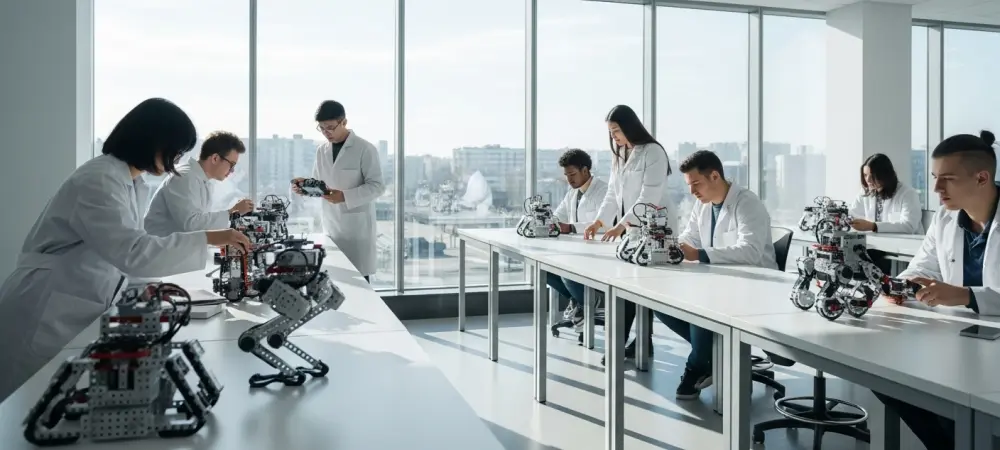
The shift toward robotics is being mirrored in the classroom, where the Robot Academy has become a proving ground for the next generation of engineers. Using EVO-3 modular kits, students are taught to navigate the complexities of mechanical logic, turning abstract concepts into physical motion. These educational tools allow young learners to experiment with kinetic structures, ensuring that the theoretical foundations of robotics are reinforced by practical, hands-on experience in real-world scenarios.
Bridging the gap between software and hardware, students are increasingly utilizing Python and Scratch to solve intricate engineering problems. This early exposure to coding for physical systems helps children as young as eight understand how digital instructions translate into mechanical action. By cultivating technical literacy at such a formative age, the educational system is creating a direct talent pipeline that will eventually staff the high-tech factories currently under construction across the country.
3. Expert Perspectives: The Technological Shift
Governmental visionaries view the rise of robotics as a critical pillar for long-term modernization. Policymakers argue that by investing in this sector now, the state can generate thousands of high-skilled jobs that are resistant to the automation-driven displacement seen in other industries. The focus remains on creating a workforce that designs, maintains, and manages robotic systems, rather than one that merely operates them, ensuring that the labor market remains resilient and forward-thinking.
Industry thought leaders from both ROBOTIS and UzElTechSanoat emphasize the technical challenges inherent in establishing a robotics hub in a region previously known for different industrial strengths. They point out that the transition requires a massive overhaul of existing supply chains and a rigorous commitment to quality control. Despite these hurdles, experts remain confident that the synergy between Korean innovation and Uzbek industrial ambition will provide the necessary momentum to overcome regional logistical constraints.
4. The Future Horizon: Uzbek Robotics
The evolution of this ecosystem is expected to transition from a reliance on imported expertise to a self-sustaining cycle of domestic innovation. As local engineers gain experience, the nation will likely move toward designing proprietary robotic architectures tailored to its specific regional needs. This maturation will allow Uzbekistan to evolve into a significant exporter of specialized robotic components, providing high-tech solutions to neighboring markets and establishing a new economic niche in Central Asia.
Beyond the factory floor, the integration of humanoid technology is poised to transform the logistics, healthcare, and service sectors. In the coming years, automated systems could manage complex warehouse operations or assist in medical facilities, significantly increasing efficiency across the board. While the road ahead involves intense global competition and the constant need for research funding, the current momentum suggests that the republic is well-positioned to navigate these challenges and emerge as a digital leader.
5. Sustaining the Momentum
The successful integration of humanoid robotics into the national fabric demonstrated that international collaboration and grassroots education are the two most critical drivers of modern economic reform. It became clear that industrial growth could not exist in a vacuum; it required a simultaneous transformation of the educational system to produce the necessary intellectual capital. This holistic approach ensured that the infrastructure was built alongside the people who would eventually operate and innovate within it.
The focus shifted toward maintaining this pace through continuous curriculum updates and the expansion of research facilities. Policymakers recognized that the next logical step involved deepening the integration of artificial intelligence with physical robotics to enhance autonomous decision-making. By fostering an environment where technical experimentation was encouraged from a young age, the nation successfully transitioned into a proactive participant in the global digital landscape, setting a precedent for regional technological development.