

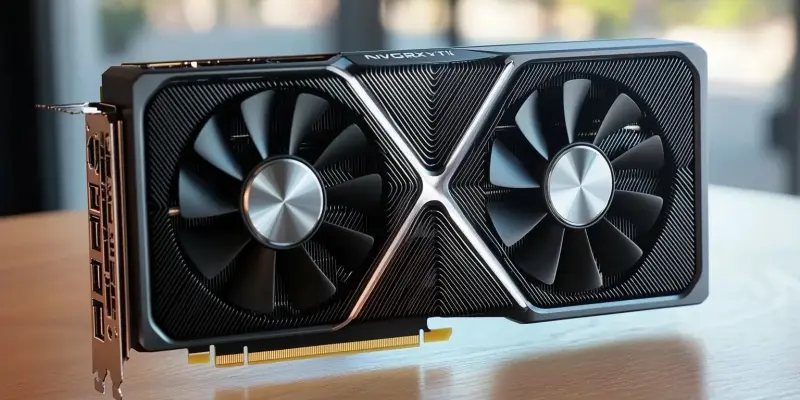
Nvidia’s upcoming launch of the GeForce RTX 5070 Ti, scheduled for February 20th, and the RTX 5070, set for March 5th, is sparking widespread anticipation and curiosity in the tech community. A highly competitive landscape awaits, with AMD also gearing up to launch its Radeon RX 9070 series in early March. Nvidia’s timing for these releases is crucial, potentially setting the stage for a battle in the mid-range GPU market. With performance expectations running high and market positioning essential, it remains to be seen if these GPUs will indeed dominate, given potential supply issues and competitive pressures.
Performance and Capabilities
The GeForce RTX 5070 Ti is already making waves before its official release, thanks to a remarkable Geekbench OpenCL score of 248,739. This surpasses Nvidia’s current 4080 Super, suggesting higher-than-expected capabilities that have piqued the interest of enthusiasts and potential buyers alike. Nvidia’s benchmarks emphasize multi-frame generation, a feature designed to elevate perceived frame rates through frame interpolation. While this technology significantly benefits single-player gaming experiences on high-refresh-rate displays, where smooth visuals are paramount, it proves less advantageous for multiplayer games, where even slight latencies can affect performance.
Jensen Huang, Nvidia’s CEO, has pointed out that the multi-frame generation feature allows the RTX 5070 Ti to perform comparably to the much higher-end RTX 4090 under specific conditions. Such claims, coupled with the impressive benchmark results, have generated both excitement and skepticism. With a price point of $749 and 16GB of VRAM, the RTX 5070 Ti is poised to attract a segment of gamers looking for a balance between performance and price. However, whether it will deliver on these high expectations remains a topic of debate, especially among those skeptical of the announced specifications.
Market Positioning and Pricing Strategies
Nvidia has strategically priced the RTX 5070 at $549, clearly positioning it against AMD’s forthcoming Radeon RX 9070. This move comes amid discussions about Nvidia’s ability to meet demand, given historical supply issues that plagued previous launches, such as the RTX 5080 and 5090. Indeed, the timing of these launches is not accidental; Nvidia likely delayed the RTX 5070 release to counteract AMD’s launch schedule and maintain a competitive edge in the market. The pricing strategy reflects Nvidia’s intent to capture the mid-range market by offering performance that is accessible without sacrificing substantial capabilities.
Furthermore, the impending release of mainstream models like the RTX 5060 Ti and 5060, positioned at $419 and $329 respectively, underscores Nvidia’s comprehensive strategy to dominate various market segments. The 5060 Ti is expected to be available in both 8GB and 16GB variants, whereas the 5060 will be limited to 8GB. By providing a range of options, Nvidia ensures that it caters to diverse consumer needs, from cost-sensitive buyers to more demanding gamers. This tiered pricing model supports Nvidia’s broader goal of penetrating and securing a more extensive share of the GPU market.
Consumers and industry experts alike are curious to see how Nvidia’s new offerings will stand up to AMD’s releases and whether they will meet the high performance and availability standards expected. The GPU landscape is poised for an exciting showdown as these new products hit the shelves.