

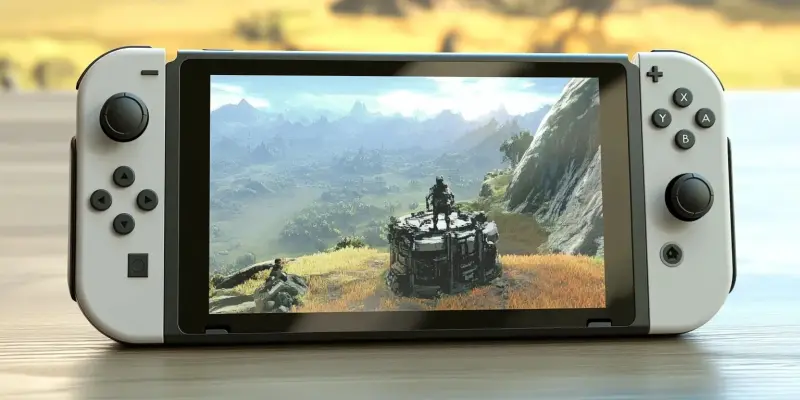
The gaming community is buzzing with anticipation as leaks continue to emerge regarding Nintendo’s upcoming Switch 2, which promises several technological advancements over its predecessor. Recent leaks have intensified this excitement, particularly with the surfacing of alleged photos of the Switch 2 motherboard and a newly published patent. This patent hints at an AI-assisted upscaling technology, akin to Nvidia’s DLSS, that could significantly enhance the gaming experience on this handheld device. This technology, if implemented, would allow for upscaling of images from lower resolutions to higher ones, thereby improving visual fidelity without necessitating excessive hardware power.
AI-Assisted Upscaling and Its Implications
In late 2024, Nintendo’s patent filed back in 2023 was made public, revealing some intriguing details about the company’s plans for the Switch 2. This patent suggests that Nintendo is exploring machine learning-based upscaling to enhance image quality on the new console. This means that lower resolution images, such as those at 900 x 540 pixels, could be upscaled to 1080p or even 4K. Such technology has the potential to provide gamers with significantly improved visuals without needing the console to be equipped with extremely powerful hardware.
Furthermore, the benefits of this upscaling technology extend beyond just image quality. By allowing developers to use lower resolution assets that can then be upscaled, game installation sizes might be reduced substantially. This would be particularly advantageous if the Switch 2 maintains the use of proprietary game cards. In such a scenario, the need for large downloads for high-resolution games could be alleviated, saving both space and time for gamers eager to dive into new releases. The integration of such technology would illustrate Nintendo’s commitment to enhancing the user experience by leveraging innovative solutions.
Hardware Improvements and Backward Compatibility
In addition to the potential for advanced upscaling technology, several other leaks about the Switch 2 have surfaced, consolidating expectations for its hardware capabilities. The console is rumored to feature 12GB of LPDDR5X RAM, an 8-inch LCD screen, and magnetic attachments for Joy-Con controllers. A chip based on Nvidia’s Ampere architecture is also expected, though precise performance metrics have yet to be confirmed. These hardware improvements would represent a significant upgrade from the original Switch, promising to deliver a more powerful and seamless gaming experience.
A notable aspect confirmed by Nintendo is that the Switch 2 will be backward compatible with Switch games—a feature that will undoubtedly please current Switch owners. This compatibility ensures that users can migrate their existing game libraries to the new console without any loss. Additionally, Nintendo has officially announced that the Switch 2 will be unveiled before April 1 of the upcoming year. As details about the hardware continue to emerge, there appears to be a consensus among leakers that the Switch 2 will incorporate AI-assisted upscaling technology, solidifying its position as a modern and innovative gaming device.
Balancing Innovation with Compatibility
With advanced technology on the horizon, the Switch 2 could very well set a new standard for handheld gaming devices, blending innovation with Nintendo’s signature gameplay experiences. The excitement is growing as continuous leaks hint at numerous enhancements, including AI-assisted upscaling technology that could bring major improvements to visual fidelity without requiring excessive hardware power. As gamers eagerly await the official release, it is clear that the next generation of the Nintendo Switch has the potential to transform the gaming industry once again.