

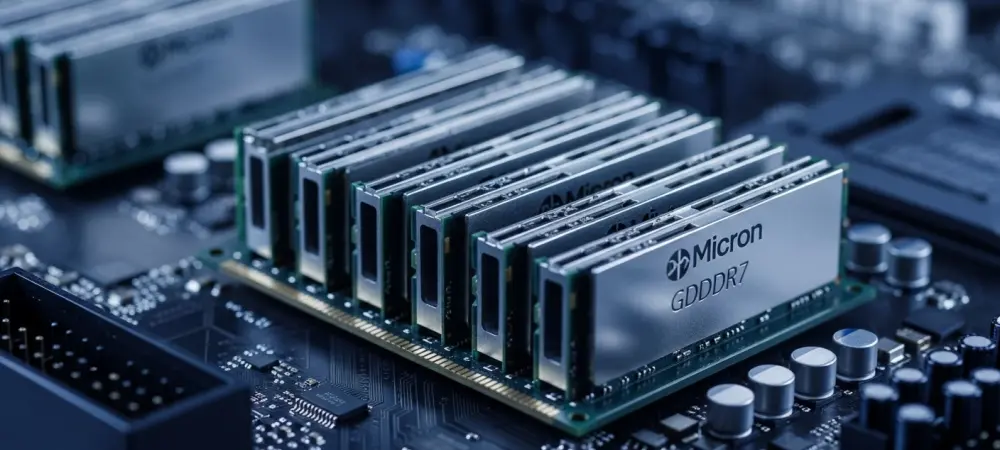
The global memory market is entering a transformative phase as Micron stabilizes the supply of its innovative 24 Gb modules, a move that fundamentally alters the cost-to-performance ratio for modern graphics processing units. By introducing these 3 GB modules, Micron joined industry leaders Samsung and SK Hynix in a push toward denser VRAM architectures. This technical leap addressed the surging demand for high-capacity memory in gaming and local AI inference. Micron’s specific offerings, ranging from 28 GT/s to 32 GT/s, provided a versatile foundation for manufacturers to optimize their hardware tiers without sacrificing efficiency or significantly increasing production costs.
The Historical Shift from Standard to Denser Architectures
For years, 1 GB and 2 GB modules served as the primary building blocks for consumer graphics cards. However, the limitations of these lower densities became apparent as modern software outpaced available memory buffers. Historically, increasing capacity required adding more physical chips, which complicated board layouts and increased thermal loads. The move to 3 GB modules solved these engineering hurdles, enabling higher VRAM totals on smaller circuits. This shift represented a logical progression from the GDDR6 era, focusing on density rather than just raw clock speeds to meet the needs of high-resolution textures.
Strategic Implications of the 3GB Module
Enhancing Entry-Level and Mid-Range Accessibility
One of the most vital outcomes of this higher density involved the democratization of VRAM for mid-range cards. Previous generations often struggled with memory starvation, where the GPU core was powerful enough for advanced rendering but lacked the buffer to handle the data. By using 3 GB chips, a card like the rumored RTX 5050 could achieve 9 GB of memory using only three modules. This approach simplified manufacturing while ensuring that budget-conscious users received a hardware configuration capable of longevity in an increasingly demanding software market.
Balancing Performance and Bandwidth Across the Spectrum
While SK Hynix pushed boundaries with 36 Gbps chips, Micron’s strategy focused on the lucrative middle ground between 28 GT/s and 32 GT/s. This performance tier offered the optimal balance between manufacturing yields and power consumption, which is critical for mass-market adoption. Offering two distinct variations allowed Micron to serve different price points, from high-end laptops to professional workstations. This diversity ensured that system builders could match bandwidth to specific workloads without the premium costs associated with peak-speed components currently in development.
Ensuring Supply Chain Resilience for Blackwell and Beyond
The availability of 3 GB modules from three separate major suppliers provided a critical safety net for the Blackwell architecture launch. Having multiple vendors ensured that production bottlenecks for the RTX 50 series remained minimal, preventing the scarcity issues seen in previous cycles. This competitive environment also paved the way for future mid-cycle refreshes. Because the underlying infrastructure for 3 GB modules was finalized early, manufacturers gained the flexibility to adjust memory configurations rapidly in response to market shifts or competitor movements.
Anticipating the Next Evolution in GPU Performance
Looking forward, the widespread integration of GDDR7 signals a future where local AI execution and complex ray tracing are no longer exclusive to flagship cards. As 32 GT/s modules transitioned into mass production, the industry began phasing out older GDDR6 components for all but the most basic office hardware. This evolution meant that 12 GB and 18 GB configurations became the new standard for the mid-range market. These changes ensured that consumer hardware remained resilient against the rising requirements of sophisticated software environments over the next few years.
Practical Considerations for the Modern Hardware Market
For buyers in the current market, prioritizing VRAM capacity became the most important factor when evaluating new hardware. The “8 GB barrier” that hindered many recent gaming experiences was finally dismantled by these high-density chips. Professionals also benefited from this shift, as workstation cards offered significantly more headroom for 3D rendering and large dataset processing within compact form factors. Investing in cards that leveraged these 3 GB modules ensured a longer lifespan for both gaming rigs and professional setups as developers utilized larger memory pools.
Finalizing the Vision for Next-Generation Graphics
The transition toward high-density memory proved to be a decisive moment for the hardware industry. Manufacturers prioritized VRAM density to overcome previous architectural bottlenecks, which resulted in a more robust ecosystem for both creators and gamers. Micron’s participation in this market stabilized prices and encouraged technological competition across all price brackets. This shift ultimately established a new baseline for graphics performance, ensuring that next-generation systems possessed the memory capacity required to handle the most demanding digital tasks of the era.