

We’re thrilled to sit down with Dominic Jainy, a seasoned IT professional with deep expertise in networking technologies, artificial intelligence, and blockchain. With a passion for exploring cutting-edge applications across industries, Dominic brings a wealth of knowledge to today’s discussion on Unshielded Twisted Pair (UTP) cables—a cornerstone of modern networking. In this interview, we dive into the fundamentals of UTP, its historical significance, the nuances of its design and categories, and the practical considerations of using it in various environments. Let’s uncover the insights behind this ubiquitous technology.
How would you describe Unshielded Twisted Pair (UTP) cables to someone who’s new to networking?
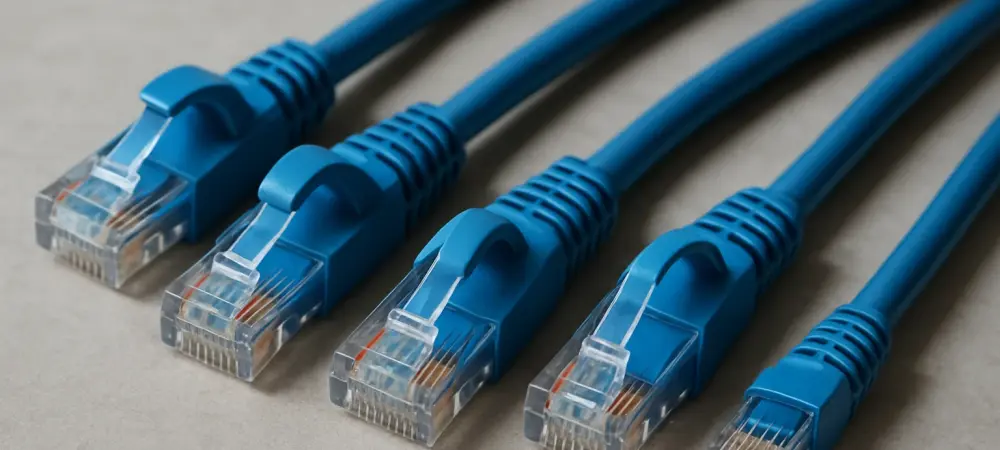
UTP cables are essentially a type of copper wiring that’s widely used in networking and telecommunications. Picture a set of thin copper wires twisted together in pairs, wrapped in a plastic sheath. The “unshielded” part means there’s no extra metal layer around the wires to block interference, but the twisting design helps with that naturally. They’re the go-to for things like Ethernet connections in offices or even telephone lines because they’re affordable and easy to work with.
What are some of the most common applications of UTP cables in today’s networks?
You’ll find UTP cables almost everywhere in networking. They’re the backbone of local area networks, or LANs, connecting computers, routers, and switches in offices and homes. They’re also used in traditional phone systems for voice communication. Depending on the specific type of UTP cable, they support everything from basic internet setups to high-speed data transfers in more complex environments like data centers.
Can you walk us through the history of the twisted-pair design and why it was such a game-changer?
The twisted-pair concept dates back to 1881, when Alexander Graham Bell came up with it. At the time, interference was a huge problem in early telephone systems—signals would bleed into each other, creating noise. By twisting the wires together, Bell found that the interference canceled out to a large degree because the electromagnetic fields from each wire balanced each other. That breakthrough laid the foundation for reliable communication over long distances and is still the core principle behind UTP cables today.
How does the twisting of wires in a UTP cable actually improve network performance?
The twisting is all about reducing interference. When two wires are twisted together, any external electromagnetic noise affects both wires equally, which cancels out the disruption in the signal. It also cuts down on crosstalk, which is when signals from one pair of wires interfere with another pair. The tighter and more consistent the twists, the better the protection, which is why higher categories of UTP cables often have more precise twisting patterns to handle faster data speeds.
What are the key differences between the various categories of UTP cables, and how do they impact usage?
UTP cables are classified into categories, or “CAT,” based on their performance capabilities, as defined by standards like TIA/EIA-568. For instance, CAT3 is an older type used mostly for phone lines, supporting just 10 Mbps. CAT5 and CAT5e are more common for Ethernet, with CAT5e supporting up to 1 Gbps. Then you’ve got CAT6 and CAT6a, which are built for higher speeds—up to 10 Gbps over shorter distances—and are often used in data centers or enterprise networks. Each step up usually means tighter twists and better insulation, which translates to higher bandwidth and less interference.
How does UTP stack up against alternatives like shielded twisted pair (STP) in terms of design and practicality?
UTP and STP both use the twisted-pair design, but STP has an extra layer of metallic shielding around the wires, which gives it better protection against electromagnetic interference. That makes STP ideal for environments with a lot of electrical noise, like industrial settings. However, UTP is much cheaper and easier to install since it’s more flexible and doesn’t need grounding. So, unless interference is a major issue, most people opt for UTP because of the cost and simplicity.
What are some real-world challenges you’ve encountered when working with UTP cables, and how do you address them?
One common issue with UTP is that it’s sensitive to physical damage. If you bend or stretch the cable too much, you can mess up the twists inside, which increases interference and degrades performance. I’ve also seen problems in setups where cables are run too close to power lines, picking up noise. To tackle this, I always stress proper cable management—using cable trays or conduits—and keeping UTP away from electrical sources. Planning the layout carefully during installation can save a lot of headaches later.
Looking ahead, what’s your forecast for the role of UTP cables in the future of networking?
I think UTP cables will remain a staple in networking for a long time, especially for smaller-scale or cost-sensitive setups. They’re just so versatile and economical. However, as data demands keep skyrocketing, especially with things like 5G and IoT, we might see a shift toward fiber optics for high-bandwidth needs in larger enterprises. That said, innovations in UTP, like improved categories beyond CAT6a, could keep them competitive. They’ll likely coexist with newer tech, serving different niches based on budget and performance requirements.