

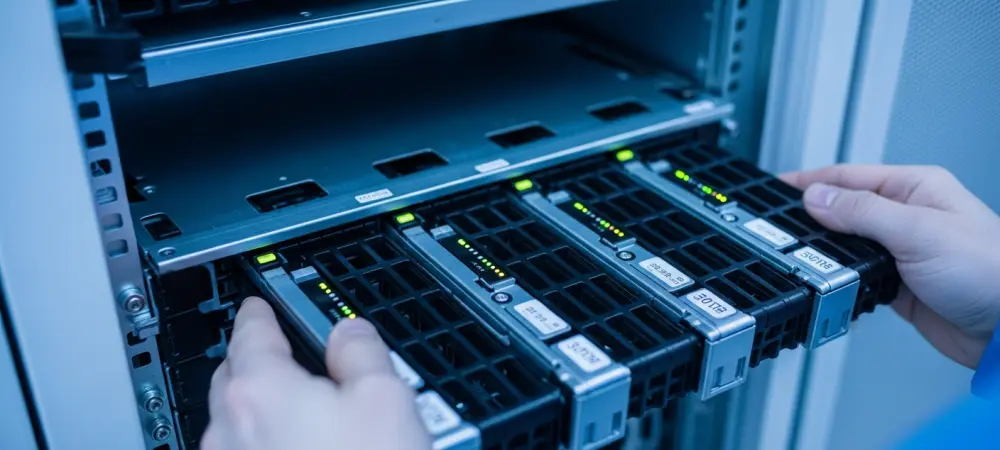
The transition from small-scale storage arrays to massive, multi-terabyte environments has fundamentally altered the risk profile of traditional data protection methods that once defined the industry. For nearly three decades, RAID 5 served as the standard-bearer for balancing storage efficiency and data redundancy, but the arrival of high-capacity mechanical drives has pushed this configuration to its breaking point. As drives move toward the thirty-terabyte mark, the mathematical assumptions that supported single-parity protection are no longer valid, leaving data vulnerable during the most critical moments of recovery. This shift is not merely an incremental change in hardware performance; it represents a total collapse of the safety margins that IT professionals have relied upon since the turn of the century. The fundamental crisis stems from a widening gap between drive capacity and the physical reliability of the magnetic media. While engineers have successfully packed more data into the same physical footprint, the error rates associated with reading that data have not improved at the same pace. This disparity creates a situation where the sheer volume of data on a single drive now exceeds the statistical likelihood of reading that drive without encountering an unrecoverable error. Consequently, the very process of rebuilding a failed array has become a high-risk gamble that frequently results in total data loss. Understanding the obsolescence of RAID 5 requires a deep dive into the mechanical and mathematical realities of modern storage, exploring why yesterday’s best practices have become today’s greatest liabilities.
The Historical Success of Single Parity
Economics and Efficiency in the Early Storage Era
To understand the current decline of RAID 5, it is necessary to look back at the economic landscape that made it the preferred choice for enterprise storage. In the early 2000s, storage was a precious and expensive resource, and the “N-1” capacity rule offered a significant advantage over simple mirroring. By dedicating only one drive’s worth of space to parity, organizations could maximize their available storage while still maintaining a safety net against hardware failure. This efficiency was a primary selling point for small and medium-sized businesses that needed to optimize every gigabyte of space they purchased, making RAID 5 the undisputed king of the server room during a time when drive capacities were measured in hundreds of gigabytes.
The performance profile of RAID 5 also aligned perfectly with the workloads of that era. Before the widespread adoption of flash storage, mechanical drives provided the necessary throughput for file servers and databases, and RAID 5 offered a balance of read and write performance that met most requirements. The complexity of calculating parity was handled by dedicated hardware controllers, which offloaded the burden from the main processor. This synergy between hardware capability and storage demands created a period of stability where RAID 5 was seen as a robust and reliable standard. For many years, the risks were manageable because the physical limits of the drives had not yet reached a point where they challenged the underlying mathematics of parity-based protection.
During this period, the storage industry was focused on scaling up, but the scale was still within the comfort zone of single-parity systems. A failure in an array consisting of four or five 500GB drives was a minor inconvenience that could be resolved in a couple of hours. The total amount of data that needed to be read and recalculated during a rebuild was small enough that the surviving drives were not subjected to extreme stress. The brief window of vulnerability was the key to RAID 5’s success; the probability of a second failure occurring within such a short timeframe was statistically negligible. As long as the rebuild times remained short, the safety of the data was virtually guaranteed, reinforcing the belief that RAID 5 was a permanent fixture in the IT toolkit.
Hardware Limitations and Narrow Windows of Risk
The reliability of early RAID 5 implementations was largely a function of the modest size of the hard drives themselves. When a drive failed in a 2026-era legacy environment using 1TB or 2TB units, the surviving drives in the array only had to process a relatively small amount of information to reconstruct the missing data. The mechanical components of the surviving drives were tasked with a workload that was intensive but brief, lasting only as long as it took to scan the remaining surfaces. The physical duration of the rebuild was the most important safety metric, and in those days, it was consistently low.
Furthermore, the physical density of the data on the platters was low enough that the drive heads could easily track and read sectors without the high sensitivity required by modern, high-density disks. The magnetic grains on the platters were larger and more stable, leading to fewer instances where a sector would become unreadable due to environmental factors or minor physical degradation. This inherent stability of the media complemented the RAID 5 structure, as the controller rarely had to deal with multiple errors simultaneously. The storage ecosystem was in a state of equilibrium where the hardware’s physical capabilities were more than sufficient to support the software’s mathematical requirements for data protection.
This operational simplicity allowed for a high degree of confidence in the recovery process. IT administrators could replace a drive on a Friday afternoon and be certain that the array would be healthy by the time they returned on Monday morning. The simplicity of the recovery process also meant that the hardware controllers were rarely pushed to their limits, preventing thermal throttling or software hangs that can plague more complex modern systems. However, this era of stability was built on the assumption that drive capacities would grow at a manageable rate. As the industry began to push the boundaries of areal density to reach the massive capacities seen in 2026, the physical and mathematical foundations that supported this confidence began to erode at an accelerating pace.
The Mathematical Collapse of Reliability
The URE Threshold and the Capacity Gap
The primary catalyst for the obsolescence of RAID 5 is the Unrecoverable Read Error (URE) rate, a metric that describes the statistical frequency of a drive encountering a sector it cannot read. Most consumer-grade and even some enterprise-grade SATA drives are rated with a URE of one error per $10^{14}$ bits read. In the past, when a drive held only 500 gigabytes, this rating provided a massive buffer, as the total number of bits on the drive was far below the threshold where an error was expected. A user could read the entire drive hundreds of times before the math suggested they might hit a bad sector. This statistical advantage was the silent protector of RAID 5 arrays for over two decades.
The problem in 2026 is that hard drive capacities have surged into the dozens of terabytes, while the URE rate has remained largely stagnant at that same $10^{14}$ threshold. A single 20TB drive contains approximately $1.6 times 10^{14}$ bits, meaning that reading the drive from start to finish is mathematically more likely than not to produce at least one unrecoverable error. When several of these high-capacity drives are placed in a RAID 5 array, the combined bit count of the surviving drives during a rebuild is staggering. To reconstruct a failed drive in a five-disk 20TB array, the system must successfully read 80TB of data—nearly $6.4 times 10^{15}$ bits—without hitting a single error. The math is no longer on the user’s side; the probability of failure during a rebuild has moved from “rare” to “statistically probable.”
This mathematical gap creates a “certainty of failure” that makes RAID 5 a dangerous choice for modern high-density storage. Even if the hardware is brand new and the environment is perfect, the sheer volume of data being processed during a recovery operation exceeds the reliability ratings provided by the manufacturers. If a single URE is encountered during the rebuild, the parity calculation for that block fails. Because RAID 5 only has one layer of parity, there is no secondary source of data to resolve the error. Depending on the sophistication of the RAID controller, this can lead to a “hole” in the data, a corrupted file, or a total collapse of the array. The safety net has become too small for the volume of data it is expected to catch.
Statistical Probability and the Failure Point
The convergence of massive capacity and static error rates has transformed the RAID 5 rebuild process into a high-stakes lottery where the odds of winning are constantly decreasing. In a modern 2026 data center environment, the time required to read every bit of data from a 24TB or 30TB drive is measured in days, not hours. During this extended window, the array is operating in a “degraded” state with zero redundancy. The math is no longer on the user’s side; the probability of failure during a rebuild has moved from “rare” to “statistically probable.” The statistical probability of a successful recovery is the product of the reliability of every individual drive in the set, and as those drives grow larger, the product of their reliability increasingly approaches zero.
This reality is particularly jarring when considering the workload of the remaining drives in the array. Unlike normal operation, where the system only reads the specific data requested by a user, a RAID rebuild requires a sequential scan of every single sector on every surviving platter. This is the most taxing operation a hard drive can perform, as it forces the drive to maintain a constant high-speed read for fifty or sixty hours straight. Any latent weakness in the drives, such as a microscopic defect in the platter or a slightly misaligned actuator arm, is likely to manifest under this extreme stress. The rebuild itself acts as a catalyst for the very failure it is trying to fix, creating a feedback loop of risk that single-parity systems simply cannot survive.
Furthermore, the impact of a failed rebuild has grown exponentially more severe. Losing a 2TB array in 2010 was a setback, but losing a 100TB array in 2026 can be a catastrophic event for a business or an individual. The density of information stored on these modern disks means that the stakes are higher than ever before. When a RAID 5 array fails during a rebuild, the loss is often total, as the parity information needed to reconstruct the files is permanently lost. This combination of increased risk and increased consequence has led to a fundamental shift in how storage architects view data protection. The focus has moved away from simple hardware availability toward a more robust model of mathematical certainty and multi-layered redundancy.
The Dynamics of the Rebuild Trap
System Exhaustion and Mechanical Stress
The physical reality of a RAID 5 rebuild on modern hardware is a grueling test of endurance that often pushes mechanical drives beyond their operational limits. When an array enters a degraded state, the controller must read every bit of data from the surviving disks to fill in the gaps left by the missing drive. For high-capacity drives in the 20TB to 30TB range, this process generates a tremendous amount of heat and vibration. The drives are forced into a 100% duty cycle for multiple consecutive days, which is a significant departure from the bursty, intermittent workloads they usually handle. This sustained mechanical activity accelerates wear and tear at the exact moment the system is most vulnerable to another failure.
Thermal management becomes a critical issue during these multi-day marathons. As the drives spin and the actuators move constantly across the platters, internal temperatures can rise significantly, especially in high-density enclosures where airflow may be restricted. Heat is the enemy of hard drive longevity, as it can cause the lubricants in the spindle bearings to break down or lead to thermal expansion that affects the precision of the read/write heads. If one of the surviving drives is already nearing the end of its life, the intense heat of a rebuild can easily trigger a catastrophic failure. In a RAID 5 configuration, this secondary failure is the end of the line, as there is no additional parity to cover the loss of a second disk.
Vibration is another factor that is often overlooked but becomes highly relevant during a full-array scan. Modern high-capacity drives use extremely narrow tracks to achieve their high densities, requiring the actuator arm to maintain perfect alignment within nanometers. When all drives in an enclosure are reading at full speed simultaneously, the cumulative vibration can interfere with the tracking mechanisms. This can lead to “seek errors” or force the drive to slow down and retry reads, further extending the duration of the rebuild and increasing the window of risk. The mechanical stress of a RAID 5 rebuild is not just a side effect; it is a primary driver of the “rebuild trap” that characterizes modern high-capacity storage.
Controller Behavior and Data Volatility
Beyond the mechanical stress on the disks, the RAID controller itself becomes a potential point of failure during a high-capacity rebuild. Calculating the parity for tens of terabytes of data requires substantial computational resources, and if the controller is an older model or integrated into a low-power system, it may struggle to keep up with the data stream. In 2026, many storage systems have moved toward software-defined storage (SDS), where the CPU handles parity calculations. While this offers more flexibility, it also means that the rebuild process must compete with other system tasks for processor cycles and memory bandwidth. A bottleneck in the controller can cause the rebuild to stall or become inconsistent, adding another layer of uncertainty to the recovery.
The behavior of the RAID controller when it encounters a URE during a rebuild is particularly critical. In a single-parity system like RAID 5, the controller has no way to verify which data is correct if it encounters a read error on a surviving disk. Some controllers are programmed to be “merciful,” attempting to skip the bad sector and continue the rebuild, which results in a small amount of data corruption in the final array. Others are programmed to be “strict,” immediately marking the entire array as failed to prevent the spread of silent corruption. Neither outcome is desirable; one leads to “bit rot” and damaged files, while the other leads to a complete loss of access to all data on the array.
This volatility is compounded by the fact that modern file systems and applications are less tolerant of data errors than they were in the past. A single flipped bit in a critical database file or an encrypted container can render the entire file unreadable. In the RAID 5 era, a failed rebuild often meant the total loss of the volume because the file system metadata could not be reconstructed. As drive capacities continue to climb, the volume of metadata and the complexity of file structures also increase, making the integrity of every single bit even more vital. The “rebuild trap” is therefore not just a physical or mathematical problem, but a systemic one that affects the reliability of the entire data stack from the platters to the application layer.
Empirical Reality and Failure Modes
Manufacturer Ratings and Batch Failures
While theoretical math provides a sobering look at RAID 5’s weaknesses, real-world empirical data reveals even more complex failure modes that the math doesn’t always capture. One of the most significant factors in 2026 is the reality of “batch failures,” which occurs because most RAID arrays are built using drives that are identical in every way. When an organization buys a set of 22TB drives for a new server, those drives usually come from the same manufacturing plant, the same production run, and even the same shipping pallet. They have identical internal components and have been subjected to the exact same environmental conditions throughout their lives. This lack of diversity is a hidden risk factor that RAID 5 is ill-equipped to handle. Because these drives are nearly identical, they tend to share the same inherent weaknesses and wear patterns. If one drive fails due to a component reaching its end-of-life or a subtle manufacturing defect, it is highly probable that the other drives in the same batch are on the verge of failing as well. In this context, the failure of the first drive is not a random, isolated event; it is a signal that the entire set of hardware has reached its limit. When the RAID 5 rebuild starts, it places the maximum possible stress on these remaining, equally-worn drives. The result is often a second failure within hours of the first, a scenario that happens far more frequently in the field than simple probability would suggest.
This “domino effect” exposes the flaw in relying on manufacturer URE ratings as the only measure of reliability. A drive might be rated for a specific error frequency, but that rating assumes a level of randomness that rarely exists in a synchronized RAID environment. In practice, the drives in an array age in lockstep. By the time one drive dies, the others may be hanging on by a thread, and the brutal workload of a 48-hour rebuild is the final blow that brings the whole system down. RAID 5 assumes that failures are independent events, but the empirical reality of storage in 2026 shows that failures are often clustered, making single-parity protection a dangerously thin line of defense.
Latent Sector Errors and Silent Corruption
Another major failure mode that plagues high-capacity RAID 5 arrays is the presence of “latent sector errors,” often referred to as silent data corruption or bit rot. These are sectors on a disk that have become unreadable over time due to magnetic decay or physical degradation, but because the data in those sectors hasn’t been accessed recently, the system is unaware of the problem. In a healthy RAID 5 array, these latent errors are invisible and don’t affect day-to-day operations. However, the moment a drive fails and a rebuild begins, these hidden “landmines” become a catastrophic threat to the entire dataset.
During a rebuild, the controller must read every single sector on every surviving disk. When it hits a latent sector error that it didn’t know existed, it suddenly finds itself in a position where it cannot complete the parity calculation for that block. In a RAID 5 setup, this creates an unrecoverable hole in the data because there is no second parity block to look at. The rebuild may fail entirely, or it may finish with corrupted files that the user won’t discover until they try to open them months later. This “silent” nature of the failure is particularly insidious, as it gives a false sense of security that the data is protected when it is actually slowly rotting away on the platters.
The risk of latent sector errors scales directly with drive capacity. A 24TB drive has a much larger surface area and more sectors than an older 4TB drive, providing more opportunities for magnetic decay to occur. Furthermore, as drives sit in a server for three or four years, the likelihood of a sector becoming unreadable increases. RAID 5’s inability to cope with a latent error during a rebuild is one of the most cited reasons for its obsolescence in professional environments. Without a second layer of parity to verify and correct these errors, a high-capacity RAID 5 array is essentially a ticking time bomb waiting for a rebuild to trigger a collapse.
Modern Standards for Resilient Storage
The Rise of Dual Parity and RAID 6
The storage industry has responded to the collapse of RAID 5 by standardizing on dual-parity configurations, most notably RAID 6 and its software-defined counterparts like ZFS RAIDZ2. RAID 6 functions similarly to RAID 5 but adds a second block of parity for every stripe of data, allowing the array to survive the simultaneous failure of two drives. This second layer of protection is the direct answer to the “rebuild trap.” If a URE or a latent sector error is encountered while rebuilding the first failed drive, the RAID controller can use the second parity block to calculate the missing data and continue the process without interruption. This mathematical safety net effectively nullifies the threat posed by high URE rates. The transition to RAID 6 has become the baseline requirement for any system using drives larger than 8TB or 10TB. While it requires the “sacrifice” of an additional drive’s worth of capacity, the trade-off is a massive leap in reliability. For a modern 2026 enterprise, the cost of one extra 20TB drive is negligible compared to the potential loss of an entire 100TB volume. RAID 6 provides the breathing room needed to handle the multi-day rebuild times of high-capacity disks, ensuring that even if a second drive shows signs of fatigue during the process, the data remains intact and accessible. This resilience has made dual parity the new “gold standard” for local redundancy.
Beyond RAID 6, more advanced systems are now looking toward triple parity (RAIDZ3) for exceptionally large arrays or for environments where rebuild times can stretch into a week or more. As drive capacities continue to push toward 40TB and 50TB, even the safety margins of RAID 6 may eventually be challenged. However, for the current era, RAID 6 offers the best balance of performance, capacity, and safety. It acknowledges the physical reality that modern drives are large, slow to rebuild, and statistically prone to errors, providing a structural solution to a mechanical problem. By decoupling the safety of the array from the reliability of a single drive, RAID 6 has restored the confidence that was lost as RAID 5 became obsolete.
Niche Applications for Single Parity
Despite its decline in the enterprise and high-capacity space, RAID 5 is not completely disappearing; rather, it is being relegated to specific, low-risk niches. In 2026, RAID 5 remains a viable option for arrays composed of Solid State Drives (SSDs) where the drive capacities are relatively small and the rebuild times are measured in minutes rather than days. Because SSDs do not have the mechanical weaknesses of hard drives and can be read at extremely high speeds, the window of risk during a rebuild is significantly smaller. In these scenarios, the statistical probability of a second failure or a URE occurring during the brief reconstruction phase is still low enough to be acceptable for many users.
RAID 5 also finds a home in non-critical environments where data is frequently backed up and uptime is not a primary concern. For a home media server storing movie files that can be easily redownloaded, the risk of a RAID 5 collapse might be worth the extra storage space gained by using single parity. If the array fails, the user simply restores from a backup or re-acquires the data. In this context, RAID 5 is treated as a way to manage convenience rather than a serious data protection strategy. It serves a purpose for hobbyists and enthusiasts who are willing to trade a degree of safety for the “N-1” efficiency that originally made the format popular.
However, even in these niche cases, the trend is moving toward more robust solutions. As the cost per terabyte of high-capacity drives continues to drop, the economic incentive to stick with RAID 5 is diminishing. Most modern NAS (Network Attached Storage) devices now default to RAID 6 or proprietary multi-parity systems during setup, guiding users away from the risks of single parity. The industry is effectively “phasing out” RAID 5 through better defaults and clearer communication about the risks of high-density storage. While it may persist in legacy systems or specialized SSD arrays, RAID 5 has officially lost its status as a general-purpose recommendation for modern data storage.
Strategic Maintenance and Protection
Proactive Management and the 3-2-1 Rule
In the modern storage landscape of 2026, relying on RAID alone—even RAID 6—is no longer sufficient for comprehensive data protection. Proactive management has become a critical component of maintaining high-capacity arrays, with “data scrubbing” serving as the first line of defense against silent corruption. Data scrubbing is a process where the storage controller periodically reads every block of data and compares it against the parity information to ensure consistency. By running a scrub once a month, a system can identify and repair latent sector errors while all drives are healthy, preventing those errors from becoming fatal “landmines” during a future rebuild.
Furthermore, the complexity of modern drives requires a shift toward more sophisticated monitoring tools. Simple SMART (Self-Monitoring, Analysis, and Reporting Technology) alerts are often too late to prevent a failure. Advanced storage platforms now use machine learning to analyze drive telemetry, looking for subtle patterns in seek times, retry rates, and temperature fluctuations that might indicate an impending failure. By identifying a “dying” drive weeks before it actually stops working, IT managers can perform a proactive replacement, which is far less stressful on the array than a reactive rebuild following a sudden crash. This transition from reactive to predictive maintenance is a hallmark of the 2026 storage environment. Ultimately, the most important lesson of the RAID 5 era is the importance of the 3-2-1 rule: three copies of data, on two different media types, with one copy stored off-site. RAID is a tool for high availability—it keeps the system running when a piece of hardware breaks—but it is not a backup. A RAID array cannot protect against ransomware, accidental deletion, or a catastrophic environmental event like a fire or flood. True data security requires a multi-layered approach where RAID provides the local uptime and a robust backup strategy provides the long-term safety net. In an era of 30TB drives and massive datasets, this holistic approach is the only way to ensure that information remains safe and accessible for the long haul.
Future-Proofing Storage Architectures
Looking toward the future of storage, the obsolescence of RAID 5 has paved the way for more resilient architectures like erasure coding and distributed object storage. Erasure coding is a more flexible and powerful version of parity that allows for even higher levels of redundancy, such as “n+3” or “n+4” protection, where an array can survive the loss of three or four drives simultaneously. This technology is already common in large cloud provider environments and is beginning to trickle down to mid-sized enterprise systems. By breaking data into many small chunks and spreading them across dozens of drives, these systems eliminate the “rebuild trap” by distributing the recovery workload across a massive pool of resources.
Another emerging trend is the use of “shingled” and “heat-assisted” magnetic recording (SMR and HAMR) drives, which offer even higher densities but come with unique performance characteristics. These drives require even more careful management than traditional PMR (Perpendicular Magnetic Recording) disks, further reinforcing the need for intelligent storage controllers and dual-parity configurations. As we move into the late 2020s, the concept of a “simple” RAID array is being replaced by intelligent storage clusters that manage data placement, health monitoring, and recovery as a continuous, automated process. The manual overhead of managing RAID levels is slowly being replaced by software that optimizes for both performance and durability.
In conclusion, the decline of RAID 5 was an inevitable consequence of the industry’s success in scaling hard drive capacity. The transition to higher densities provided immense benefits for data storage but at the cost of the mathematical safety margins that once protected single-parity systems. By moving to RAID 6, implementing proactive data scrubbing, and strictly adhering to the 3-2-1 backup rule, organizations successfully adapted to the new realities of the 2026 storage landscape. The era of the “risky rebuild” served as a valuable wake-up call, reminding the industry that data protection must evolve at the same pace as the hardware it resides on. Moving forward, the focus remained on building resilient, multi-layered systems that prioritized the integrity of the data above the efficiency of the storage medium.