

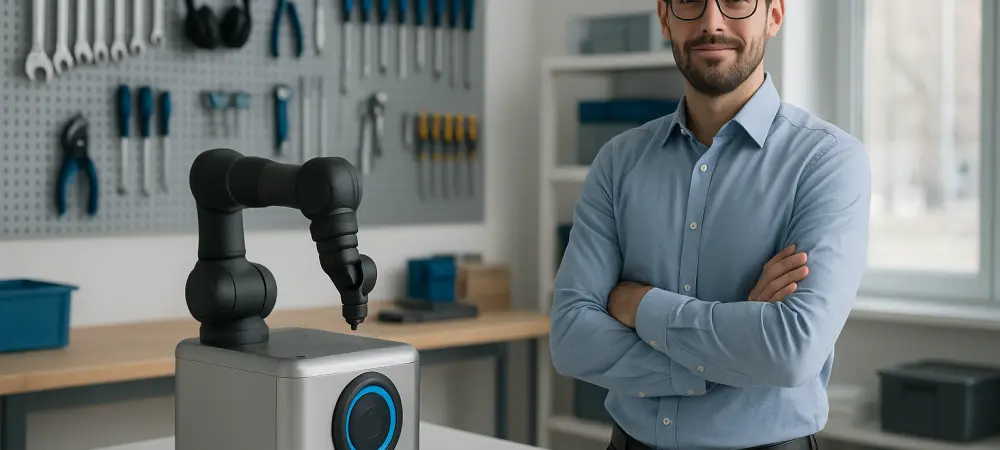
The debut of the g-Series robot arms introduces an AI-ready tool flange that integrates vision and sensing capabilities directly into the hardware to eliminate complex cabling. This advancement, showcased at the 2026 International Manufacturing Technology Show, marks the official entry of Universal Robots into a new era of physical intelligence. By redesigning the platform from the ground up, the company has addressed the persistent challenges of integration friction and limited computational power that have previously hindered large-scale automation. This Seventh-Generation system is the culmination of data gathered from over 100,000 global installations, providing a robust and unified ecosystem for modern industry. The focus shifts away from basic repetitive motion toward a more cognitive approach where robots can perceive and react to their environment in real time. Manufacturers are now equipped with tools that simplify the deployment of complex sensors, allowing for a faster transition to full production capacity without the traditional technical hurdles.
Software Architecture: Empowering Edge Intelligence
The foundation of this new platform is the PolyScope X operating system, which utilizes modern programming tools and open APIs to create a versatile development environment. By incorporating ROS2 communication protocols, the software allows for the seamless execution of edge-AI applications directly on the robot controller. This setup is particularly beneficial for the current 2026 to 2028 operational cycle, as it enables the integration of third-party software packages without the latency issues common in older systems. The containerized architecture of PolyScope X ensures that complex path-planning algorithms and vision-processing tasks can run simultaneously, providing the robot with the necessary intelligence to navigate dynamic factory floors. This modular approach to software means that developers can easily update and refine their AI models, ensuring that the robotic fleet remains at the cutting edge of technological capability as industrial requirements continue to evolve over time.
Beyond its core processing capabilities, the software environment promotes a high degree of interoperability between various hardware components and external logic controllers. This eliminates the need for expensive middleware or custom drivers, significantly reducing the total cost of ownership for automated systems. Small and medium-sized enterprises can now deploy sophisticated robotics solutions that were once only feasible for large corporations with extensive engineering resources. The intuitive user interface also allows for rapid task switching, which is essential in today’s high-mix manufacturing landscape. By providing a standardized framework for communication, Universal Robots has created an ecosystem where innovation can flourish through the contribution of various partners and developers. This connectivity ensures that every robotic unit is not just an isolated piece of machinery, but a connected node in a larger digital production network. The software essentially acts as the connective tissue that binds advanced sensors and mechanical precision together.
Hardware Innovation: Enhanced Power and Tactility
Hardware upgrades for the Gen 7 platform include the CB7 Core controllers, which provide 40% more compute power in a frame that is 30% smaller than previous generations. This increase in performance is vital for processing the high-bandwidth data streams required by modern vision systems and sophisticated force sensors. The compact design allows the controller to be integrated into space-constrained environments, providing more flexibility for plant floor layouts. Additionally, the new TP7 Core teach pendant has been re-engineered to be 20% lighter, featuring an HD display and a virtual joystick that improves ergonomic comfort during long programming sessions. These improvements are complemented by the SP7 Smart Panel, which allows for touch-to-teach programming directly at the tool flange. By bringing the interface closer to the task, operators can define waypoints and actions with greater precision and speed. The hardware design focuses on balancing raw computational strength with user-centric features that simplify the daily operation of robotic cells. The integration of physical AI was further realized through native force-torque sensing and impedance control, giving the g-Series arms an advanced sense of touch. These features allowed the robots to perform delicate tasks like polishing or assembly with a level of dexterity that mimicked human hands. To ensure these systems could operate reliably in any environment, the platform met rigorous ISO and UL certifications for both physical safety and cybersecurity. The transition to this new standard of automation demonstrated that the most effective solutions were those that combined physical robustness with intelligent software. Manufacturers who utilized these tools found that they could adapt to shifting market demands more quickly, securing their operations against future supply chain disruptions. In practice, the adoption of these AI-powered systems served as a catalyst for broader digital transformation. Looking toward next steps, the focus shifted to optimizing these deployments through continuous data analysis.