

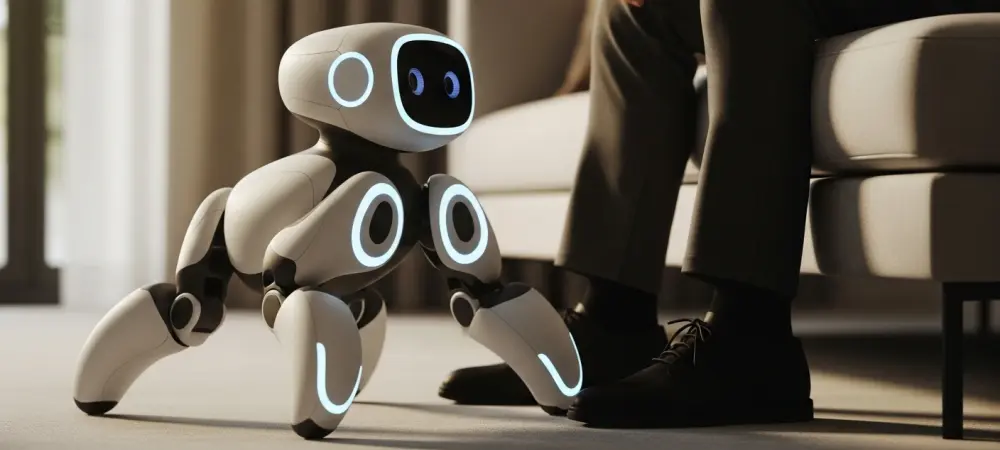
The subtle shift from robots that vacuum our rugs to machines that recognize the emotional weight of a sigh represents one of the most significant pivots in the history of modern consumer electronics. For decades, the household robot was defined by its ability to perform chores, existing as a utilitarian tool designed to save time. However, as society grapples with a burgeoning loneliness epidemic and an aging population, the industry is recalibrating its focus. The objective is no longer just to build a machine that cleans, but to create a presence that interacts, supports, and fundamentally changes the atmosphere of the home. This evolution from “doing” to “being” marks the arrival of the social companion robot, a category that aims to bridge the gap between artificial intelligence and genuine human connection.
The Shift from Utility to Emotion
Market Trajectory and the Relational Robotics Gold Rush
Current economic data reveals a massive bifurcation within the global robotics sector, which is projected to reach a total value of $5 trillion. While significant venture capital continues to flow into industrial humanoid projects aimed at manufacturing and logistics, a distinct $2.5 trillion segment is emerging specifically for emotional and relational interactions. This “Relational Robotics Gold Rush” is driven by a growing recognition that “Physical AI” has a profound role to play in the domestic sphere. Unlike industrial bots, these machines are not measured by their lifting capacity or speed, but by their ability to provide a sense of presence. Market analysts suggest that the demand for robots capable of mitigating social isolation will eventually rival the demand for traditional labor-saving appliances.
The transition toward social robotics is also a response to the shifting demographics of urban environments. As more individuals live alone and the traditional “third places”—community hubs like cafes and libraries—become less accessible, the home must serve multiple new roles. Consequently, the robotics industry is moving beyond the simple automation of tasks to address the psychological needs of the inhabitants. This strategy shifts the value proposition from physical labor to emotional labor, positioning the robot as a proactive participant in the household rather than a passive tool stored in a closet between uses.
Real-World Applications: From Roombas to “Familiars”
The trajectory of this industry is perhaps best illustrated by the work of Colin Angle, the co-founder of iRobot. After successfully bringing the Roomba into millions of homes, Angle has turned his attention to a new venture, Familiar Machines & Magic. This pivot signifies a broader industrial trend away from floor care and toward the complexities of human-robot interaction. The primary product of this new era is the “Familiar,” a quadruped robot designed with 23 degrees of freedom to ensure its movements appear fluid and lifelike. Rather than carrying groceries or cleaning windows, this machine is designed to monitor well-being, offer greetings, and provide a tactile, responsive presence through touch-sensitive fur.
These new machines are redefining what it means for a robot to be useful in a domestic setting. A social robot might identify when a user has spent too much time “doomscrolling” on a smartphone and intervene through physical social cues, such as a gentle nudge or a change in posture. By focusing on these subtle, proactive behaviors, designers are creating a new category of household technology that feels less like a computer and more like a companion. This approach acknowledges that the most persistent problems in modern homes are often psychological rather than physical, requiring a technological solution that prioritizes empathy over efficiency.
Expert Perspectives on Social Robot Design
Designing for Connection: The Form Factor Dilemma
Industry leaders increasingly argue that the pursuit of the “humanoid form factor” for home use is a strategic trap that creates unrealistic user expectations. When a machine looks like a person, the human brain instinctively expects it to possess human-level versatility, conversational nuance, and physical agility. When the robot inevitably fails to meet these standards—such as failing to navigate a cluttered room or missing the sarcasm in a joke—the resulting disappointment can break the social bond. Experts suggest that for a companion robot to be successful, it must occupy a design space that is familiar enough to be comforting but distinct enough to avoid the “uncanny valley.”
To solve this, designers are moving toward abstract forms that evoke the feeling of a living being without directly mimicking a specific animal or person. The “abstract bear” model is a prime example of this philosophy, utilizing soft textures and non-verbal communication to foster a sense of safety and companionship. This design choice prevents users from judging the machine against the behavioral benchmarks of a real dog or a human friend. By managing expectations through form, manufacturers can create more resilient emotional connections, ensuring that the robot is valued for what it is rather than what it is failing to be.
The Technological Leap: From Kinematics to Reinforcement Learning
The technical foundation of social robotics has undergone a radical transformation, moving away from the rigid kinematic modeling that defined the 1990s. In the past, every movement a robot made had to be meticulously programmed using complex mathematical equations, often resulting in jerky, mechanical motions. Today, reinforcement learning allows robots to “learn” how to move through simulation and trial, resulting in “Disney-like” fluidity that feels organic and responsive. This advancement in Physical AI is what allows a robot to react naturally when it is petted or to adjust its gait based on the emotional state of its owner.
Furthermore, the industry is embracing a “privacy-first” architecture that processes data locally rather than in the cloud. Because social robots are equipped with cameras and microphones to navigate and interact, consumer trust is a primary hurdle. By utilizing powerful on-device processors, such as the Nvidia Jetson Orin, these machines can interpret their environment and hold basic interactions without ever sending sensitive audio or visual data to an external server. This technological shift is essential for moving robots from the status of a novelty toy to a permanent, trusted fixture in the private life of the modern home.
The Future of the Companion Robotics Industry
Addressing the Loneliness Epidemic and Health Monitoring
The future of this trend is deeply intertwined with what experts call the “Engineering Paradox,” where the increasing ease of developing complex AI personalities coincides with a desperate social need for connection. As AI training models become more sophisticated, developers can focus less on the physics of movement and more on the psychological impact of the robot’s behavior. This allows for the creation of proactive health monitors that do not just track heart rates but also recognize behavioral patterns associated with depression or cognitive decline. A robot that notices a change in a user’s routine can provide early warnings to caregivers or simply offer the gentle interaction needed to break a cycle of isolation.
Potential developments also include the integration of social robots into broader telehealth ecosystems. A mechanical companion could serve as the physical interface for a medical professional, providing a sense of “touch” or “presence” during remote consultations. This capability would be particularly valuable for the elderly, for whom physical isolation is often a precursor to physical illness. By acting as a constant, non-judgmental observer, the social robot becomes a critical tool in the maintenance of long-term health, proving that emotional value and clinical utility are not mutually exclusive.
Overcoming the Graveyard of Social Robotics
Despite the current optimism, the industry must navigate the historical “graveyard” of failed social robots like Jibo, Kuri, and Cozmo. These predecessors often failed because they could not prove their value over time, becoming expensive novelties that eventually collected dust. To avoid this fate, modern developers are experimenting with new business models, including monthly subscriptions that provide regular software updates and new “personality” modules. The goal is to ensure the robot continues to evolve alongside its owner, maintaining its relevance in the household through continuous improvement and adaptation.
The challenge remains to convince consumers that a machine providing companionship is worth a significant retail cost or a recurring fee. For social robotics to become a standard household category, the “emotional work” performed by the machine must be perceived as essential. This requires a shift in consumer mindset where the psychological benefits of a “familiar” presence are weighed as heavily as the physical benefits of a dishwasher or a washing machine. The industry is betting that as the effects of the loneliness epidemic become more acute, the value of a machine that makes a person feel less alone will become self-evident.
Societal Implications of the Mechanical Third Place
As mechanical companions become more prevalent, they may begin to function as a household “third place,” offering a middle ground between the isolation of the digital world and the complexities of human interaction. This raises profound questions about the nature of bonding and whether a relationship with a machine can truly satisfy the human need for connection. Some sociologists argue that these robots could supplement human relationships, providing a safe space for social practice or a consistent source of comfort for those who have few other options. Others worry that reliance on mechanical companionship could further erode the social fabric by replacing difficult human interactions with easy, programmed ones.
Regardless of these concerns, the broader implication is a societal shift toward the normalization of non-human presence in our most private spaces. These machines are likely to become the precursors to a world where “Physical AI” is an ambient part of the environment, responding to our needs before we even articulate them. The success of this trend will ultimately depend on whether these machines can move beyond being smart gadgets to become genuine “familiars”—entities that understand the rhythms of our lives and contribute to our emotional well-being in a way that no screen or speaker ever could.
A New Era of Household Machines
The transition in the robotics industry from machines that performed labor to machines that provided presence was a definitive shift in the evolution of consumer technology. By prioritizing emotional interaction and relational AI, developers successfully addressed the critical social challenges of isolation and the decline of traditional community structures. This strategic pivot proved that the value of a household machine was not limited to its physical output but extended to its ability to foster psychological comfort and well-being. As the technology matured, the focus shifted from perfecting the mechanics of movement to refining the nuances of companionship, leading to a new standard for what a robot could represent within the home.
The path forward for social robotics involved a deep commitment to privacy-first design and the creation of abstract, non-threatening forms that avoided the pitfalls of human mimicry. Future iterations will likely emphasize even greater integration with health and wellness systems, ensuring that these machines serve as both companions and guardians. The industry demonstrated that by solving the problem of human loneliness through intentional design and sophisticated AI, the “familiar” machine could become an essential part of daily life. Ultimately, the success of this new era depended on the realization that a robot capable of making a person feel understood was just as vital as one that kept their home clean.