

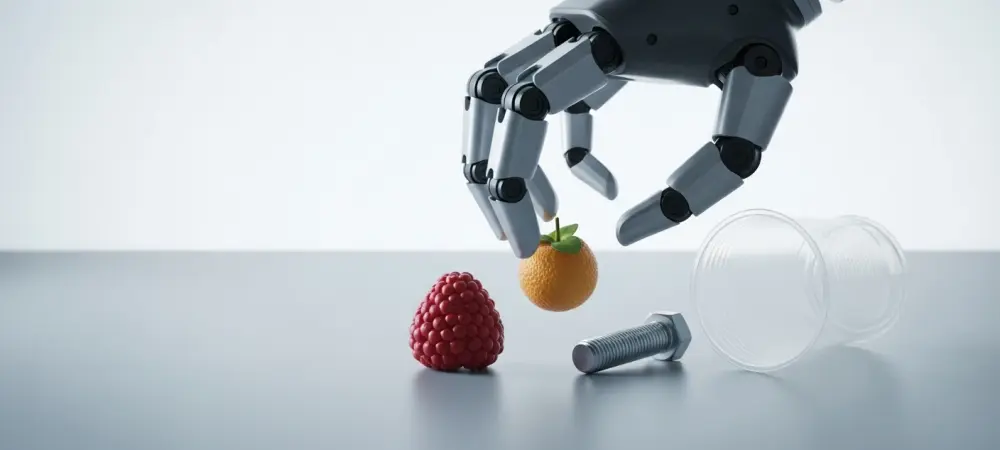
The historical trajectory of robotics has long been defined by a frustrating paradox where machines can navigate complex terrains or perform heavy lifting but fail miserably at the delicate task of peeling an orange or handling a soft piece of fruit. For decades, the industry remained comfortably lodged between two ineffective extremes that prevented any meaningful interaction with the physical world. On one side stood the industrial parallel-jaw gripper, a pair of high-precision pliers that functioned beautifully in highly structured environments but lacked the versatility to handle anything outside of a pre-programmed coordinate system. On the other side were the humanoid “mannequin claws,” stiff appendages that appeared human-like in marketing materials but served essentially as decorative weights while the robot performed more basic tasks like walking or dancing. This persistent discrepancy created a “manipulation gap” that effectively barred robots from entering domestic spaces or unstructured industrial settings where variability is the only constant.
As the industry reaches a critical inflection point, the race toward multi-billion-dollar valuations has shifted its focus from how robots move through space to how they interact with the objects within it. Fine motor skills are no longer viewed as a secondary feature but as the most significant hurdle remaining in the quest for general-purpose automation. This shift in priority has given rise to a fascinating ideological divide within the tech sector, exemplified by the contrasting strategies of Genesis AI and Kyber Labs. While one organization bets on the supremacy of digital intelligence and massive data synthesis, the other advocates for a return to fundamental mechanical pragmatism. The outcome of this competition will likely dictate the next decade of automation, determining whether the future belongs to the “robotic brain” or to the “rugged hand.”
The AI-Centric Philosophy of Genesis AI
Intelligence Through DatThe GENE-26.5 Architecture
Genesis AI recently emerged from its development phase with the introduction of the GENE-26.5, a platform the company characterizes as the first genuine “robotic brain” capable of achieving human-level physical manipulation. The core of their philosophy rests on the belief that the hardware bottleneck is an illusion; they argue that the real reason robots cannot perform complex tasks is simply that they lack the sophisticated neural architecture to process physical feedback. To demonstrate this capability, the company showcased an autonomous system preparing a multi-stage breakfast, a sequence that involved cracking eggs, slicing vegetables with consistent thickness, and precisely seasoning the food. Unlike many previous industry demonstrations that relied on teleoperation or artificial speed-up, this sequence operated at a standard human pace, suggesting that the underlying model was making real-time decisions based on visual and tactile input rather than following a rigid script.
The implications of the GENE-26.5 architecture extend far beyond the kitchen, targeting tasks that require a high degree of spatial reasoning and material awareness. In their recent pilot tests, the system successfully managed the application of electrical tape to thin, flexible wiring, a task that has historically stumped robotic systems due to the complex tension dynamics involved in the material. Furthermore, the robot demonstrated an ability to separate stuck plastic cups from a tightly packed stack, sensing the exact amount of friction and “stickiness” required to pull them apart without damaging the thin plastic. By prioritizing an “AI-first” strategy, Genesis AI is betting that a sufficiently powerful foundation model can eventually overcome any minor hardware deficiencies, treating the physical robot as a mere peripheral for a centralized, highly generalized intelligence. This approach suggests that the primary task for developers is no longer engineering better joints, but rather curating the massive datasets required to teach a machine how to feel the world around it.
Synthesizing Reality: The Full-Stack Simulation Ecosystem
To support their ambitious vision of a general-purpose robotic brain, Genesis AI has developed a comprehensive ecosystem designed to solve the chronic data scarcity that plagues physical AI. Because high-quality training data for robotic manipulation is notoriously difficult to acquire, they have introduced a noninvasive data-collection glove that humans wear while performing routine tasks. This device records not just the motion of the fingers, but the specific forces applied and the tactile feedback received during the interaction. By capturing the nuance of human dexterity in real-world settings, the company can feed high-fidelity “demonstrations” into their learning models at a scale previously thought impossible. This creates a feedback loop where the AI learns the relationship between visual cues and physical resistance, allowing it to generalize its knowledge across thousands of different objects without needing a specific program for each one.
Furthermore, this data collection is supplemented by a high-speed digital simulator that allows the system to practice millions of iterations in a virtual environment before ever attempting them in the physical world. This “sim-to-real” pipeline is critical for refining the robot’s ability to handle edge cases, such as an egg that rolls unexpectedly or a knife that is slightly duller than usual. The ultimate goal of this full-stack approach is to create a system where the hardware becomes a secondary delivery mechanism for a superior digital intelligence. By focusing on the “brain,” Genesis AI hopes to create a model that can be downloaded onto any robotic chassis, instantly granting it the ability to perform complex manual labor. This strategy reflects a broader trend in the tech industry where software-defined solutions are expected to cannibalize traditional mechanical engineering, turning the robotic hand into a commodity that simply executes the commands of a sophisticated, data-driven core.
Kyber Labs and the Pragmatism of Physical Engineering
Mechanical Transparency: Reimagining the Actuator System
In sharp contrast to the digital-heavy focus of their competitors, Kyber Labs argues that the industry’s failure to achieve true dexterity is fundamentally a hardware problem. Founded by engineers with backgrounds in high-stakes environments like SpaceX and medical device manufacturing, Kyber critiques current high-end robotic hands for being both prohibitively expensive and excessively fragile. Their central thesis is “force over precision,” a departure from the traditional robotics focus on kinematics. While most systems try to calculate the exact millimeter coordinates for a finger’s position, Kyber argues that humans actually operate based on “torque transparency.” A person doesn’t need to know the exact distance between their thumb and index finger to pick up a potato chip; they simply feel the resistance of the chip and adjust their grip force accordingly to avoid breaking it.
To replicate this human-like “feel,” Kyber has radically simplified the mechanical design of their robotic hands by stripping away the complex, high-ratio gearboxes that dominate the industry. Traditional 300-to-1 gearboxes provide incredible power, but they essentially act as a “black box” that prevents the motor from sensing what is happening at the fingertip. By utilizing direct-drive or low-ratio motors, Kyber allows the motor itself to act as the primary sensor. This design choice enables the hand to detect resistance as light as a feather without the need for expensive, delicate tactile sensors that are prone to failure in dirty or high-impact environments. This “SpaceX mindset” of radical simplification aims to create a rugged, affordable hand that can be deployed today on standard industrial arms, proving that mechanical transparency is the key to bridging the gap between a research lab and a functioning warehouse floor.
The SpaceX Paradigm: Iterative Resilience in Hostile Environments
Kyber Labs leans heavily into an iterative engineering philosophy, favoring rapid deployment and real-world testing over the slow pursuit of theoretical perfection. They argue that the only way to truly understand the requirements of a robotic hand is to put it to work in “narrow” but meaningful applications, such as uncapping test tubes in a clinical laboratory or sorting through varied industrial scrap. By performing these tasks thousands of times in actual production environments, Kyber gathers what they call “ugly data”—the unpredictable failures, grit, and wear-and-tear that digital simulators often fail to account for. This approach is reminiscent of the “pottery class” metaphor, where the group tasked with making the highest quantity of pots eventually produces the best quality because they learned through the wreckage of their repeated failures.
This focus on durability and repairability is intended to solve the economic bottleneck that has kept sophisticated robotic hands out of the market. A robotic hand that requires a team of PhD engineers to maintain every week is not a viable business solution, regardless of how “intelligent” its software might be. Kyber’s designs emphasize a high “mean time between failures” and a modular construction that allows for quick, low-cost repairs by standard technicians. By prioritizing the “muscles and bones” of the robot, Kyber is positioning itself as the provider of the essential physical infrastructure required for the coming automation wave. They contend that while a great brain is useful, it is useless without a body that can survive the rigors of 24/7 operation in an environment that wasn’t designed for a fragile machine. This hardware-first approach suggests that the most successful robots will not be those that are the smartest in the lab, but those that are the most resilient in the field.
The Path to Commercial Viability
From Controlled Demos to the Chaos of the Market
The transition from a polished promotional video to a commercially viable deployment involves a series of hurdles that many startups are currently struggling to clear. While a robot making breakfast in a controlled laboratory environment is a significant technical achievement, the real-world kitchen or factory floor presents a level of chaos that traditional robotics cannot easily handle. Beyond the primary task of manipulation, a robot must possess the “common sense” to manage secondary requirements, such as hygiene and cross-contamination. In a culinary context, this means the robot must be programmed to wash its own hands and sanitize surfaces after handling raw ingredients, a level of automated versatility that is still in its early stages. The economic reality is that a robot must not only perform the task but must do so at a cost lower than the human labor it is intended to assist or replace.
This economic pressure is driving both Genesis AI and Kyber Labs to look beyond the “cool factor” of their tech and focus on unit economics and long-term maintenance. High-end research hands currently cost as much as a luxury vehicle, making them impossible to deploy for mass-market SKU coverage in retail or warehousing. The challenge lies in scaling the manufacturing process while maintaining the high sensitivity required for dexterity. Furthermore, the durability of these systems must be high enough that they do not become a liability for the organizations that adopt them. As the industry moves forward, the focus is shifting away from “can the robot do the task” toward “can the robot do the task a million times without failing.” This shift marks the end of the experimental phase of robotic manipulation and the beginning of a more mature, commercially-driven era where reliability and cost-effectiveness are the primary metrics of success.
Strategic Convergence: The Future of Unified Manipulation
The most likely outcome for the robotics industry is a convergence of the AI-first and hardware-first ideologies, as neither approach is entirely sufficient on its own. Genesis AI provides the necessary “endgame” vision—a general-purpose intelligence that can adapt to any task—but it requires the rugged, force-sensitive hardware that Kyber Labs is perfecting to survive the transition into the real world. Without the intelligence to generalize, a rugged hand remains a specialized tool; without a rugged body, a brilliant AI remains a desktop curiosity. This convergence will likely result in a new class of machines that combine “torque-transparent” mechanical design with a foundation model trained on massive sets of human physical data. This unified approach will finally move the industry past the “clutter and claw” phase, enabling robots to handle delicate, non-standardized objects with a level of grace that was once the sole domain of biological organisms.
The path forward involved a clear division of labor between the digital and physical domains. It became evident that data scarcity was the primary hurdle for AI development, while mechanical fragility was the primary hurdle for physical deployment. The industry recognized that moving away from rigid, position-based movement toward force-driven interaction was essential for safety and versatility. This shift allowed for the development of robots that can work alongside humans in unpredictable environments without the need for safety cages or constant human oversight. As these technologies matured, the benchmark for robotic success transitioned from simple locomotion to complex, multi-step manipulation. The era where a robot making breakfast was a futuristic trope ended, replaced by a reality where machines could finally feel, sense, and interact with the physical world with a human-like touch. The remaining focus shifted toward ensuring these systems were affordable and reliable enough for global scale.