

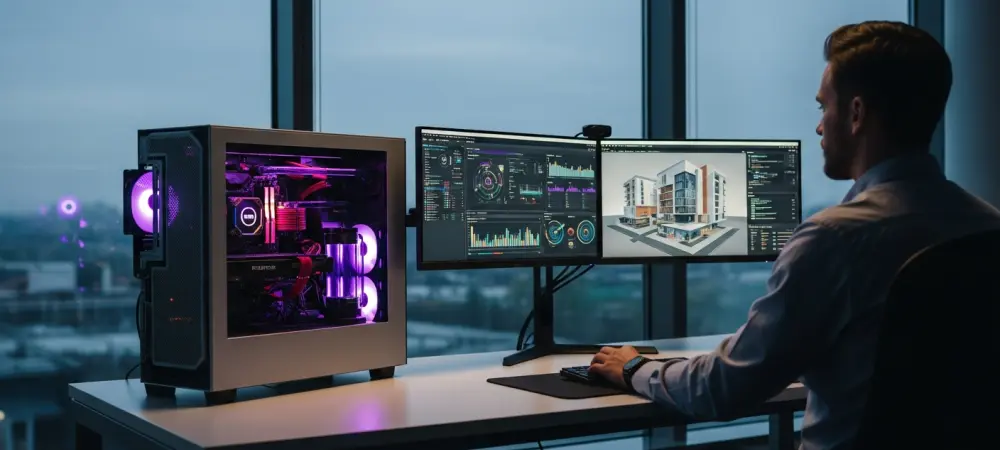
The traditional reliance on massive cloud data centers for artificial intelligence is currently being dismantled by a new breed of specialized silicon that places supercomputing capabilities directly onto a local desktop. This localized AI revolution signifies a departure from cloud-dependent processing, favoring high-performance workstations that offer immediate feedback and heightened security. NVIDIA is formally entering the AI PC segment with the RTX Spark platform, a move that disrupts the personal computing market by bringing server-grade intelligence to consumer hardware. The strategic significance of this launch lies in its ability to empower users with on-device autonomy, reducing the friction previously associated with remote AI server latency.
1. Market Trajectory and Ecosystem Integration
1.1. Industry Adoption and Supply Chain Momentum
The Fall launch of the RTX Spark platform has triggered a rapid adoption curve among high-end consumers and enterprise users seeking to modernize their digital infrastructure. Primary partners like ASUS and MSI led the initial rollout, showcasing flagship systems that integrate NVIDIA’s latest Blackwell-Grace architecture into sleek, workstation-class designs. Following this first wave, other major manufacturers including Acer and Gigabyte are preparing their own lineups to capture the growing demand for localized intelligence. This rollout provides a substantial economic boost to the Taiwanese supply chain, where vendors are ramping up production of specialized components. Companies focusing on advanced liquid cooling, high-speed connectivity modules, and robust power delivery systems are seeing a surge in orders as these new PCs require significant thermal management. The integration of Microsoft, Dell, and HP into the ecosystem further solidifies the platform as the new benchmark for professional computing standards across the globe.
1.2. Specialized Applications in Professional and Consumer Spheres
Local AI processing is transitioning Large Language Models and agent-based assistants from remote servers to the edge, significantly enhancing data privacy. By running these complex models locally, professionals in sensitive fields like law or finance can leverage advanced intelligence without risking data leaks. The N1X chip provides the necessary horsepower to maintain low-latency interactions, making the “AI agent” a seamless part of the daily user experience rather than a delayed web service. High-end content creation also benefits from the unified 128 GB LPDDR5X memory interface, which allows for the manipulation of massive datasets in real time. Professionals working on 3D rendering or complex simulations no longer face the memory bottlenecks common in traditional GPU setups. Furthermore, the Blackwell architecture elevates enthusiast gaming to a new performance ceiling, enabling simulations and visuals that were previously reserved for high-end data center clusters.
2. Strategic Industry Perspectives on AI PC Dominance
2.1. The Shift to ARM Architecture
NVIDIA is taking a proactive software approach by providing native Windows on ARM support, ensuring that the developer community is ready for the architecture shift. This transition is crucial for maintaining performance efficiency while delivering the high throughput required for neural processing tasks. By moving toward ARM, the platform balances the aggressive power demands of AI with the sophisticated thermal profiles needed for thinner laptop form factors.
2.2. Collaborative Engineering: NVIDIA and MediaTek
The significance of the partnership between NVIDIA and MediaTek cannot be overstated, as it merges mobile-class efficiency with desktop-class performance. This collaboration has resulted in a hybrid design that excels at both background task management and intensive computational bursts. Such engineering synergy allows the RTX Spark platform to outperform traditional x86 systems in specialized AI benchmarks while maintaining a competitive energy profile.
2.3. Premium Market Positioning
Experts analyze the $2,500 to $3,000 price point as a calculated move to define the premium segment of the professional market. While this pricing remains high for the average consumer, it targets a niche of power users who prioritize performance over cost. This strategic positioning creates a halo effect for the brand, setting a high standard that will eventually trickle down to more affordable consumer models as the technology matures.
3. The Future of On-Device Intelligence and Performance Standards
3.1. Hardware Evolution: From Flagship to Mainstream
As the market matures, the hardware is expected to evolve from the flagship N1X chip toward a more accessible “N1” variant. This mainstream version will likely offer a streamlined configuration, making AI-capable hardware available to a broader demographic. This expansion is essential for software developers who need a large install base to justify the creation of local AI-first applications and tools.
3.2. Overcoming Technical Hurdles
The increase in local AI computing demands brings significant challenges in thermal management and power delivery that manufacturers must address. As chips become more powerful, the industry is forced to innovate in chassis design and power efficiency to prevent throttling during heavy neural workloads. Solving these technical hurdles is the current priority for engineers as they seek to maximize the longevity and reliability of these high-performance systems.
3.3. Industry Implications
The RTX Spark platform is forcing a standard shift in how software is optimized for localized neural processing across all industries. Developers are moving away from generic code toward specialized kernels that take full advantage of the Grace-Blackwell architecture. This shift ensures that every cycle of the GPU and CPU is utilized effectively, setting a new precedent for how personal computers interact with modern software.
3.4. Long-Term Vision
Looking ahead, the potential for autonomous AI agents to become a standard feature in personal computing seems inevitable by the late decade. These agents will operate silently in the background, managing complex workflows and predicting user needs through local learning. This vision transforms the computer from a passive tool into a proactive partner, fundamentally changing the human-computer interaction model for the better.
4. Conclusion: A Defining Moment for Personal Computing
The RTX Spark platform represented a pivotal moment in bridging the gap between massive data centers and the home office. It effectively shifted the center of gravity for artificial intelligence away from the cloud and placed it firmly within the local workstation. This transition demanded that stakeholders and developers prioritized ARM compatibility and local memory optimization long before the retail debut. By establishing a unified ecosystem with partners like MediaTek and ASUS, NVIDIA solidified its leadership during a critical era of hardware evolution. The resulting shift in performance standards forced the entire industry to rethink the capabilities of a personal computer. Ultimately, the successful deployment of the Blackwell-Grace architecture ensured that the next generation of computing was defined by autonomy, privacy, and unprecedented local power. Stakeholders who adapted to these new requirements found themselves best equipped to navigate the future of intelligent technology. Moving forward, the industry must continue to refine these local systems to ensure that advanced intelligence remains accessible and efficient for every professional user.