

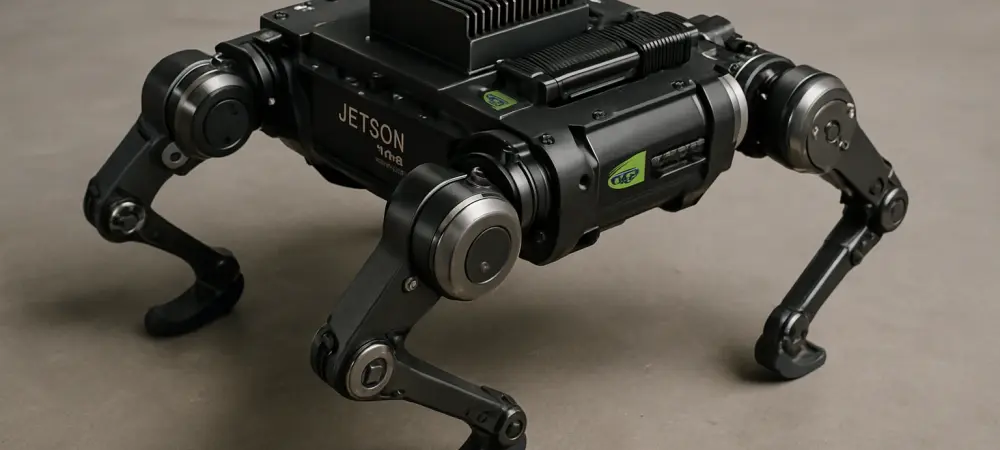
Imagine a world where robots no longer hesitate, where they can instantly analyze their surroundings, make decisions, and act without a flicker of delay, even in the most chaotic environments like bustling warehouses or high-stakes surgical rooms. This isn’t a distant dream but a reality being forged by groundbreaking advancements in on-device AI. At the forefront of this revolution stands Nvidia’s Jetson Thor, often dubbed the “robot brain,” a compact yet powerful AI computer reshaping the landscape of robotics and automation. This analysis dives deep into the transformative trend of on-device AI processing, spotlighting Jetson Thor’s technical prowess, its impact on industries, real-world applications, expert perspectives, and the future it promises for physical AI in an increasingly automated world.
The Rise of On-Device AI in Robotics with Jetson Thor
Market Demand and Performance Benchmarks
The robotics industry is witnessing an unprecedented surge in demand for on-device AI processing, driven by the need to eliminate latency and reduce reliance on cloud connectivity. Industry reports indicate that sectors like manufacturing and logistics are increasingly prioritizing autonomous systems capable of real-time decision-making, with market projections estimating a compound annual growth rate of over 20% for edge AI solutions from this year to 2027. This trend reflects a broader push for robots that can operate independently in dynamic, unpredictable settings without the delays inherent in cloud-dependent systems.
Jetson Thor addresses this demand head-on with staggering performance metrics that set a new standard in the field. Delivering 2,070 FP4 teraflops of AI compute power, it offers 7.5 times the performance of its predecessor, Jetson AGX Orin, while achieving 3.5 times better energy efficiency within a 130 W power envelope, as per Nvidia’s official specifications. These figures highlight Thor’s ability to bring data center-grade computing to the edge, enabling robots to process vast sensor data and execute complex tasks without external support.
With the Jetson AGX Thor developer kit now available as of this year, its release aligns perfectly with escalating needs across multiple sectors. Industries such as manufacturing, where robots must coordinate in real time, and logistics, where autonomous delivery systems are scaling rapidly, stand to benefit immensely. This timely introduction positions Thor as a critical tool for organizations aiming to stay competitive in an automation-driven market, promising a leap forward in operational efficiency.
Real-World Implementations and Early Innovators
Jetson Thor’s capabilities translate directly into transformative applications across diverse fields, showcasing its potential to redefine robotic functionality. In manufacturing, for instance, factory robots powered by Thor can perform intricate product inspections visually while simultaneously coordinating movements with other machines, all in real time. This multitasking ability eliminates bottlenecks that older systems faced, enhancing productivity on assembly lines.
Healthcare provides another compelling use case, where surgical robots equipped with Thor enhance precision during complex procedures. These robots can process live data from multiple sensors to assist surgeons with unparalleled accuracy, potentially reducing risks in critical operations. Early adopters like Amazon Robotics, Boston Dynamics, Caterpillar, and Medtronic are already integrating Thor into their systems, demonstrating confidence in its ability to power next-generation solutions in logistics, heavy machinery, and medical technology.
However, Thor’s design caters primarily to larger robotic systems, such as autonomous vehicles and industrial delivery bots, due to its cost and power requirements. Smaller devices like drones or compact IoT sensors may find these specifications less feasible, highlighting a limitation in its universal applicability. Despite this, for enterprises focused on robust, high-performance automation, Thor emerges as an ideal platform, setting a benchmark for what larger robots can achieve in demanding environments.
Industry Perspectives on Jetson Thor’s Influence
Expert opinions underscore the profound significance of Jetson Thor’s on-device computing power for advancing physical AI. Robotics specialists have noted that Thor’s ability to handle multiple AI models concurrently—such as vision processing and motion planning—marks a pivotal shift, allowing developers to create robots that interact with the physical world more intuitively. This capability is seen as a cornerstone for building truly autonomous machines that don’t merely follow scripts but adapt to real-world complexities.
Nvidia’s competitive edge also garners significant attention, with industry leaders pointing to its expansive ecosystem as a key advantage. With over 2 million developers and 7,000 companies already engaged with Nvidia platforms, Thor benefits from a ready-made community and seamless integration with tools like the Isaac robotics software suite. Analysts argue that this synergy of hardware and software creates a formidable barrier for competitors, positioning Nvidia as a dominant force in high-end robotics computing.
Yet, challenges remain, as experts caution about adoption hurdles tied to Thor’s $3,499 price point and 130 W power consumption. These factors could deter smaller firms or applications requiring ultra-low energy profiles, prompting discussions on tailored adoption strategies. Some suggest that larger enterprises with substantial budgets and power infrastructure will drive initial uptake, while cost reductions or scaled-down variants might broaden access in the future, shaping how different sectors leverage this technology.
Future Outlook for Jetson Thor and Physical AI
Looking ahead, Jetson Thor holds the potential to catalyze groundbreaking advancements in robotics by enabling machines that are not just autonomous but also highly responsive across varied environments. Imagine warehouse robots navigating cluttered spaces with split-second precision or retail bots personalizing customer interactions on the fly. Such developments could push the boundaries of what automation achieves, setting new standards for operational agility in unpredictable settings.
The broader implications of Thor’s capabilities extend to redefining efficiency, safety, and user experience in critical industries. In logistics, faster and smarter delivery robots could streamline supply chains; in healthcare, enhanced robotic assistants might improve patient outcomes; and in retail, interactive machines could elevate shopping experiences. These possibilities signal a future where physical AI becomes integral to everyday operations, fundamentally altering how businesses function and compete.
Nevertheless, challenges loom on the horizon, including competition from custom AI chips developed by giants like Tesla, which prioritize in-house solutions for specific needs. Additionally, balancing cost and power demands remains crucial for wider applicability, as does addressing potential disruptions from emerging rivals. While Nvidia’s current lead appears strong, the evolving landscape suggests that sustained innovation and adaptability will be essential to maintain dominance in this fast-paced field.
Key Takeaways and Next Steps
Jetson Thor stands as a transformative force in robotics, embodying the shift toward on-device AI with unmatched technical superiority and early traction among industry leaders. Its ability to deliver real-time, autonomous decision-making aligns seamlessly with the growing demand for smarter automation across manufacturing, healthcare, logistics, and beyond. This innovation marks a defining moment in the journey of physical AI, bridging the gap between theoretical potential and practical impact.
Reflecting on the strides made, it becomes evident that Thor has already begun reshaping industries by empowering robots with unprecedented independence and responsiveness. The collaboration with major players like Amazon Robotics and Medtronic has laid a strong foundation, proving the platform’s value in high-stakes applications. Yet, the path forward has its hurdles, with cost and power constraints signaling a need for strategic deployment focused on larger systems.
Moving into the next phase, businesses, developers, and innovators are encouraged to explore Thor’s capabilities to gain a competitive edge in the robotics revolution. Experimenting with tailored integrations and advocating for scalable solutions could address existing limitations, while close monitoring of market trends and competitor moves will ensure adaptability. Embracing this technology with a forward-thinking mindset has the potential to unlock new frontiers in automation, driving progress in ways that are only beginning to be imagined.