

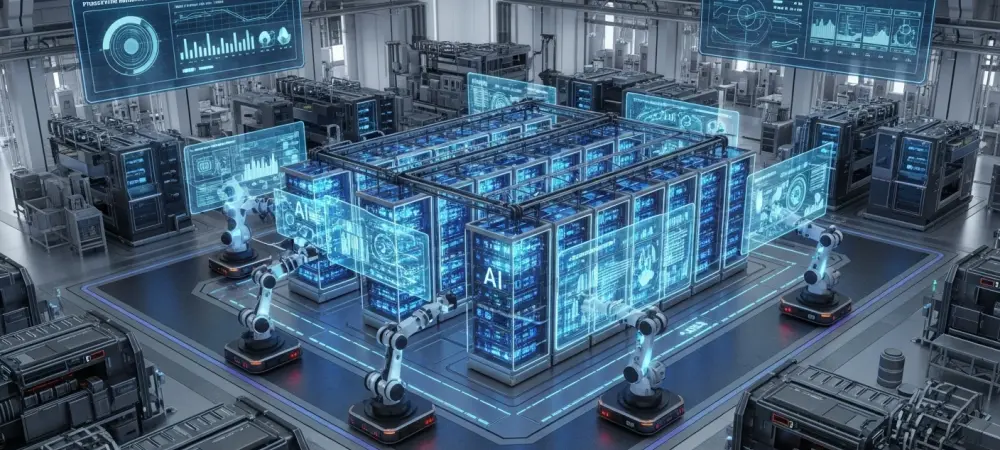
The shift of high-performance artificial intelligence from sterile, climate-controlled data centers to the unforgiving environments of the rugged industrial frontline marks a pivotal moment in technological history. This transition signifies a departure from centralized dependency, as high-density computation finds its home in the dust of mine sites and the vibration of factory floors. Localized processing is no longer a luxury but a fundamental requirement for operational continuity and real-time decision-making in sectors where every millisecond of latency translates to lost revenue or compromised safety. Modular hardware advancements now provide the backbone for this movement, enabling high-density AI to thrive where it was previously impossible.
A comprehensive look at the landscape reveals that the future of industrial autonomy depends on infrastructure that matches the intelligence of the software it hosts. This trend analysis explores how localized systems overcome environmental hostility through innovative cooling and modularity. By examining market adoption drivers and the convergence of private connectivity, one can understand the trajectory toward total operational independence. High-performance AI is leaving the climate-controlled data center for the factory floor, necessitating a rethink of how physical systems are built and maintained.
The Evolution of High-Density Edge Computing
Market Growth and the Transition to Localized Processing
The migration from cloud-based models toward edge-native deployments is driven by the sheer volume of data generated by modern industrial sensors. Decentralization trends indicate that organizations are increasingly moving away from the “send everything to the cloud” philosophy in favor of processing at the source. This shift is supported by milestones in cooling technology, specifically immersion-cooled systems like the 18.4 kW Horizon unit. These systems allow for high-density compute in a 5U form factor, providing the capacity needed for intensive AI workloads without the thermal management limitations of traditional air-cooled racks. Statistical shifts emphasize that the need for low latency and data sovereignty has made edge-centric infrastructure the standard for non-traditional environments. Bandwidth efficiency also plays a major role, as processing data locally reduces the cost and technical burden of transmitting massive datasets over satellite or cellular links. By maintaining functionality even without cloud connectivity, these localized units ensure that critical operations remain active regardless of external network stability.
Real-World Applications and Industrial Implementations
In the realm of autonomous heavy industry, mining and defense sectors are already utilizing ruggedized AI to enhance situational awareness and self-operating machinery. These systems enable vehicles to navigate hazardous terrain and identify obstacles with zero reliance on remote servers. Moreover, manufacturing and logistics sectors have deployed sophisticated computer vision for real-time defect detection. By catching production errors as they occur, companies minimize waste and maintain high-quality standards across automated warehouse environments.
Critical infrastructure, including energy grids and telecommunications, utilizes private 5G networks and edge AI to facilitate predictive maintenance. Sensors on distributed grids can detect anomalies in electrical flow or equipment temperature, triggering automated responses before a failure occurs. These case studies highlight a broader trend where the physical location of hardware no longer limits the sophistication of the software it can run.
Expert Perspectives on Industrial Autonomy and Resilience
Industry leaders argue that redefining hardware modularity is essential for locations where technical expertise is scarce and access is limited. Modular power and cooling systems allow for easier maintenance, as individual components can be replaced or upgraded without disturbing the entire unit. This flexibility is vital for remote sites that require high uptime but lack the luxury of on-site IT teams. Furthermore, experts emphasize that the sovereignty mandate requires sensitive data to be processed within local jurisdictions to comply with security regulations and protect intellectual property.
Bridging the gap between Information Technology (IT) and Operational Technology (OT) is another consensus point among professionals. Integrating AI infrastructure with existing frameworks requires standard protocols and intelligence from Programmable Logic Controllers (PLCs). By incorporating these elements into systems like Horizon, companies ensure that AI capabilities are not just added on but are deeply embedded into the fabric of industrial automation.
Future Outlook: The Next Generation of Industrial Edge AI
Scaling in harsh environments will likely see further developments in electronics that withstand extreme vibrations and temperature fluctuations. Future iterations of ruggedized hardware will focus on even higher density and smaller footprints to accommodate space-constrained locations. The convergence of edge AI and private 5G will redefine distributed network capabilities, providing a robust foundation for the next generation of interconnected devices.
The broader implications for Industry 4.0 suggest that overcoming geographical isolation through total operational autonomy will become the standard. As private connectivity becomes more prevalent, the ability to deploy AI at the extreme edge will reduce the digital divide between urban centers and remote industrial outposts. Organizations that successfully navigate these challenges will reap the benefits of increased safety and efficiency.
Conclusion: Navigating the Edge-First Era
The successful implementation of modular, high-performance infrastructure closed the gap that once existed between abstract AI theory and harsh industrial reality. Organizations that prioritized resilient edge frameworks secured a definitive advantage in safety and efficiency by ensuring that intelligence remained local and reliable. This era of decentralized intelligence proved that the physical environment was no longer a barrier to utilizing the most advanced computational power available to the modern workforce. The move toward resilient edge infrastructure emerged as a non-negotiable prerequisite for any organization seeking to maintain a competitive advantage in a fast-paced market. Leaders who embraced these decentralized solutions navigated the complexities of data sovereignty and environmental hostility with greater agility. Ultimately, the adoption of localized intelligence served as the cornerstone for a more autonomous and resilient industrial landscape, setting a new benchmark for how technology and physical labor interacted.