

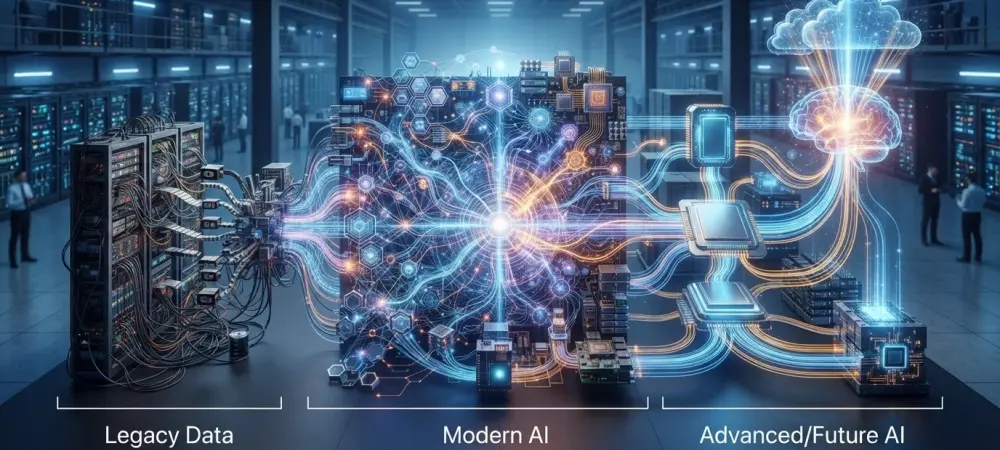
The sheer velocity at which modern autonomous agents execute complex operational workflows has effectively rendered traditional, lag-heavy data warehousing models obsolete for any enterprise seeking to maintain a competitive edge. This architectural shift is no longer a matter of technical preference but a requirement for survival. In 2026, the rise of the Streamhouse represents the culmination of a decade of data engineering evolution, finally aligning the state of the business with the speed of its logic. Software has transitioned from being a peripheral tool to becoming the very nervous system of the organization, where every millisecond of latency acts as a potential point of failure.
This paradigm shift is driven by the reality that autonomous systems do not possess the intuitive skepticism of a human operator. When a person views a dashboard, they often account for potential delays in data reporting; however, a machine-speed agent treats available data as absolute truth. Consequently, the reliance on historical batch-processing models has created a dangerous gap between the actual state of the market and the information fueling automated decisions. The Streamhouse architecture bridges this gap by ensuring that the underlying data infrastructure is as dynamic and responsive as the AI agents it supports.
When the Speed of AI Outruns the Freshness of Your Data
The Operational Risk of Autonomous Agents Acting on Stale Information
The implementation of autonomous agents across supply chains and customer service platforms has introduced a new category of operational risk. These agents are designed to execute actions without waiting for manual confirmation, which means they are entirely dependent on the “freshness” of their input data. If an agent accesses a customer profile that has not been updated to reflect a recent high-priority complaint or a change in subscription status, it may offer an inappropriate promotion or apply an incorrect discount. This lack of situational awareness transforms AI from an efficiency tool into a liability, where the speed of execution only serves to accelerate the compounding of errors.
Moving Beyond “human-in-the-loop” Buffers to Machine-Speed Execution
In previous eras of software deployment, the “human-in-the-loop” served as a critical buffer against data inaccuracies. Humans could interpret context, recognize anomalies, and halt processes if the data seemed suspicious or outdated. As organizations move toward full machine-speed execution, this safety net is disappearing. To compensate, the data architecture itself must take on the responsibility of validation and real-time consistency, ensuring that the environment the AI perceives is a perfect reflection of the current reality.
Why a Three-Minute Data Lag Can Lead to Irreversible Business Failures
The consequences of data latency are no longer measured in minor inconveniences but in irreversible business failures. A three-minute delay in updating inventory levels can lead an automated system to oversell a product during a flash sale, resulting in thousands of canceled orders and damaged brand reputation. Similarly, in the financial sector, a lag in fraud detection data can allow a series of unauthorized transactions to be processed before the system even recognizes the breach. In a world where competitors operate on real-time data, a few minutes of staleness is the difference between a successful transaction and a costly operational disaster.
The Crisis of Latency in Modern Enterprise Systems
From Back-Office Utility to Operational Fabric: The Software-Centric Business
Modern business is no longer supported by software; it is defined by it. The transition from utilizing back-office utilities to developing a software-centric operational fabric has fundamentally changed the requirements for data accessibility. In 2026, every transaction, customer interaction, and logistics movement generates a stream of data that must be immediately integrated into the broader business context. This evolution demands that data be treated as a live, flowing resource rather than a static asset to be stored and analyzed at a later date, as the business logic is now inseparable from the data it consumes.
The Limitations of Historical “batch and store” Architectures
For decades, the standard approach to data management involved “batch and store” cycles, where data was collected throughout the day and processed in large chunks during off-peak hours. While this was efficient for generating retrospective reports, it is fundamentally incompatible with the needs of modern AI. Batch systems create “dark periods” where the organization is effectively blind to recent changes, forcing AI models to operate on what is essentially ancient history. This architectural rigidity prevents businesses from responding to real-time market shifts, leaving them vulnerable to more agile competitors who have abandoned the batch mentality.
Bridging the Gap Between Retrospective Dashboards and Real-Time AI Needs
Traditional dashboards were designed to help executives look backward to understand what happened last week or last month. In contrast, real-time AI needs to know what is happening right now to decide what to do in the next second. Bridging this gap requires a total re-engineering of the data pipeline. Instead of moving data through a series of slow-moving filters and storage bins, the architecture must support a continuous flow where analytical insights and operational actions are generated simultaneously. This allows the organization to move from reactive management to proactive, automated orchestration.
Defining the Streamhouse: A Unified Architecture for “Now”
The Core Concept of a Shared, Dependable State of Business Context
The Streamhouse is defined by its ability to maintain a shared, dependable state of business context across the entire enterprise. It functions as a single source of truth that is updated in real-time, ensuring that every department and every AI agent is working from the same information. By centralizing the business logic within the stream processing layer, the Streamhouse eliminates the discrepancies that occur when different systems interpret raw data in isolation. This creates a cohesive digital environment where the “state” of an order or a customer is consistent, regardless of which application is querying it.
Pillar 1: Maintaining an Always-Current State Through Incremental Processing
A fundamental requirement of the Streamhouse is the use of incremental processing to maintain an always-current state. Rather than recomputing entire datasets from scratch, the system only processes the changes—the “deltas”—as they occur. This approach drastically reduces the computational overhead and ensures that the data is updated within milliseconds of a real-world event. By treating data as a continuous progression rather than a series of snapshots, the Streamhouse allows for “point-in-time” queries that can reflect the exact status of the business at any given moment, providing the granularity required for high-stakes AI decision-making.
Pillar 2: Respecting Decentralization and System Specialization
Despite the need for a unified state, the Streamhouse architecture respects the necessity of decentralization and system specialization. It acknowledges that different parts of a business require different tools; a high-frequency trading platform has different needs than a long-term analytical warehouse. The Streamhouse acts as the connective tissue that allows these specialized systems to communicate without forcing them into a restrictive, monolithic silo. It enables data to remain at the edge where it is generated while still being accessible and meaningful to the centralized AI models that govern global operations.
Pillar 3: Elevating Stream Processing to Mission-Critical Infrastructure Standards
In the Streamhouse paradigm, stream processing is elevated from a secondary utility to a mission-critical infrastructure standard. This means the system must provide the same levels of reliability, security, and disaster recovery as a core banking database. Organizations are now implementing rigorous schema governance and data contracts to ensure that a change in one stream does not break downstream processes. As autonomous systems become the primary drivers of revenue, the stability of the stream becomes the stability of the business itself, necessitating a shift in how engineers prioritize system uptime and data integrity.
Validating the Paradigm through Industry Adoption and Standards
Case Studies: Slashing Latency at Yelp and Orchestrating Agents at Neuron Systems
The validity of the Streamhouse model is evidenced by the dramatic results seen at major technology firms. For instance, the engineering team at Yelp successfully transitioned to a streaming lakehouse architecture, which reduced their data latency from 18 hours to mere minutes, allowing for more responsive local recommendations. Meanwhile, Neuron Systems has utilized event streams to orchestrate complex networks of autonomous agents, ensuring that every agent in the fleet is synchronized with the latest operational parameters. These examples demonstrate that the Streamhouse is not just a theoretical improvement but a proven method for enhancing operational agility and reducing costs.
The Formation of the Streamhouse Working Group and Vendor-Neutral Standards
The rapid adoption of this architecture led to the formation of the Streamhouse Working Group earlier in 2026. This consortium of industry leaders and technology vendors is focused on creating open, neutral standards that prevent vendor lock-in and encourage interoperability. By establishing common protocols for how state is managed and shared between streaming engines and storage layers, the group is ensuring that the Streamhouse remains a flexible and accessible paradigm for all enterprises. This standardization is critical for the long-term health of the ecosystem, as it allows organizations to swap out specific components of their stack without rebuilding their entire data foundation.
Expert Perspectives on Semantic Clarity and the Cost of Redundant Business Logic
Industry experts frequently emphasize that the true value of the Streamhouse lies in semantic clarity. When business logic is defined once within the streaming layer, it prevents the costly redundancy of multiple teams rebuilding the same logic in different applications. This “DRY” (Don’t Repeat Yourself) principle, applied to data engineering, significantly reduces the risk of conflicting definitions of key metrics like “active users” or “available inventory.” Furthermore, the reduction in redundant processing lowers the overall cloud compute expenditure, making the Streamhouse as much an economic breakthrough as it is a technical one.
Framework for Strategic Implementation
Identifying High-Value Domains: Customers, Inventory, and Orders
The first step in implementing a Streamhouse involves identifying the high-value domains where real-time accuracy provides the greatest return on investment. Typically, these are domains like customer experience, inventory management, and order fulfillment, where a discrepancy between data and reality has immediate financial consequences. By focusing on these core entities, organizations can build a foundation that supports the most critical AI workflows. Starting with a narrow but deep implementation allows the technical team to prove the value of the architecture before expanding it to more peripheral parts of the business.
The Four-Question Audit for Data Ownership and Requirements
Before deploying the technical stack, architects should conduct a four-question audit to clarify data ownership and requirements. They must determine which system is the ultimate authority for the data, what specific business rules govern its interpretation, whether redundant logic exists across teams, and what the minimum freshness requirement is for each consumer. Answering these questions ensures that the Streamhouse is built with a clear understanding of the organizational context, preventing the “data swamp” problem that plagued earlier generations of data lakes. This audit serves as the blueprint for how data flows and who is responsible for its quality.
Building the Stack: From Durable Streams and Stateful Engines to Open Table Standards
Constructing a Streamhouse requires the integration of several key components: durable streams for event logging, stateful engines like Apache Flink for continuous computation, and open table formats like Apache Iceberg for storage. These tools work in concert to capture every change event, process it according to business logic, and store the resulting state in a format that is accessible to both real-time agents and historical analysts. Since 2026, the focus has shifted toward ensuring these components are highly integrated, allowing for seamless movement of data between the streaming and serving layers without the need for complex, manual ETL processes.
Transitioning From Raw Event Logs to Actionable Business Context
The final phase of implementation is the transition from managing raw event logs to providing actionable business context. A Streamhouse does not just deliver a list of “what happened”; it delivers an updated view of “what is.” This distinction is vital for AI, as it allows the model to interact with refined entities—like a complete customer profile—rather than having to aggregate thousands of individual events on the fly. By shifting the heavy lifting of state aggregation into the Streamhouse, the organization empowers its AI agents to act with greater precision and lower latency, finally fulfilling the promise of the software-defined enterprise. The transition to the Streamhouse model marked a significant turning point in the history of data management, ensuring that the state of the business remained permanently synchronized with the speed of innovation. Organizations that recognized the limitations of batch-processing early in 2026 successfully avoided the operational bottlenecks that hindered their slower competitors. They established clear governance frameworks that prioritized data freshness as much as data volume. This shift allowed engineers to move away from the reactive troubleshooting of stale reports and toward the proactive design of real-time systems. As the industry moved toward standardized protocols, the integration of autonomous AI into daily operations became more reliable and secure. These steps effectively redefined the standard for modern enterprise architecture, ensuring that the state of the business remained permanently synchronized with the speed of innovation.