

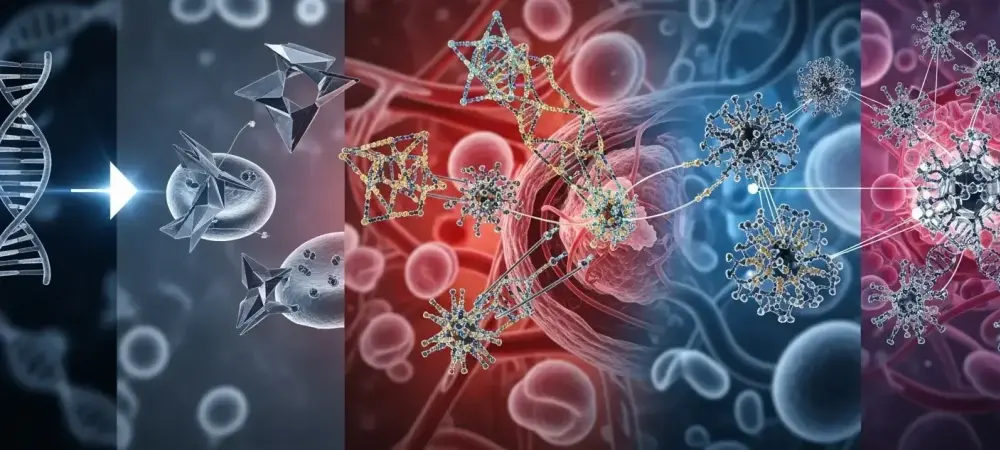
Dominic Jainy is a forward-thinking IT professional whose expertise sits at the intersection of artificial intelligence, machine learning, and blockchain. With a profound interest in how emerging technologies reshape traditional industries, he has become a leading voice in the evolution of molecular-scale engineering. His work explores the transition from rigid mechanical systems to adaptive, biological frameworks that promise to revolutionize both medicine and computing. In this conversation, we delve into the mechanics of DNA nanotechnology, the challenges of engineering at the nanoscale, and the transformative role of AI in designing the biological robots of tomorrow.
The discussion covers the shift from metallic to biological construction materials, the sophisticated methods used to trigger motion in nanostructures, and the precision required for targeted drug delivery. Dominic also explores the parallels between DNA architecture and silicon-based computing, the physical hurdles of molecular motion, and how massive genetic datasets are accelerating innovation.
Traditional robots are typically made of metal and plastic, but molecular robotics utilizes DNA as a programmable construction material. How does switching to biological molecules change the design of joints and actuators, and what specific advantages does this provide when navigating the complex environment of the human body?
Transitioning to DNA as a building block fundamentally redefines our “mechanical toolkit” by utilizing the inherent properties of deoxyribonucleic acid. In traditional robotics, you deal with rigid metals and chips, but at the nanoscale, we use single-stranded DNA for flexibility and double-stranded sections to provide rigid structural support. This allows us to create biological joints and actuators that are not only 1/500th to 1/1000th the width of a human hair but are also natively compatible with the body’s chemistry. Because these machines are made of the same material that runs through our veins, they can operate seamlessly within biological environments without triggering the rejection responses a plastic or metal device might encounter. It is a shift from forcing a machine into a biological space to building a machine that is part of that space.
DNA origami allows for folding strands into specific geometries like cages and gears. When designing these nanostructures, how do you implement biochemical “fuel” sequences to trigger mechanical movement, and what are the primary trade-offs between chemical control and external physical signals like magnetic fields?
The movement in these structures is often achieved through a process called DNA strand displacement, where a “fuel” strand literally kicks another strand out of its position to act as a molecular switch. This chemical approach is incredibly precise and versatile for individual tasks, but it does produce waste molecules and often requires extensive experimental screening to get right. On the other hand, we can use external signals like light, heat, or magnetic fields to trigger motion much faster across a large population of robots. The trade-off is that while physical signals are rapid, they lack the “joint-level” independent control that chemical fuel sequences provide, making it a constant balancing act between speed and granular accuracy.
Molecular machines have demonstrated the ability to capture viruses or deliver clotting drugs specifically to tumor blood vessels. Could you walk us through the step-by-step process of how these robots identify a diseased cell target and the mechanisms they use to release a payload without affecting healthy tissue?
The process begins with “mechanical programmability,” where the robot is designed to remain in a closed or inactive state until it encounters a specific biological marker. For instance, in a study involving SARS-CoV-2, flexible DNA fingers were designed to recognize and capture the virus from saliva within just 30 minutes, performing as accurately as a standard lab test. For drug delivery, the robot travels through the bloodstream until it detects the unique environment of a tumor’s blood vessels; only then does the structure “unfold” to release its payload, such as a clotting drug. This autonomous targeting ensures that healthy tissues are bypassed, drastically reducing the side effects typically associated with systemic treatments.
Beyond healthcare, DNA robots are being explored for ultra-dense data storage and molecular computing. What does the physical architecture of a DNA-based storage system look like compared to traditional silicon chips, and what milestones must be reached before this technology is viable for commercial computing?
The physical architecture of DNA storage is far more three-dimensional and dense than the flat, layered world of silicon chips, utilizing DNA as a template to arrange nanoparticles and light sources into ordered patterns. We have already seen experiments where chemical marks are “printed” onto synthetic DNA to encode images without the need to write every single base from scratch, which is a massive leap in efficiency. However, for this to become commercially viable, we must overcome the massive hurdle of scale and cost-effectiveness. We need to reach a milestone where we can produce billions of identical, high-yield machines and develop more sophisticated computational modeling tools that can reliably predict how these structures behave at the 100-nanometer scale.
Random molecular motion and thermal fluctuations often disrupt the behavior of machines at the 100-nanometer scale. What specific engineering strategies help stabilize movement against Brownian motion, and how can manufacturing processes be scaled to produce billions of identical, high-yield DNA machines for real-world use?
At the nanoscale, Brownian motion—the random, chaotic jostling of particles—is a constant adversary that can easily knock a simple machine off course. To stabilize movement, we are moving away from simple, isolated designs toward advanced modularity and translating macroscale mechanical principles, like firm joints and origami-inspired folding, to the molecular level. Scaling this up requires a total revolution in bio-manufacturing that can produce these complex shapes with high fidelity and low cost, which is currently one of the field’s greatest bottlenecks. We are essentially trying to move from “crafting” individual molecules in a lab to “printing” them by the trillions in a factory-like setting.
AI and large-scale genetic datasets are now being used to predict folding pathways and optimize DNA sequence configurations. How do these computational tools accelerate the innovation cycle for nanorobotics, and what role do simulation models play in preventing structural failures before a physical prototype is synthesized?
AI and Large Language Models are transformative because they can uncover structural patterns within massive datasets that a human researcher might miss, such as the 5-billion-cell atlas currently being developed. These tools allow us to simulate and analyze the dynamics of a DNA machine, predicting exactly how it will fold and move before we ever spend a cent on physical synthesis. By automating the design evaluation process, we can filter out thousands of “structural failures” in a digital environment, which significantly shortens the time it takes to move from a theoretical concept to a functional biological prototype. It effectively turns the slow, trial-and-error process of molecular biology into a high-speed engineering discipline.
What is your forecast for DNA robotics?
I believe we are entering an era where medicine will be “intelligently executed” from the inside out, rather than applied from the outside in. Within the next decade, the convergence of AI and DNA nanotechnology will likely lead to the creation of standardized “parts libraries” that allow us to snap together nanorobots for custom tasks as easily as we write software today. While the field is currently in its proof-of-concept stage, the move toward personalized, genomics-driven medicine is already gaining massive financial momentum, with companies like Illumina seeing billions in revenue and 74% stock growth as they build the sequencing backbone for this revolution. My forecast is that DNA robots will eventually transition from being laboratory curiosities to becoming the primary tools for non-invasive “nano-surgery” and ultra-high-density data storage, fundamentally blurring the line between biology and technology.