

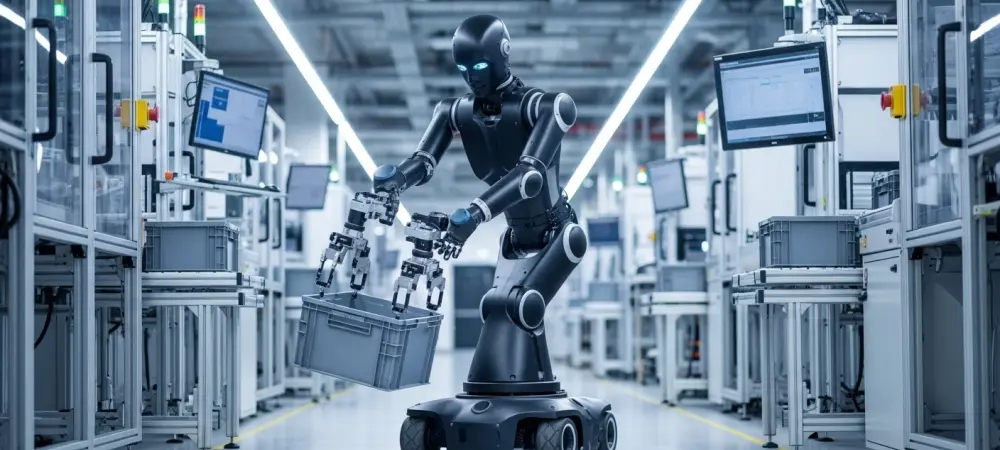
The successful integration of autonomous humanoid technology at the Siemens electronics plant in Erlangen represents a significant shift from digital simulation to tangible industrial utility. This deployment of the HMND 01 Alpha robot marks a transition where physical AI is no longer confined to experimental laboratories but is actively contributing to high-output production environments. Developed in collaboration with the U.K.-based firm Humanoid and powered by Nvidia’s advanced AI stack, this project serves as a definitive case study for the next generation of manufacturing. The relevance of this initiative lies in its ability to solve long-standing bottlenecks in factory logistics and labor availability. By integrating autonomous humanoid units into existing workflows, Siemens aims to prove that these machines can handle complex, unstructured tasks once reserved for humans. This analysis explores how the convergence of advanced hardware, real-time simulation, and edge computing is creating a new blueprint for the factory of the future.
Tracing the Evolution: From Fixed Arms to Humanoids
Historically, industrial automation was defined by stationary robotic arms bolted to factory floors, programmed to perform repetitive, highly predictable tasks. While efficient, these systems lacked the flexibility to navigate changing environments or handle diverse objects without significant re-engineering. The shift toward humanoid robots reflects a broader industry trend where machines must perceive, reason, and act in spaces designed for human occupancy.
These background developments are rooted in the increasing complexity of global supply chains and a shrinking manufacturing workforce. As production demands become more customized and fast-paced, the foundational concepts of fixed automation have become insufficient. The move toward a humanoid form factor—specifically one equipped with wheels and advanced manipulators—allows for a more versatile tool that integrates into existing infrastructure without requiring a total redesign of the plant.
Integrating Advanced Robotics into Modern Production Lines
Technical Synergies: Nvidia’s AI Stack and Siemens’ Xcelerator
The success of the HMND 01 Alpha is largely due to the deep integration of hardware and software through the Siemens Xcelerator platform and Nvidia’s AI infrastructure. By utilizing the Nvidia Jetson Thor edge computing platform, the robot possesses the onboard processing power required for real-time decision-making. Furthermore, Siemens maintains a live digital twin of the Erlangen facility, allowing the robot to navigate with a high degree of spatial awareness. This synergy enables the use of reinforcement learning through advanced simulation tools, where the robot practices tasks millions of times in a virtual environment before ever touching a physical object. The primary benefit is a drastic reduction in deployment time and an increased ability to adapt to new container types or obstacles. However, the challenge remains in ensuring that these virtual simulations translate perfectly to the reality of a live factory floor, where lighting and human movement are constantly changing.
Performance Metrics: Operational Success in High-Demand Environments
During the initial trials, the HMND 01 Alpha demonstrated that humanoid robots can meet the rigorous throughput requirements of a modern electronics plant. The robot achieved a consistent performance of 60 moves per hour, maintaining a success rate of over 90 percent. Perhaps most importantly, the unit proved capable of continuous operation for more than eight hours, demonstrating its endurance throughout a standard work shift.
These metrics provide a compelling argument for the viability of humanoid systems as autonomous partners. While traditional automated guided vehicles can move goods from point to point, the HMND 01 Alpha can perform pick and place tasks, effectively bridging the gap between transportation and manual handling. Comparative analysis suggests that while specialized machines might be faster at a single task, the humanoid’s versatility offers a higher long-term return on investment.
Overcoming Structural Challenges: Scaling Complex Infrastructure
Despite the success in Erlangen, the deployment of humanoid robots introduces unique complexities, ranging from regional regulatory standards to the physical constraints of older industrial sites. Siemens addressed these challenges by utilizing an omnidirectional wheeled base, which provides better stability and mobility in tight factory aisles than bipedal walking systems might offer in an industrial context.
Industry patterns suggest that a common misconception is that these robots are intended to replace human workers entirely. In reality, they are being deployed to address severe labor shortages and to take over ergonomically taxing or mundane tasks. By debunking the myth of total human displacement, Siemens and its partners are focusing on a human-centric automation model where the robot acts as a reliable assistant, allowing human personnel to focus on quality control.
The Future of Adaptive Manufacturing and Autonomous Labor
The successful trial in Germany is a precursor to a wider shift toward fully AI-driven, adaptive manufacturing sites. Emerging trends suggest that future factories will not be static environments but dynamic ecosystems where robots and humans share the same workspace without safety cages. As AI models become more sophisticated, we can expect robots to transition from executing commands to understanding intent, allowing them to collaborate through natural language. From an economic perspective, the mass adoption of humanoid robots could reshape global manufacturing footprints. Companies may choose to bring production back to high-cost regions as the productivity gains from AI labor offset higher overhead costs. Regulatory changes regarding machine safety and AI ethics will likely follow, setting new international standards for how autonomous systems must behave in public and professional spheres.
Strategic Considerations: Implementing Humanoid Solutions
For businesses looking to follow this lead, the major takeaway is the importance of a digital-first strategy. Investing in digital twin technology is no longer optional; it is the prerequisite for training and deploying reliable physical AI. Companies should start with small-scale pilots in controlled logistics environments—such as container management—before attempting to automate more intricate assembly processes.
Actionable recommendations include prioritizing the interoperability of software stacks. The collaboration between Siemens, Nvidia, and Humanoid illustrates that no single company can solve the robotics puzzle alone; success requires a modular approach where simulation, edge computing, and hardware are linked. Professionals in the field should focus on upskilling in robot orchestration, as the role of the manager evolves into that of a fleet supervisor for autonomous systems.
Paving the Way for the Next Industrial Revolution
The deployment in Erlangen confirmed that the era of industrial humanoid robots had arrived. By combining industrial expertise with computational power, the project demonstrated that autonomous machines were able to meet the high-stakes demands of a live production environment. The results showed that these systems were not merely futuristic concepts but practical tools for immediate use. This transition established a foundation for a new industrial revolution where the line between digital intelligence and physical labor became increasingly blurred. Leaders identified that the focus must now turn toward creating standardized communication protocols between different robotic fleets to ensure safety. For manufacturers worldwide, the message remained clear: the future of production was defined by machines that were autonomous, adaptive, and increasingly humanoid.