

Every so often, a piece of hardware arrives that aims not merely to raise the bar for performance but to launch it into an entirely different stratosphere, challenging what enthusiasts believe is possible.
Is the Astral 5080 the New King of 4K Gaming?
The ASUS ROG Astral RTX 5080 enters the market as a flagship custom-designed graphics card, a testament to engineering pushed to its limits. This review seeks to determine if its elite performance, premium cooling, and striking aesthetic design justify a significant price increase over the Founders Edition and competing models. For enthusiast gamers and content creators, the central question is whether this investment translates into a tangibly superior experience.
Unboxing a Celestial Beast: Design and Core Specifications
The white edition of the ROG Astral makes a statement before it is even installed. Its pristine white shroud, constructed from a mix of brushed metal and high-quality polymers, creates a visually stunning centerpiece for any build, accented by subtle, customizable RGB lighting. This aesthetic appeal is built upon a foundation of formidable technology, featuring the latest GPU architecture, a generous pool of GDDR7 VRAM, and aggressive factory boost clocks powered by a robust power delivery system.
At the heart of the card’s design is an advanced ROG cooling solution. A massive custom heatsink, interwoven with a network of heat pipes and a large vapor chamber, works in concert with newly designed axial-tech fans. This intricate system is engineered not only to dissipate immense heat efficiently but also to operate with a near-silent acoustic profile, ensuring that performance is not achieved at the expense of a quiet gaming environment.
Putting the Astral to the Test: Real-World Performance Benchmarks
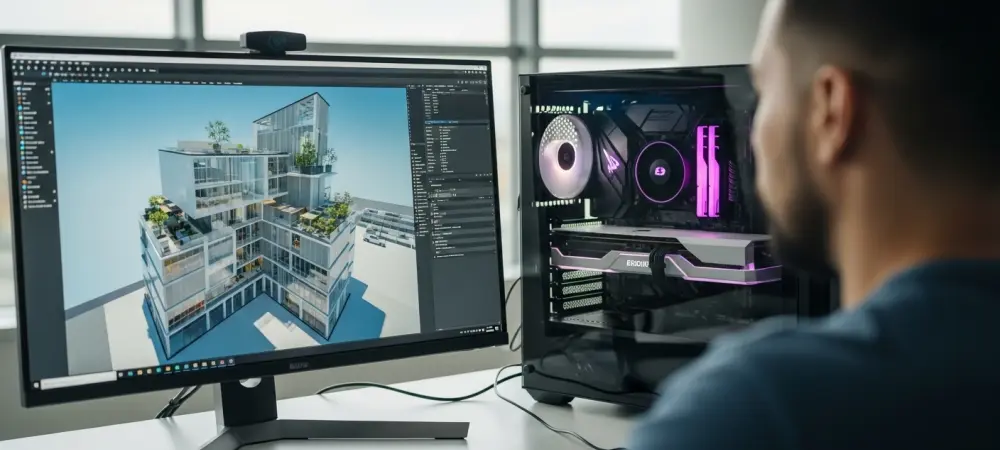
In a suite of demanding modern AAA titles, the Astral RTX 5080 consistently delivered exceptional 4K gaming performance. It maintained high average frames per second and impressively stable 1% lows, even with all graphical settings maxed out, providing an incredibly smooth and immersive visual experience. The card’s prowess extended to ray tracing, where it rendered complex lighting and reflections with ease, further enhanced by the significant performance uplift from the latest DLSS technologies. Beyond gaming, the Astral proved to be a formidable tool for creative professionals, dramatically reducing render times in applications like Blender and accelerating export processes in Adobe Premiere Pro. Throughout these intense workloads, the custom cooling system performed admirably, keeping thermal output well within optimal ranges while maintaining remarkably low noise levels, confirming the effectiveness of its sophisticated design.
The Highs and Lows: Strengths and Weaknesses
The primary advantages of the ROG Astral are undeniable. It offers class-leading 4K and ray tracing performance that sets a new benchmark for consumer graphics. This power is managed by a remarkably effective and quiet cooling system, all housed within a chassis that exudes premium build quality and offers superior overclocking headroom for those who wish to push the limits even further.
However, this level of excellence comes with significant drawbacks. The most prominent is the exorbitant price point, placing it far beyond the reach of most mainstream consumers. Furthermore, its large physical dimensions demand a spacious case with ample clearance, and its high power consumption necessitates a potent, high-wattage power supply, adding to the overall cost of a compatible system.
The Final Verdict on the ROG Astral RTX 5080
The ASUS ROG Astral RTX 5080 stands as an absolute powerhouse, successfully delivering on its promise of uncompromising performance. The synthesis of its raw graphical power, an exceptionally well-engineered cooling solution, and a premium physical design creates a product that excels in every metric.
Its performance in both 4K gaming and demanding creative applications is nothing short of spectacular. While its cost is substantial, the card represents the pinnacle of what is currently achievable in a consumer-grade GPU. For those whose goal is to build a system with no compromises, the ROG Astral makes a compelling case for its premium price tag.
Who Should Buy This Premium Powerhouse?
Ultimately, the decision to purchase the ROG Astral RTX 5080 comes down to a simple yet critical calculation of priority versus cost. The ideal user is the no-compromise enthusiast who values peak performance, superior cooling, and premium aesthetics above all else. For this specific audience, the card represents a worthwhile, if extravagant, investment. In contrast, budget-conscious gamers should consider more cost-effective alternatives that deliver a significant portion of the performance at a more accessible price point.