

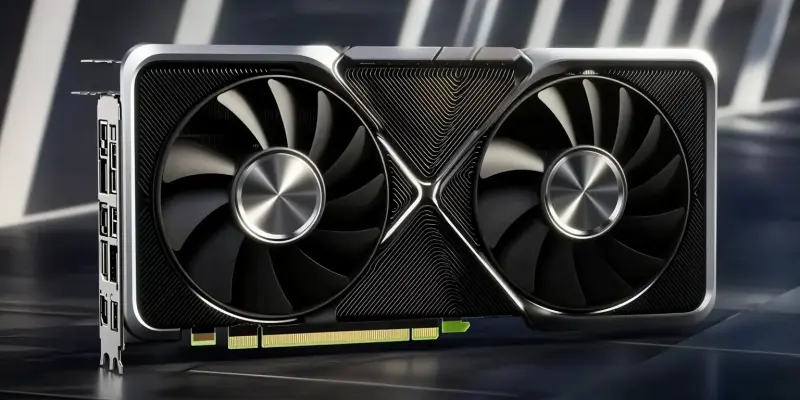
Nvidia’s latest move in the professional graphics card market is making waves as it reduces prices for its RTX Pro 6000 Blackwell Series. These state-of-the-art GPUs, initially listed at $8,435, are now available for as little as $7,673. This strategic price adjustment aims to make the top-tier graphics cards more accessible to professionals and enhance Nvidia’s market penetration. This pricing strategy is expected to bolster Nvidia’s competitiveness in a rapidly evolving industry, making these high-end graphics solutions more obtainable for professionals seeking cutting-edge performance without incurring exorbitant costs.
These moves are not just about reducing prices. Nvidia has also introduced various configurations of the RTX Pro 6000 Blackwell series to cater to diverse market segments. The range includes the server version, which is set to be bundled exclusively with complete server systems, ensuring that enterprises can directly benefit from Nvidia’s advanced technologies. Additionally, the Max-Q version is designed for high-efficiency environments, sacrificing a small amount of performance for significant reductions in power consumption. This approach demonstrates Nvidia’s commitment to addressing the unique needs of different sectors within the professional market, providing tailored solutions that balance performance and efficiency.
Diverse Configurations to Meet Varied Needs
Nvidia’s diverse configuration strategy is particularly compelling, with the Max-Q version of the RTX Pro 6000 Blackwell garnering attention among professionals seeking high efficiency. This variant offers slightly reduced performance, approximately 10% less than the standard model, but it is offset by a dramatic 50% reduction in power consumption. This makes the Max-Q version an ideal choice for multi-GPU systems where overall efficiency is paramount. By offering such distinct variations, Nvidia ensures that its product lineup can meet a broad spectrum of professional requirements, from those needing maximum computational power to those prioritizing efficiency and sustainability.
Furthermore, the server version of the RTX Pro 6000 Blackwell series is speculated to be available exclusively as part of complete server bundles. This move underscores Nvidia’s focus on providing integrated solutions that deliver high performance out of the box, without requiring additional standalone purchases. Bundling the server version with complete systems ensures that enterprises can seamlessly incorporate Nvidia’s powerful GPUs into their existing infrastructure, enhancing their computational capabilities without the need for complex installations or configurations. This approach not only simplifies deployments but also reinforces Nvidia’s value proposition in the enterprise market.
Expanding Product Portfolio
In addition to the RTX Pro 6000, Nvidia has expanded its product portfolio with several new models in the RTX Pro series, including the somewhat underpowered RTX Pro 2000. Although it offers less memory and lower power specifications compared to its predecessor, the RTX 2000 Ada Generation, the RTX Pro 2000 remains a viable option for professionals looking for a more cost-effective solution. This model is designed to strike a balance between affordability and capability, making it accessible to a wider range of users without compromising too heavily on performance. As such, it caters to those needing reliable performance for less intensive tasks while maintaining a strong price-to-performance ratio.
The enhanced models within the series, such as the RTX Pro 4000, 4500, and 5000, illustrate significant improvements over their predecessors. These GPUs feature advancements in power efficiency, increased CUDA core counts, and better memory bandwidth, reflecting Nvidia’s ongoing commitment to pushing the boundaries of GPU performance and efficiency. These enhancements ensure that professionals across various fields can achieve higher levels of productivity and performance. Nvidia’s strategy to offer a diverse range of models addresses the evolving needs of the market, providing tailored solutions that deliver superior performance across different professional applications.
Strategic Pricing for Better Market Positioning
A standout feature in Nvidia’s pricing strategy is the competitive positioning of the RTX Pro 4000, which is priced at $1,407. This is notably lower than the previous generation RTX 4500 AG, which was priced at $2,139. Despite the reduced cost, the RTX Pro 4000 offers improved performance metrics, including better power efficiency and a higher CUDA core count. This positioning makes it an attractive option for professionals seeking powerful graphics solutions at a more affordable price point. It underscores Nvidia’s effort to make advanced technology accessible, ensuring that more users can benefit from enhanced performance without facing prohibitive costs.
Similarly, the RTX Pro 5000 is competitively priced at $2,268, offering substantial improvements over its predecessor, the RTX 5000 AG, which was priced at $3,742. The new model boasts lower power consumption and higher memory bandwidth, aligning with Nvidia’s vision of delivering high performance while maintaining cost-effectiveness. This makes the RTX Pro 5000 an excellent choice for professionals who need robust computational power without the hefty price tag. By strategically pricing these models, Nvidia reinforces its commitment to providing value-packed options that cater to a broad spectrum of professional needs.
Performance Gains and Market Leadership
Nvidia has significantly impacted the professional graphics card market by reducing prices on its RTX Pro 6000 Blackwell Series. Originally priced at $8,435, these advanced GPUs are now available for as low as $7,673. This strategic price cut is meant to make top-tier graphics cards more affordable for professionals, aiming to enhance Nvidia’s market share. This pricing strategy is expected to boost Nvidia’s competitiveness in a quickly evolving industry, providing high-end graphics solutions to professionals looking for cutting-edge performance without outrageous costs.
But Nvidia’s moves go beyond just slashing prices. The company has launched multiple configurations of the RTX Pro 6000 Blackwell series to meet diverse market needs. This range includes a server version, bundled exclusively with complete server systems, allowing enterprises to harness Nvidia’s advanced technologies. Additionally, the Max-Q version is tailored for high-efficiency environments, offering slight performance reductions to achieve significant power savings. Nvidia’s approach emphasizes its dedication to meeting the varying needs of professionals, providing tailored solutions that balance performance and efficiency perfectly.