

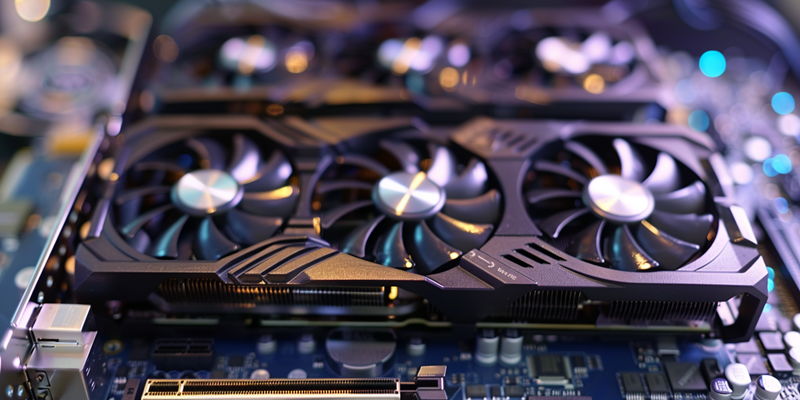
In the fiercely competitive world of gaming hardware, China’s Moore Threads is making waves by dramatically improving the performance of its MTT S80 gaming GPU through dedicated driver optimizations. Not long ago, the MTT S80 was struggling to rival the performance of older-generation GPUs, such as NVIDIA’s GTX 1050. However, the landscape has shifted with Moore Threads’ assertive push on software enhancements. Recent reports indicate that these updates have been nothing short of transformative, doubling the GPU’s performance in relatively short order.
The momentum of progress for the MTT S80 is evident in the leaps and bounds made in popular game titles. For example, the beloved game Genshin Impact now smoothly operates at an impressive 50-60 frames per second at full HD resolution, which would have been unthinkable for the S80 just the previous year. Similarly, staples like League of Legends now achieve soaring frame rates of 380-410 FPS at 1080p. These real-world enhancements are confirmed by the GPU’s significantly improved synthetic benchmark scores, which signal a resounding shift in its competitive standing.
A Leap Forward in Gaming Performance
Synthetic benchmarks, often a bellwether for a GPU’s potential, underscore the MTT S80’s growth spurt, with the GPU scoring a notable 8617 points in 3DMark Fire Strike—a doubling of its prior prowess. This escalation of capability is largely owing to massive improvements brought about by the latest 260.70 driver. These optimizations have not only boosted the S80’s game compatibility but have also fine-tuned its overall performance.
The enhanced MTT S80 is more than a match for many of its contemporaries, flaunting a unique position as the world’s sole truly PCIe 5.0 compatible card. The 16 GB GDDR6 memory and the formidable suite of 4096 MUSA cores operating at a robust 1.8 GHz clock speed mark it as a technological marvel. Despite the commendable leaps made, Moore Threads continues to operate in the shadows of the titans like NVIDIA and AMD. Nevertheless, the Chinese manufacturer’s commitment to performance enhancement is a telltale sign of its potential to disrupt the market status quo.
Commitment to Driver Optimization
In the cutthroat arena of gaming technology, Moore Threads has caused a stir with the performance boost to its MTT S80 gaming GPU, thanks to driver optimizations. Initially, the S80 lagged behind older GPUs like NVIDIA’s GTX 1050 in terms of capability. But with an aggressive approach to software upgrades, its fortunes have taken a sharp turn. These enhancements have doubled the GPU’s output in a short span.
The upward trajectory is clear when looking at how the MTT S80 handles gaming favorites. The hit title Genshin Impact, previously a challenge, now runs between 50-60 FPS at 1080p resolution on the S80—an outcome that seemed unlikely just a year prior. Additionally, games like League of Legends are reaching new heights with 380-410 FPS at the same resolution. These practical gains in performance are matched by the GPU’s significantly better benchmark scores, marking a decisive turnaround in its market position.