

Setting the Stage for Modern IT Infrastructure
In an era where data drives every facet of healthcare, from patient records to real-time diagnostics, the pressure on IT infrastructure has never been greater, and hospitals and trusts face the daunting challenge of managing escalating data volumes while ensuring uninterrupted service and stringent security. Modular data centers have emerged as a transformative solution, offering rapid deployment and scalability to meet these demands. This review delves into the capabilities of modular data center technology, spotlighting its role in revolutionizing healthcare IT systems with a focus on sustainability and efficiency.
The urgency for such innovation is evident as traditional data centers struggle with high energy costs and lengthy setup times. Modular solutions promise a way forward by providing pre-engineered, customizable setups that can adapt to specific organizational needs. With industries like healthcare at the forefront of digital transformation, understanding the potential of this technology becomes paramount for stakeholders aiming to balance operational excellence with environmental responsibility.
In-Depth Analysis of Features and Performance
Scalable Architecture for Dynamic Needs
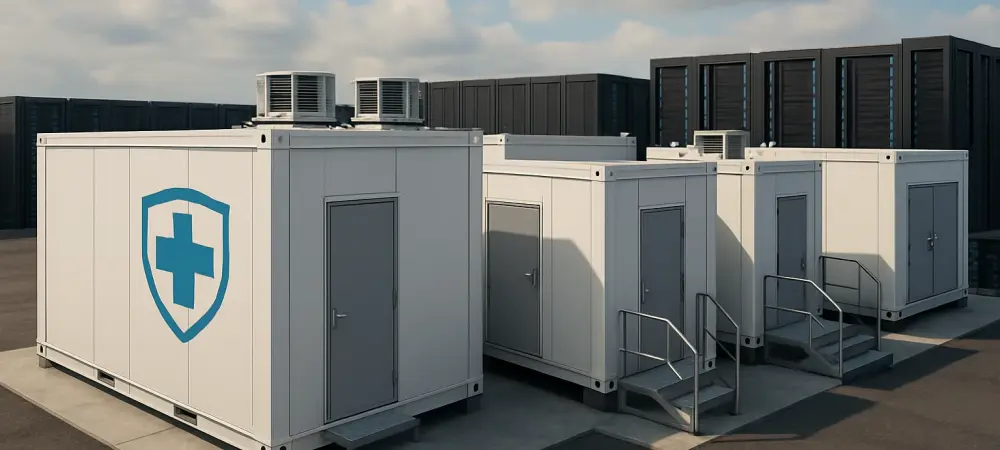
Modular data centers stand out due to their inherent flexibility, designed with a scalable architecture that allows organizations to expand capacity as demand grows. Unlike conventional setups requiring extensive overhauls, these systems incorporate pre-engineered components such as racks and power units, facilitating swift adjustments. This adaptability proves crucial in healthcare settings where IT requirements can shift rapidly due to patient influx or regulatory changes.
The streamlined deployment process further enhances their appeal. Components arrive ready for assembly, significantly cutting down installation timelines compared to traditional builds. For institutions needing to maintain pace with technological advancements, this feature ensures minimal disruption while scaling operations, a key advantage in maintaining service continuity.
Energy Efficiency as a Core Strength
A defining characteristic of modular data centers lies in their focus on energy conservation, integrating technologies like modular cooling units and advanced uninterruptible power supplies (UPS). These systems are engineered to optimize power consumption, often achieving impressive Power Usage Effectiveness (PUE) metrics. For instance, implementations have recorded PUE values as low as 1.2, reflecting substantial reductions in energy waste.
This emphasis on sustainability aligns with broader environmental goals, particularly in sectors under pressure to lower carbon footprints. By minimizing electricity usage—sometimes by up to 60% compared to older server rooms—these solutions not only reduce operational costs but also contribute to greener practices, an aspect increasingly prioritized by regulatory bodies and public expectations.
Reliability for Critical Operations
Ensuring uptime remains a cornerstone of modular data center design, especially for critical applications in healthcare where data integrity is non-negotiable. Features such as integrated power distribution units (PDUs) and robust backup systems safeguard against disruptions, maintaining operational continuity even during unforeseen events. This reliability is vital for hospitals managing sensitive patient information and life-saving systems.
Beyond hardware, the incorporation of real-time monitoring tools enhances system resilience. Leveraging Internet of Things (IoT) and artificial intelligence (AI), these centers can predict and address potential failures before they escalate. Such proactive management underscores their suitability for environments where every second of downtime can have significant consequences.
Real-World Impact in Healthcare
Examining specific deployments reveals the tangible benefits of modular data centers in healthcare settings. A notable example involves a $1.8 million collaboration between Schneider Electric and DataCentre UK for South Warwickshire University NHS Foundation Trust (SWFT). This project deployed two modular centers to support IT infrastructure across four hospitals, utilizing Schneider Electric’s EcoStruxure solutions for enhanced configurability. The results speak volumes about performance, with SWFT achieving a remarkable 60% reduction in electricity consumption alongside a PUE of 1.2. This case highlights how tailored modular designs can address unique operational challenges, ensuring both efficiency and resilience in handling critical healthcare data, setting a benchmark for similar initiatives.
Reflecting on the Journey and Looking Ahead
Having explored the intricacies of modular data center technology, it becomes clear that these solutions deliver exceptional value in modernizing IT infrastructure. Their ability to scale effortlessly, coupled with significant energy savings, positions them as a game-changer for industries like healthcare. The SWFT project stands as a testament to their potential, demonstrating measurable improvements in efficiency and system reliability.
Moving forward, the focus should shift toward addressing adoption barriers such as high initial costs and integration complexities with existing systems. Strategic partnerships with technology providers will be essential to tailor solutions that meet specific regulatory demands, particularly in healthcare. Additionally, continued investment in innovations like waste heat repurposing could further elevate their sustainability profile.
As the technology matures, stakeholders should prioritize pilot programs to test modular setups in diverse scenarios, gathering data to refine deployment strategies. Collaboration across NHS trusts could foster shared learning, accelerating the transition to energy-efficient, resilient IT frameworks. This path promises not only operational advancements but also a commitment to environmental stewardship in the digital age.