

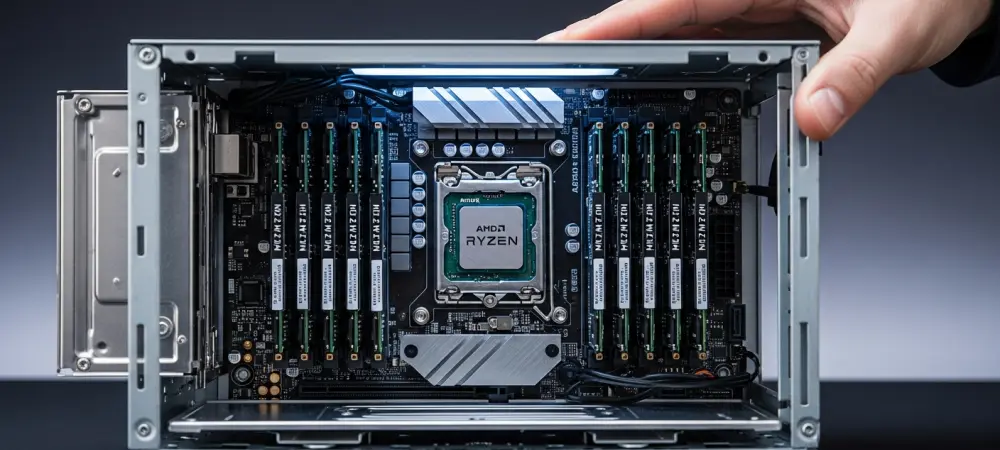
The landscape of home computing is undergoing a fundamental transformation as manufacturers move away from simple media servers toward specialized hardware designed to anchor local artificial intelligence ecosystems. The Minisforum N5 Max represents a bold pivot for a brand traditionally known for its diminutive desktop workstations, now venturing into the high-stakes world of on-premises AI and advanced data management. By integrating a high-capacity Network Attached Storage (NAS) framework with a dedicated AI workload hub, this hybrid machine offers a compelling alternative to cloud-dependent services. Technical enthusiasts and growing enterprises alike are increasingly seeking ways to maintain sovereignty over their datasets while minimizing the latency that inevitably accompanies remote server processing. Localizing large language models on hardware like the N5 Max ensures that sensitive information never leaves the physical premises, providing a level of security and control that is becoming indispensable in an era where data privacy is at a premium.
Driving the impressive computational capabilities of this machine is the AMD Ryzen AI Max+ 395 processor, a sixteen-core powerhouse utilizing the sophisticated Strix Halo architecture. This silicon is specifically engineered to handle the parallel processing requirements of modern generative models without needing a massive, power-hungry discrete graphics card. The standout feature of this internal hardware is the sixty-four gigabytes of unified memory, which provides the necessary capacity to load complex AI models that would typically exceed the memory limits of consumer-grade hardware. This shared memory pool offers a distinct advantage over traditional systems, ensuring the hardware does not hit a performance wall during memory-intensive inference tasks. By allowing the CPU and GPU to draw from the same massive reservoir of RAM, the system maintains high efficiency, effectively bridging the gap between standard office PCs and professional-grade AI workstations.
Industrial Connectivity and Tiered Storage Capacity
High-Speed Networking and Port Selection
To handle the massive data transfers required for modern training sets, the N5 Max includes dual 10GbE Ethernet ports and two high-bandwidth USB 4 ports capable of reaching speeds up to 80Gb/s. These connections are absolutely vital for serving multiple concurrent users or feeding data-hungry AI training processes without creating frustrating bottlenecks in the workflow. Such a robust port selection places the device firmly in the professional category, offering external expansion speeds that are rarely seen in the consumer NAS market. In the current 2026 technological environment, where file sizes for high-resolution media and model weights continue to balloon, having twenty gigabits of potential network throughput ensures that the device remains relevant for years to come. This focus on high-speed I/O allows the N5 Max to function as a central nervous system for a small office or a sophisticated home laboratory, facilitating rapid backups and seamless media streaming.
Furthermore, the inclusion of the latest USB standards allows users to attach external expansion enclosures or high-speed NVMe docks with almost no penalty in transfer rates. This flexibility is essential for researchers who may need to move large datasets between different physical locations or air-gapped systems. The dual 10GbE ports also allow for network redundancy or link aggregation, which can significantly increase the reliability of the system in a production environment. By prioritizing these high-speed interfaces, the design team has acknowledged that raw processing power is only half the battle; the ability to move data into and out of the processor is what defines a truly effective AI hub. Consequently, the networking hardware provides a stable foundation for a variety of use cases, from collaborative video editing to hosting complex, multi-layered neural networks that require constant data synchronization across a local area network.
Dynamic Internal Drive Configuration
The storage architecture of the N5 Max supports a versatile tiered approach, combining five 3.5-inch SATA bays with five internal M.2 NVMe slots for a total of ten accessible drives. This configuration allows users to store bulk data on traditional spinning disks while using lightning-fast SSDs for caching or as a primary tier for active databases and AI models. The result is a system that can effortlessly juggle massive storage requirements alongside the rapid access speeds needed for real-time model execution and file indexing. Having such a high density of M.2 slots is particularly beneficial for AI workloads, as it enables the creation of high-speed RAID arrays specifically for large language model weights, which benefit greatly from low-latency read speeds. This hybrid design ensures that users do not have to choose between the cost-effectiveness of high-capacity hard drives and the blazing performance of modern flash storage solutions.
Despite the brilliance of the internal storage engineering, the physical implementation of the drive caddies leaves something to be desired in terms of long-term durability. While the compute engine is housed on a clever sliding tray for easy maintenance, the mechanical drive caddies are constructed from somewhat fragile plastic that feels at odds with the premium internal silicon. These thin rails have been observed to snap under minimal pressure if the user is not extremely careful during the installation process, creating a noticeable gap between the high-end components and the external hardware quality. This design choice represents a curious point of cost-cutting in a machine that is otherwise built like a tank, suggesting that while the performance was a priority, the mechanical longevity of the drive interface may have been secondary. Users are advised to handle the drive swapping process with significant caution to avoid damaging the internal mounting points, especially when populating all five of the large-form-factor bays.
Software Limitations and Third-Party Solutions
The Hurdles of Miniscloud
Despite the stellar hardware specifications, the proprietary Miniscloud operating system currently feels like an unfinished product that struggles to match the sophistication of the silicon. It lacks a standard web-based management interface, which is a surprising omission for a device categorized as a NAS, forcing users to rely entirely on a dedicated mobile or desktop app for basic administrative tasks. With a barren app ecosystem and no reliable built-in backup utilities, the native software experience remains a significant barrier for those seeking a polished, enterprise-ready solution out of the box. The absence of a robust package manager or a containerization GUI means that users who want to deploy custom AI tools or media servers must navigate a limited and often non-intuitive interface. This software gap creates a friction point that may discourage less technical users who expect a “plug-and-play” experience similar to more established brands in the storage market.
The mobile-first approach of the Miniscloud software also presents challenges for power users who prefer the precision and multi-window capabilities of a traditional web browser for server management. Administrative functions are often buried under layers of simplified menus, making it difficult to monitor detailed system health or fine-tune network settings on the fly. The absence of a mature community or extensive documentation for the native OS means that troubleshooting software-specific bugs can be a lonely and time-consuming endeavor. While the hardware can certainly handle high-intensity tasks, the software often acts as a governor, preventing the user from easily accessing the full potential of the AMD Ryzen AI Max+ 395 processor. In its current state through 2026, the factory operating system appears to be more of a placeholder than a definitive platform, requiring significant updates to meet the expectations of the professional demographic it targets.
Embracing Open-Source Alternatives
Because the factory software is currently underdeveloped, many early adopters have found success by turning to established open-source platforms like TrueNAS or Open Media Vault. The N5 Max hardware responds exceptionally well to these third-party operating systems, often delivering superior stability and noticeably faster file transfer performance compared to the native Miniscloud environment. For technical users, the device is best treated as a powerful hardware platform that simply requires a more mature software brain to reach its full potential and professional utility. Installing an alternative OS allows for the use of advanced file systems like ZFS, which provides better data integrity and snapshot capabilities that are missing from the default software. This transition transforms the N5 Max from a limited consumer gadget into a robust, enterprise-grade storage server capable of handling the most demanding industrial or creative workloads.
The process of migrating to a third-party operating system also unlocks the ability to run Docker containers and virtual machines with ease, utilizing the sixteen cores and large memory pool to their maximum capacity. This flexibility is essential for running local AI instances such as Ollama or LocalAI, which can be managed much more effectively through the comprehensive interfaces provided by open-source communities. Users have reported that once the software hurdles are cleared by switching to a more competent OS, the hardware truly begins to shine, demonstrating the massive overhead provided by the Strix Halo architecture. This approach emphasizes that the value of the N5 Max lies in its physical engineering rather than its bundled services, making it a “bring-your-own-software” powerhouse for those willing to do the initial setup work.
Storage Benchmarks and AI Inference Testing
Breaking Data Transfer Speed Records
Performance testing conducted in late 2026 reveals that the N5 Max is a storage powerhouse, particularly when the 10GbE connection is fully utilized to its maximum theoretical limit. It has recorded some of the fastest transfer rates in its class, moving massive multi-terabyte datasets in seconds and showing significant gains when SSD caching is properly enabled via the M.2 slots. These benchmarks confirm that once the software hurdles are cleared through the use of high-performance drivers, the hardware is more than capable of handling high-demand data environments without breaking a sweat. In sequential read and write tests, the system consistently saturated the network bandwidth, proving that the internal bus architecture is robust enough to prevent any internal data congestion. Such performance is critical for tasks like 8K video editing or large-scale data ingestion for machine learning projects, where every second saved in data movement translates to increased productivity. The impact of the five NVMe slots cannot be overstated, as they allow for a massive high-speed cache that significantly accelerates random I/O operations for active databases. When configured in a RAID 0 or RAID 5 array, these internal SSDs provided a throughput that exceeded the requirements of the dual 10GbE ports, ensuring that the bottleneck was always the network rather than the internal storage medium. This headroom is essential for future-proofing, as it allows the system to remain competitive as faster networking standards become more common in home and small office environments. For users who frequently work with thousands of small files, such as developers or digital photographers, the responsiveness of the NVMe tier provides a level of fluidness that traditional NAS units simply cannot match. The testing phase demonstrated that the N5 Max is a high-performance engine that only needs a capable pilot to navigate complex data landscapes with unparalleled speed and efficiency.
Local AI Modeling and Processing Power
AI performance on the N5 Max is equally noteworthy, especially when running Mixture of Experts models that leverage the large unified memory pool to manage billions of parameters locally. While a BIOS-level cap currently limits the GPU to forty-eight gigabytes of the available sixty-four gigabytes of RAM, the device still manages to produce impressive token-per-second rates on various large language models. These results highlight a system that was optimized for scale rather than raw gaming speed, making it a unique and powerful tool for developers who need to run larger parameter sets without the cost of cloud inference. The ability to load a thirty-billion or even seventy-billion parameter model onto a single compact device is a game-changer for independent researchers who require privacy and low operational costs. Even with the current firmware limitations, the N5 Max outperformed many traditional desktops equipped with mid-range discrete graphics cards in terms of model capacity and sustained inference stability. The evaluation of the system concluded that the Minisforum N5 Max offered an unmatched ratio of hardware power to physical footprint, provided the user was prepared to handle the software configuration independently. Developers should have considered the installation of a Linux-based environment to fully unlock the NPU and GPU capabilities for specific tensor operations, as this led to a significant increase in processing efficiency. Technical teams found that the machine excelled as a dedicated local server for private AI agents, effectively removing the need for external API subscriptions for many daily tasks. Moving forward, the most effective use of this hardware involves a dual-boot or virtualized setup where the storage is handled by a robust OS and the AI workloads are isolated in high-performance containers. By treating the N5 Max as a foundation rather than a finished appliance, professionals successfully transformed the device into a centerpiece of their 2026 local computing infrastructure.