

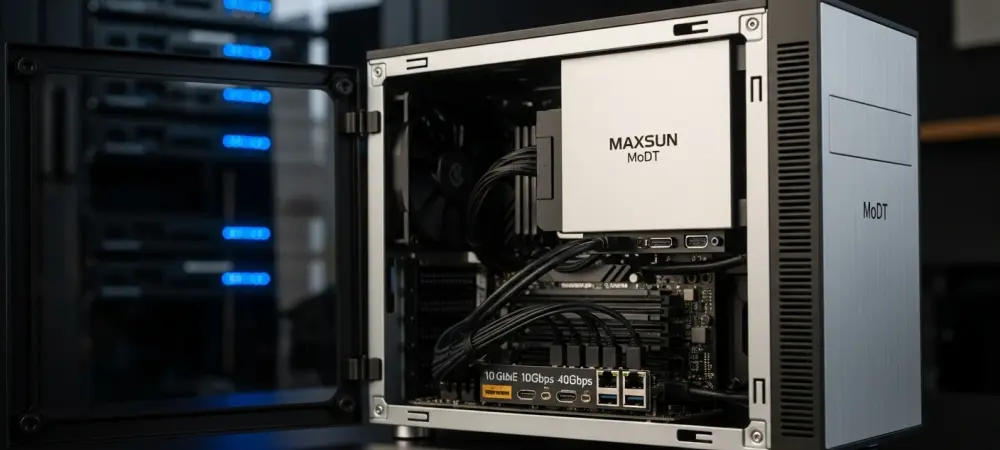
The traditional boundary separating thermally constrained mobile chips from power-hungry desktop processors has finally collapsed as manufacturers prioritize energy efficiency without sacrificing professional-grade connectivity. Mobile-on-Desktop technology represents a strategic pivot in the hardware industry, taking the high-efficiency silicon found in premium laptops and repurposing it for modular desktop use. This review explores the evolution of this technology through Maxsun’s innovative motherboard lineup, which bridges the gap between low-power consumption and high-performance workstation requirements.
The Emergence of MoDT: Integrating Mobile SoCs into Desktop Environments
The concept of MoDT involves the meticulous adaptation of mobile System-on-Chips into desktop-grade PCBs, allowing users to leverage advanced lithography usually reserved for portable devices. Unlike traditional socketed CPUs, these mobile SoCs are soldered directly to the motherboard, reducing latency and optimizing power delivery within a controlled thermal envelope. This shift reflects a broader industry trend toward maximizing performance-per-watt, especially as energy costs and environmental concerns influence modern hardware procurement.
Specialized motherboard designs are essential to this transition, as they must translate mobile-centric power rails into standard desktop ATX or mATX power delivery systems. By doing so, manufacturers provide a platform for small-form-factor computing that rivals the throughput of larger systems. This technology appeals to a growing demographic of users who require high computational density without the acoustic and thermal overhead of conventional high-TDP desktop architectures.
Technical Analysis of Maxsun’s Next-Generation Platforms
Flagship Performance: The Panther Lake SK-PTLNAS Motherboard
The SK-PTLNAS stands as a flagship ATX solution, integrating Intel Core Ultra Series 3 Panther Lake processors to deliver unprecedented efficiency for home servers. By utilizing a 6+4 phase VRM, the board ensures stable power delivery to the Core Ultra 7 356H even under sustained multi-threaded workloads within a 65W TDP. This specific implementation is unique because it combines a mobile core with five M.2 slots and Mini SAS ports, creating a storage-dense environment rarely seen in the consumer market.
The inclusion of PCIe Gen5 technology and dual 40Gbps USB-C ports further distinguishes this platform from its competitors. Most MoDT solutions focus solely on compact size, but the SK-PTLNAS prioritizes data throughput and networking with its 10 GbE and 2.5 GbE Ethernet options. This design allows the mobile silicon to function as the brain of a high-speed storage array, effectively utilizing every available PCIe lane for maximum I/O bandwidth.
Entry-Level Efficiency: The Wildcat Lake mATX Solution
In contrast to the flagship model, the Wildcat Lake mATX motherboard focuses on a parsimonious 28W TDP, targeting energy-conscious deployments. This board employs a 4+2 phase VRM and a 12V DC power jack, which eliminates the need for a bulky internal power supply unit and simplifies the assembly of ultra-compact machines. It is a streamlined solution that emphasizes stability over raw expansion, providing a single SO-DIMM slot and Gen4 M.2 storage.
The performance characteristics of the Wildcat Lake platform are perfectly suited for basic office computing or thin-client applications. By minimizing the component count and power draw, Maxsun has created a platform that operates silently while maintaining the responsiveness expected from Intel’s latest mobile architecture. This implementation proves that even entry-level mobile silicon can provide a robust desktop experience when paired with the right power delivery logic.
Expanding the Ecosystem: Intel Arc Pro B65 Graphics Integration
Maxsun has complemented its MoDT lineup with the Intel Arc Pro B65 series, offering both single-slot blower and passive cooling configurations. These GPUs address the specific needs of workstation users who require reliable visual output in space-constrained or noise-sensitive environments. While these cards feature a 200W TDP, their slim profile and 16-pin power connector allow them to fit into specialized desktop chassis alongside MoDT motherboards.
The passive variant is particularly significant for professional audio or laboratory environments where fan noise is a primary concern. By providing a dedicated workstation-grade GPU that integrates seamlessly with mobile-on-desktop platforms, Maxsun has created a holistic ecosystem. This combination allows for a high-efficiency compute node that excels in media encoding and basic CAD tasks without the bulk of a traditional gaming PC.
Recent Advancements and Shifting Industry Trends
The shift toward integrating architectures like Panther Lake into standard ATX frames indicates a maturing market for hybrid hardware. Industry trends are moving away from the “one size fits all” approach of massive tower PCs, favoring instead high-density storage and high-speed 10 GbE networking. As the lines between mobile and desktop silicon continue to blur, the demand for specialized MoDT hardware is expected to grow among tech enthusiasts. Moreover, the increasing availability of high-speed interconnects like Thunderbolt and USB4 on these boards enables a modularity that was previously impossible. Users can now build a compact, low-power core system and expand its capabilities through external enclosures or high-speed network-attached storage. This trend toward decentralized computing power aligns with the modern focus on efficiency and workspace optimization.
Real-World Applications and Use Cases
The most compelling deployment of Maxsun MoDT boards is found in high-density NAS and home lab environments. The ability to host five M.2 NVMe drives on a low-power mobile platform allows for the creation of silent, high-speed storage arrays that consume a fraction of the power of a standard server. For developers and IT professionals, these boards offer a perfect balance of reliability and performance for running virtualized environments or local cloud services.
Additionally, the 40Gbps USB-C connectivity makes these boards ideal for media servers and ultra-quiet workstations. Users who prioritize a distraction-free environment benefit from the passive cooling options and the low thermal output of the mobile SoCs. Whether used as a high-end plex server or a dedicated coding machine, the MoDT architecture provides a level of efficiency that traditional desktop parts simply cannot match.
Current Challenges and Technical Limitations
Despite the advantages, MoDT technology faces significant hurdles, primarily regarding the reliance on SO-DIMM memory modules. These modules often have lower maximum capacities and slower clock speeds than their desktop DIMM counterparts, which can bottleneck performance in memory-intensive applications. Furthermore, the niche nature of the market means that replacement parts and specialized cooling solutions can be harder to source than standard consumer hardware. Thermal management also presents a unique challenge, as mobile SoCs have a smaller surface area, concentrating heat into a tiny die. While this is manageable within a 65W envelope, it requires precise heatsink mounting and high-quality thermal interface materials to prevent throttling. These technical limitations mean that while MoDT is highly efficient, it remains a specialized choice for users who understand the trade-offs involved in hybrid hardware.
Future Outlook for Hybrid Hardware Architectures
The trajectory of MoDT technology suggests that future iterations will focus heavily on integrated AI acceleration. As Intel continues to refine its Neural Processing Units within mobile architectures, MoDT motherboards will likely become the preferred platform for local AI inference in home environments. This evolution will further cement the role of efficient, high-I/O boards in the eco-friendly computing sector, providing power where it is needed most. Long-term, the scalability of mobile architectures could lead to a broader disruption of the desktop market. If mobile silicon continues to close the performance gap with desktop processors, the traditional socketed CPU may become a specialty item for overclockers, while MoDT becomes the standard for general-purpose workstations. This shift would represent a fundamental change in how the industry approaches hardware lifecycle and energy management.
Final Evaluation of Maxsun’s MoDT Innovations
Maxsun’s foray into the MoDT space successfully challenged the assumption that mobile silicon was inherently inferior for heavy desktop workloads. The integration of Panther Lake and Wildcat Lake architectures into modular frames proved that performance-per-watt could dictate the next phase of hardware design. These platforms offered a unique blend of high-density storage and extreme energy efficiency that appealed to specialized professional markets. The transition toward MoDT established a new precedent for energy-conscious power users. By delivering workstation-grade features like 10 GbE networking and PCIe Gen5 on a mobile platform, the hardware provided a compelling alternative to traditional builds. Investors and enthusiasts alike looked toward these hybrid solutions as the most viable path for the future of sustainable, high-performance computing.