

As portable gaming hardware evolves, the demand for storage that is both incredibly fast and remarkably small has never been higher. Dominic Jainy, an expert in the intricate details of PC architecture and storage solutions, brings a wealth of knowledge to the table regarding how these components are being reshaped for the next generation of devices. Our discussion centers on the latest breakthroughs in SSD efficiency and memory certification, exploring how manufacturers are squeezing desktop-level performance into the palm of your hand while maintaining the thermal and power standards required for modern computing.
The conversation delves into the technical specifications of miniaturized NVMe drives designed specifically for handheld consoles, the transition to ultra-high-speed PCIe 5.0 standards in mainstream desktops, and the importance of ecosystem-specific memory tuning. We examine the trade-offs between speed, heat, and power consumption, providing a roadmap for how hardware is adapting to satisfy both the casual gamer and the hardcore enthusiast.
Handheld gaming devices require a delicate balance between high storage capacity and strict power efficiency. How do new hardware solutions like the latest mini SSDs address these unique constraints?
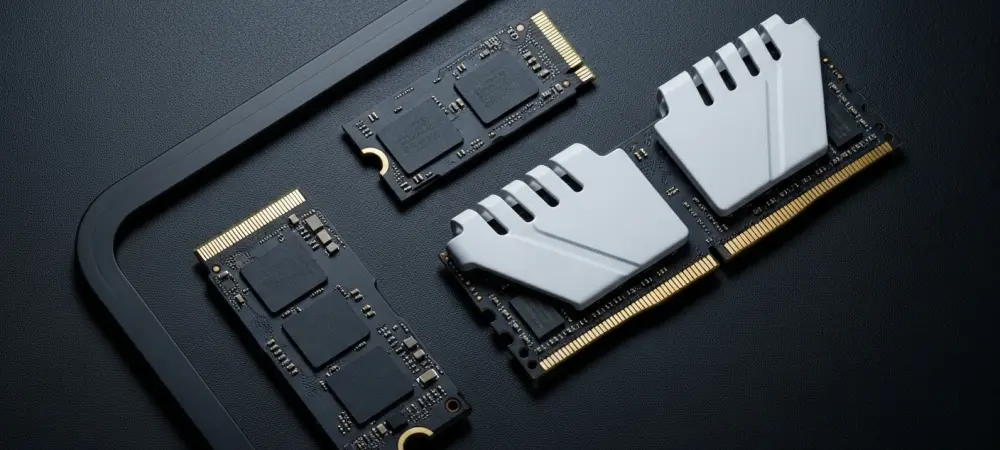
It is a fascinating engineering challenge because every single milliwatt matters when you are trying to game on the go without draining your battery in an hour. The new BL130 SSD is a perfect example of this philosophy, operating on a sub-3.5W design that significantly preserves battery life while still delivering up to 2 TB of storage capacity. In my experience, seeing these drives push 850K Read and 800K Write IOPS in a form factor small enough for a OneXPlayer is truly impressive for the handheld ecosystem. These solutions, like the cost-optimized CL100, provide speeds of up to 3700 MB/s Read, ensuring that players do not have to choose between a massive library of games and a device that stays cool in their hands. The inclusion of a 3-year warranty on these mini drives also suggests a level of durability that is essential for devices that are constantly being moved and subjected to different environments.
Looking at the leap to PCIe 5.0, what are the technical implications of hitting speeds like 11 GB/s, and how do choices in controller technology influence the end-user experience?
Moving to the M560 series represents a massive jump for power users who demand the absolute ceiling of performance, specifically reaching 11 GB/s Read and 10 GB/s Write speeds. What stands out to me is the implementation of the SMI 6nm controller, which is a strategic move to tackle the heat issues typically associated with such high throughput. By opting for a DRAM-less design and a smaller manufacturing node, the hardware achieves lower temperatures and lower power consumption, which is critical for maintaining performance over long periods. It is a relief for builders because it means they can enjoy top-tier speeds without the constant anxiety of thermal throttling ruining their workflow or high-stakes gaming sessions. Having that much bandwidth available in a standard 2280 form factor really opens up what is possible for high-end workstations and gaming rigs.
High-speed memory is often about more than just numbers on a spec sheet. What makes a specialized, certified DDR5 kit a distinct choice for someone building a modern gaming rig?
When you see something like the DW100 DDR5-RGB kit, you are looking at a product designed to bridge the gap between raw power and a seamless ecosystem experience. These 32 GB kits, consisting of two 16 GB modules, are factory-tuned to hit 6000 MT/s while remaining fully compliant with both Intel XMP and AMD EXPO standards for maximum compatibility. The real magic happens when you pair them with a certified motherboard, unlocking a specialized performance boost that gives enthusiasts a tangible edge in system responsiveness. Beyond the electronics, the tactile and visual appeal of the large white heatspreaders and vibrant RGB LEDs adds a premium sensory layer that makes a custom build feel like a centerpiece. It is about creating a system where the hardware looks as fast as it actually performs, which is a major priority for the modern PC community.
As hardware moves toward universal standards, how do these components serve both the desktop and mobile ecosystems simultaneously?
The versatility of the RU200 series highlights a smart approach to modern computing where the same high-standard DNA is shared across different form factors. By offering UDIMMs for desktops and SO-DIMMs for the mobile ecosystem, hardware manufacturers are ensuring that laptops and Mini PCs are not left behind in the DDR5 transition. These modules offer consistent 4800/5600 MT/s speeds at a very efficient 1.1V, which is essential for maintaining stability in cramped, heat-sensitive environments. Whether a user is installing an 8 GB stick or a 32 GB module, they are getting a reliable foundation that works across a vast range of hardware, from office workstations to high-end mobile workstations. This level of JEDEC compliance means that the user can expect a “plug and play” experience with CL40 or CL46 timings, reducing the friction often found when upgrading various types of devices.
What is your forecast for the future of compact gaming storage?
I expect we will see a rapid convergence where the performance of full-sized desktops becomes the standard for even the smallest portable devices. With PCIe 5.0 technology already reaching 11 GB/s in larger drives, it is only a matter of time before that same controller efficiency trickles down into the mini SSDs used in handhelds. We will likely see a push for even higher densities, perhaps 4 TB or 8 TB in these tiny form factors, as game sizes continue to balloon and users demand their entire libraries locally. The focus will shift almost entirely to thermal management and power-per-watt ratios, ensuring that the next generation of gamers can carry an entire high-performance library in their pocket without any thermal compromise.