

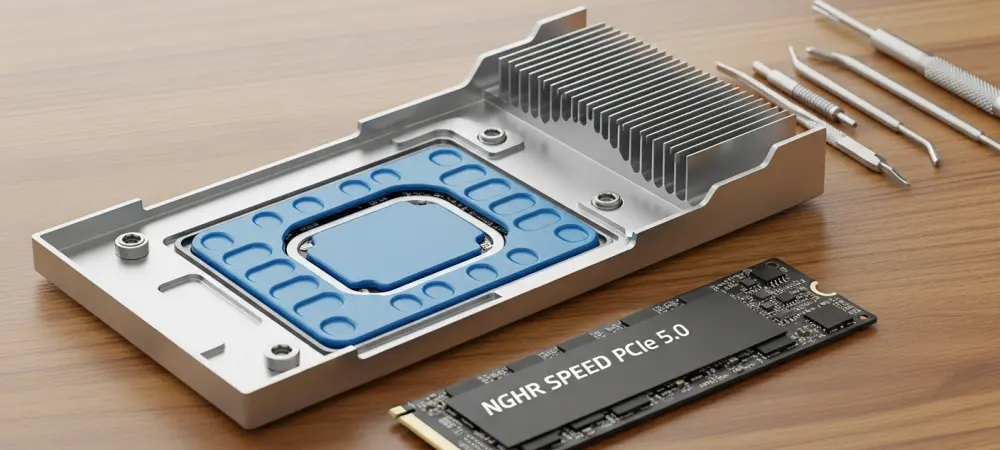
The transition from mechanical hard drives to ultra-compact M.2 NVMe storage represents one of the most significant leaps in consumer technology, yet it has brought forth a thermal challenge that many modern motherboards are ill-equipped to handle. While these small, gum-stick-sized modules have successfully unlocked sequential speeds exceeding 14,000 MB/s, they have also introduced a thermal density problem that contemporary cooling solutions are struggling to address effectively. In the current era of PCIe 5.0 dominance, the sheer amount of energy processed by high-frequency controllers and stacked NAND flash memory results in concentrated heat pockets that can quickly exceed safe operational limits. This transition has turned what was once a minor aesthetic consideration—the motherboard heatsink—into a critical piece of infrastructure that determines whether a system achieves its advertised performance or stumbles under the weight of its own output. However, a growing body of evidence suggests that many of these integrated thermal solutions are failing in their primary objective, leaving expensive hardware to cook in silence while users remain largely unaware of the performance they are leaving on the table. This systemic failure often stems from manufacturing tolerances and aesthetic-driven designs that prioritize the visual appeal of a massive metal plate over the mechanical necessity of direct contact with the silicon chips beneath.
The Performance Cost: How Thermal Throttling Cripples Speed
When an NVMe solid-state drive operates without an adequate thermal interface, it rapidly approaches its internal temperature threshold, which typically sits between 70 and 85 degrees Celsius for high-end controllers. To prevent catastrophic failure or permanent data degradation, the drive’s firmware triggers a protective state known as thermal throttling, which artificially limits the clock speeds of the controller. This immediate reduction in processing power results in a dramatic collapse of data throughput, often occurring within seconds of starting a sustained file transfer or a heavy gaming load. In documented scenarios involving modern PCIe 5.0 hardware, a drive capable of nearly 12,000 MB/s can see its performance drop to levels reminiscent of a decade-old SATA drive, hovering around a mere 600 MB/s. This staggering loss of efficiency means that the premium price paid for cutting-edge storage is effectively wasted, as the component spends more time cooling down than it does delivering the high-speed experience the consumer expected when purchasing the hardware. Beyond the immediate loss of speed, thermal throttling creates an inconsistent user experience characterized by a saw-tooth performance profile that makes system responsiveness highly unpredictable. As the drive heats up, the controller cuts power, the temperature drops slightly, and the drive attempts to ramp up speed again, only to overheat once more in a repeating cycle. Some of the most advanced drives in the current market have even been observed to permanently downshift their interface link from PCIe 5.0 to PCIe 4.0 or lower as a desperate measure to remain within safe thermal envelopes. Once this link speed reduction occurs, a full system reboot is usually the only way to restore the original bandwidth, creating a significant bottleneck for professionals involved in heavy workloads like 8K video rendering or large-scale machine learning training. The heat also stresses the solder joints and internal components over time, potentially shortening the lifespan of the drive and increasing the risk of premature hardware failure in systems that are expected to run reliably for years.
Engineering Barriers: The Z-Height and Standardization Conflict
The primary technical hurdle preventing a universal cooling solution is the lack of strict industry standardization regarding the vertical dimensions of M.2 components, commonly referred to as the Z-height. While the length and width of the circuit board are governed by clear specifications, the height of the individual NAND flash packages and controllers can vary significantly between different manufacturers and product tiers. Single-sided drives, which feature all components on the top of the board, are significantly thinner than double-sided drives that utilize the underside for additional memory chips. Because motherboard manufacturers must design their integrated heatsinks to fit as many drives as possible, they often face a difficult engineering trade-off that leads to poor contact with the thinner drives. If a heatsink is designed for a thick, double-sided drive, it will inevitably sit a fraction of a millimeter above the components of a single-sided drive, creating an insulating air gap that effectively traps heat rather than dissipating it.
Motherboard designers frequently find themselves in a precarious position where they must balance thermal efficiency against the risk of physical hardware damage. If a manufacturer includes a thermal pad that is too thick in an attempt to ensure contact with all drives, the resulting pressure can cause the M.2 circuit board to warp or bend when the heatsink is screwed into place. This physical deformation can crack solder balls under the BGA packages, leading to intermittent connection issues or complete drive death. To avoid the liability associated with damaged storage modules, many manufacturers err on the side of caution by using thinner pads or taller mounting standoffs. This conservative approach leads to the “decorative” heatsink phenomenon, where a massive piece of aluminum sits just high enough above the SSD that it provides no real cooling benefit. This mechanical misalignment is a pervasive issue across the industry, highlighting a fundamental disconnect between the groups designing the storage and those designing the platforms that house them.
Comparative Analysis: Performance Gaps Among Major Manufacturers
A comprehensive evaluation of the current motherboard market reveals that price is no guarantee of quality when it comes to integrated storage cooling. In recent stress tests involving twenty different high-end motherboards across both major CPU platforms, nearly half of the tested units failed to make adequate contact with a standard performance SSD. The results showed a alarming level of inconsistency, with some mid-range boards outperforming flagship models that cost twice as much. Only about thirty percent of the surveyed hardware provided what could be classified as “excellent” thermal contact, where the thermal pad showed clear indentation from the drive components across the entire surface area. The remaining majority ranged from questionable contact where only the controller was touched, to total failures where a visible gap remained even after the heatsink was fully tightened. This data suggests that thermal design for M.2 slots is often treated as a secondary priority compared to VRM cooling or aesthetic lighting features.
Individual brand philosophies further complicate the landscape for enthusiasts trying to build a reliable system with modern storage. ASRock has emerged as a surprisingly consistent leader in this specific area, with many of their recent designs providing high-tension mounting systems that ensure the heatsink is firmly pressed against the drive. In contrast, ASUS has often leaned toward a lighter contact approach, which prioritizes ease of installation and hardware safety but frequently results in higher operating temperatures during sustained use. Meanwhile, companies like MSI and Gigabyte have exhibited significant variance between different product lines, where a budget-oriented board might feature a superior mounting mechanism compared to a premium board that uses a more complex, but less effective, “tool-less” latch. These discrepancies mean that consumers cannot rely on brand reputation alone and must instead look for specific reviews that measure the physical pressure and thermal delta of the integrated cooling solutions on a per-model basis.
Design Flaws: Beyond the Controller-Centric Cooling Approach
One of the most persistent design oversights in the current generation of motherboards is the narrow focus on cooling the SSD controller while neglecting the NAND flash chips. While it is true that the controller is the primary source of heat and the component that triggers thermal throttling, the NAND memory also requires a stable thermal environment to ensure data integrity and long-term reliability. Flash memory is sensitive to extreme temperature fluctuations, and leaving it uncooled while the controller is chilled can create thermal gradients across the circuit board that lead to physical stress. Many integrated heatsinks utilize small thermal pads that only cover the central controller chip, leaving the surrounding memory modules exposed to the stagnant air within the PC case. This shortcut might allow a drive to pass a quick benchmark without throttling, but it fails to address the holistic thermal needs of the storage device during hours of heavy operation.
The industry has seen some movement toward more intelligent mechanical designs that aim to solve the height variability problem without relying on thicker thermal pads. Gigabyte introduced a flexible mounting technology known as EZ-Flex, which uses a spring-loaded mechanism to allow the heatsink to adjust its height based on the specific thickness of the installed SSD. This type of mechanical innovation represents a significant step forward, as it provides consistent downward pressure regardless of whether the drive is single-sided or double-sided. By allowing the cooling assembly to move and conform to the hardware, these designs eliminate the guesswork and risk associated with static heatsink heights. Such solutions prove that the cooling failure is not an unsolvable mystery of physics, but rather a matter of choosing better engineering over the cheaper, rigid metal plates that have become the industry standard for most consumer motherboards.
Practical Remediation: Effective Strategies for Thermal Stability
To address these systemic cooling deficiencies, the most effective strategy proved to be a hands-on verification of thermal pad contact immediately after the installation process. Builders who achieved the best results often replaced factory-supplied thermal interface materials with high-performance pads of specific thicknesses that corresponded precisely to their drive’s topography. It was also discovered that for sustained professional workloads, moving away from integrated motherboard solutions toward dedicated active M.2 coolers provided the only guarantee of consistent PCIe 5.0 speeds. This shift toward a more deliberate thermal management approach ensured that storage devices maintained peak efficiency throughout their lifespan without suffering from the erratic performance dips seen in stock configurations. Ultimately, the industry reached a consensus that physical inspection remained the most reliable safeguard against the silent performance degradation caused by inadequate heatsink pressure. Future-proofing a high-end system meant treating M.2 cooling with the same level of scrutiny as CPU thermal management, transforming a previously overlooked component into a cornerstone of stable system architecture. By adopting these targeted interventions, users successfully bypassed the limitations of decorative motherboard hardware and reclaimed the full potential of their high-speed storage investments.