

The sound of spinning mechanical platters and the faint hum of a cooling fan have become the background music of the modern digital home, signaling a quiet revolution in how we safeguard our personal data. For decades, the network-attached storage market felt like a comfortable duopoly, where a few established titans dictated the pace of innovation while consumers paid a premium for hardware that often felt several years behind the curve. However, a sudden influx of high-performance silicon and aggressive industrial design has shattered that complacency, forcing a reckoning for the industry’s elder statesmen. The Ugreen DXP4800 Pro has emerged not as a humble accessory, but as a sophisticated machine designed to bridge the gap between simple file storage and high-concurrency server performance.
A Disruptive Force: The New Network Storage Landscape
The arrival of the DXP4800 Pro represents a pivotal moment for a brand that was once primarily known for its sleek charging cables and laptop hubs. Entering the NAS market is a daunting task, as users do not just buy a box; they buy into a promise of long-term data integrity and software support. While the initial wave of new entrants often struggled with flimsy plastic builds or unstable operating systems, this unit presents a heavy-duty aluminum chassis that signals a commitment to professional-grade durability. It is a bold move that targets the “pro-sumer” segment—those users who have outgrown basic cloud storage and demand a local server capable of handling complex workloads without breaking the bank.
This disruption is particularly visible in the way hardware is packaged and priced in 2026. For a long time, the leading brands relied on software polish to justify using underpowered processors that struggled with modern tasks like real-time video transcoding or running virtual machines. By offering a high-spec alternative at a competitive price, Ugreen is effectively forcing the entire market to move toward a more transparent value proposition. The conversation is no longer just about which brand has the most colorful user interface, but about which device provides the computational headroom to survive the next five years of digital evolution.
The Hardware-to-Software Balance: Why It Matters Now
The modern NAS has evolved far beyond its origins as a simple network-accessible hard drive. Today, these devices serve as the central nervous system for smart homes, hosting private media libraries, managing security camera feeds, and running isolated development environments via Docker. As our 4K video libraries grow and our reliance on high-speed home networking increases, the “good enough” hardware of the past has become a significant bottleneck. Users are increasingly frustrated by devices that take minutes to generate photo thumbnails or stutter when multiple family members try to stream content simultaneously.
The DXP4800 Pro addresses this frustration by prioritizing raw specifications that were previously reserved for rack-mounted enterprise equipment. While software remains the primary interface for the user, the underlying hardware provides the muscle that makes that software feel responsive and reliable. In a market where high-speed 2.5GbE and 10GbE networking are becoming standard in households, having a NAS that can actually saturate those connections is no longer a luxury—it is a necessity for anyone serious about digital efficiency.
Under the Hood: A Deep Dive into Pro Specifications
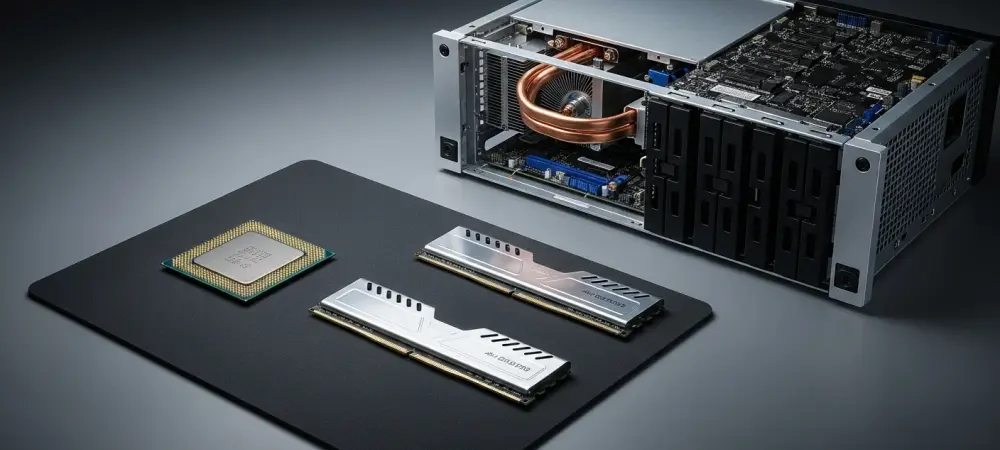
At the heart of the DXP4800 Pro lies the Intel Core i3-1315U, a processor that represents a massive leap forward from the low-power Celeron chips found in most 4-bay competitors. This 13th Gen chip utilizes a hybrid architecture, combining performance cores for heavy lifting with efficiency cores for background tasks. This means the system can manage a resource-intensive task, such as compiling code or running a Windows virtual machine, without the user experiencing any lag when they try to access their files through the mobile app. The overhead provided by this CPU ensures that the device remains snappy even when the storage volume begins to fill up.
Beyond the raw processing power, the inclusion of Intel UHD Graphics with native AV1 decoding support is a game-changer for media enthusiasts. As streaming platforms and high-end cameras transition to the AV1 codec for its superior compression and quality, older NAS units are being left in the dust, unable to transcode these files without crashing the system. The DXP4800 Pro handles these modern formats with ease, allowing for seamless playback across various devices. Furthermore, the support for up to 96GB of DDR5 memory and dual PCIe Gen 4 x4 M.2 slots means that bottlenecking is almost impossible, whether the user is employing NVMe drives for high-speed caching or as a lightning-fast primary storage tier.
The physical construction of the device complements its internal power through a design that prioritizes thermal stability and ease of use. The aluminum alloy shell is not just for show; it assists in heat dissipation, ensuring that the components remain cool during extended periods of heavy use. Practical design choices, such as the tool-free drive trays with integrated locks and the magnetic dust filter on the large rear fan, demonstrate an understanding of the long-term maintenance needs of a 24/7 server. These small details contribute to a feeling of reliability that is often missing from more budget-conscious hardware.
Expert Perspectives: The UGOS Pro Ecosystem
Industry analysts have spent the last several months scrutinizing UGOS Pro, the proprietary operating system developed to power this new generation of hardware. The general consensus is that the software is remarkably clean and approachable, stripping away the clutter that can often make a NAS feel intimidating to a newcomer. It provides a “cloud-like” experience that feels familiar to those coming from Google Drive or Dropbox, yet it retains enough depth to satisfy those who want to dive into RAID configurations and network permissions. The core stability has been praised, though experts point out that the application library is still maturing compared to the decades-old ecosystems of its rivals. One of the most surprising and lauded aspects of the Ugreen strategy is the “open hardware” philosophy. In a market where manufacturers often go to great lengths to prevent users from installing alternative software, Ugreen has taken a refreshingly hands-off approach. Power users have discovered that they can easily install third-party operating systems like TrueNAS or Unraid on this hardware without violating their warranty. This has earned the brand significant respect within the enthusiast community, as it allows users to buy the best-in-class hardware while choosing the specific software environment that fits their unique workflow.
Determining the Fit: Is This Your Next Workflow Hub?
Choosing a NAS in 2026 requires an honest assessment of your current and future networking infrastructure. If you are still operating on a basic 1GbE router with no plans to upgrade, the 10GbE capabilities of the DXP4800 Pro might be overkill for your needs. However, for those who have already invested in high-speed switches or are looking to future-proof their setup, this device offers the bandwidth necessary to move multi-gigabyte files in seconds rather than minutes. It is a tool designed for a high-speed environment, and its value is most apparent when it is allowed to run at full throttle. For individuals deeply involved in virtualization or high-end media production, the DXP4800 Pro offers a compelling growth path. The ability to expand the RAM to 96GB is almost unheard of in the 4-bay category, providing a massive playground for running multiple containers or complex automation scripts. While the power consumption is slightly higher than lower-spec models—averaging around 42W during active use—the trade-off is a level of performance that makes the device feel like a true server rather than just a smart external hard drive. It is a machine built for those who value time and responsiveness over the absolute lowest power draw.
The Verdict on a Changing Guard
The journey of network storage has reached a crossroads where the hardware must finally catch up to the ambitious software dreams of the user. Moving forward, the focus will likely shift toward more robust data recovery tools and deeper integration with decentralized cloud services. Prospective buyers should look toward optimizing their local network topology, perhaps by upgrading to Cat6a cabling or 10GbE switches, to ensure they aren’t leaving performance on the table. As the line between local storage and cloud utility continues to blur, the emphasis should remain on hardware versatility and the freedom to pivot between different software platforms as needs change.
Looking ahead, the next logical step for the industry involves more aggressive integration of artificial intelligence for automated data tiering and proactive hardware health monitoring. Users would be wise to monitor the development of open-source storage communities, as the ability to bridge hardware like the DXP4800 Pro with evolving software stacks will define the longevity of these investments. The most successful setups will be those that prioritize modularity and high-bandwidth components, ensuring that as file sizes and processing requirements inevitably grow, the central server remains the strongest link in the chain rather than the weakest.