

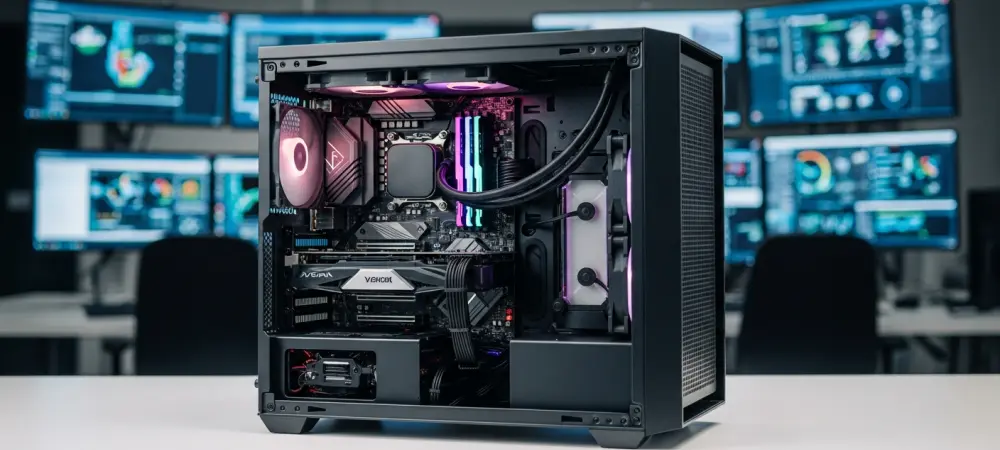
Micro Center’s latest hardware assembly featuring the AMD Ryzen 9 9950X3D processor, the MSI MAG X870E Tomahawk WiFi motherboard, and KLEVV CRAS V RGB memory attempts to bridge the gap between niche professional needs and the high-demand gaming market. For builders who once spent weeks meticulously researching compatibility and voltage tolerances, this bundle offers a curated shortcut to a flagship experience without the tedious hunt for individual components. This hardware trio acts as the central nervous system for any high-tier machine, ensuring that the heavy lifting of a modern workstation is handled with surgical precision. By consolidating these specific parts, the package targets a demographic that values both immediate out-of-the-box reliability and the headroom to push the boundaries of current software.
The Pinnacle: Zen 5 Processing Power
The core of this hardware suite is the Ryzen 9 9950X3D, a processor that represents the current peak of consumer-grade silicon in terms of multithreaded prowess and power efficiency. With a layout consisting of 16 high-performance cores and 32 threads, this chip is specifically engineered for intense parallel processing tasks that define modern digital creation workflows. Professionals engaged in 3D rendering, complex physics simulations, or 4K video production will find that the Zen 5 architecture provides a significant uplift in instructions per clock over its predecessors. This efficiency ensures that even during extended workloads, the CPU maintains high sustained frequencies without hitting thermal walls as aggressively as older designs. The integration of 16 full-sized cores means that multitasking is no longer a compromise, as background processes and heavy computational threads coexist without the stuttering or resource contention that plagued older hardware generations during peak demand. What truly distinguishes this processor for the enthusiast gaming community is the massive 128MB of L3 cache facilitated by AMD’s sophisticated 3D V-Cache technology. This vast pool of on-die storage drastically reduces the frequency with which the CPU must reach out to the system RAM for data, which in turn slashes internal latency to near-imperceptible levels. In real-world application, this translates to significantly smoother frame rates and vastly improved one-percent lows in titles that are traditionally sensitive to memory speed and latency. While standard high-core-count processors often struggle to balance productivity and gaming, the 9950X3D bridges this divide by providing the raw thread count for work and the cache-heavy architecture for play. It currently sits as a dual-threat component, capable of outperforming specialized gaming chips while offering the computational muscle required for data-intensive AI model training and large-scale software compilation for modern development.
The Foundation: Resilient Standards for Modern Systems
Supporting a 16-core flagship processor requires a motherboard with an over-engineered power delivery system, and the MSI MAG X870E Tomahawk WiFi delivers exactly that. Built upon the robust AM5 socket, this board features a high-current voltage regulator module designed to supply stable, clean power to the 9950X3D even under extreme workloads or peak performance scenarios. This stability is crucial for long-term component health, as it prevents voltage ripple and thermal spikes that can degrade sensitive silicon over several years of operation. The board also incorporates high-quality heat sinks for both the VRMs and the primary M.2 slots, ensuring that heat dissipation remains efficient during long-duration rendering sessions or intense competitive gaming marathons. By choosing the X870E chipset, MSI has provided a platform that does not just meet current standards but anticipates the needs of upcoming software that will leverage deeper integration between the processor and the chipset data lanes.
Beyond mere power delivery, the inclusion of the X870E chipset brings a host of future-proof connectivity options that prepare the system for the next generation of peripherals and networking. The motherboard is equipped with integrated WiFi 7 and high-speed USB4, offering bandwidth speeds that were previously reserved for high-end server environments or dedicated expansion cards. These features are essential for users who frequently move massive data sets or rely on ultra-low-latency wireless connections for cloud-based collaboration. Furthermore, the inclusion of PCIe 5.0 support for both the primary graphics slot and the storage lanes ensures that as faster GPUs and NVMe drives enter the market, this motherboard will fully utilize their maximum theoretical bandwidth. This level of foresight means that a builder investing in this bundle today will likely not need to replace the core platform for several years, as the motherboard is already built to accommodate the performance curves of hardware releases through 2028.
The Value: Memory Synergy and Investment Strategy
To ensure that the processor and motherboard operate at their maximum potential, the bundle includes 32GB of KLEVV CRAS V RGB DDR5 memory. Operating at a speed of 6000 MT/s with a low CAS latency of CL30, this memory kit is tuned specifically for the Ryzen 9000 series’ internal fabric clock speeds. Maintaining a 1:1 ratio between the memory frequency and the processor’s infinity fabric is vital for minimizing internal bottlenecks, making this 6000 MT/s speed the definitive “sweet spot” for performance stability. The KLEVV modules are not only functionally superior but also feature a refined aesthetic with customizable RGB lighting that complements the modern look of the Tomahawk motherboard. In memory-intensive environments like complex simulations or large-scale digital multitasking, having a low-latency, high-bandwidth kit ensures that the CPU is never left waiting for data, allowing the 16 cores of the 9950X3D to process information as quickly as the silicon’s physical limits allow for the foreseeable future. From a financial perspective, the bundle is positioned as a strategic high-value investment for power users, carrying a price tag of approximately $1,377.48. This represents a tangible savings of roughly 5% to 6% compared to purchasing these flagship components as individual units, providing a rare discount on top-tier, current-generation hardware. While the initial investment is undeniably high, the long-term value is bolstered by AMD’s established commitment to the AM5 socket, which is expected to support future CPU generations. This upgrade path means that the motherboard and memory will likely remain compatible with newer processors released through 2029, effectively spreading the cost of the platform over a much longer period than competing systems. For a user looking to build a no-compromise machine, the bundle simplifies the procurement process while providing an immediate performance floor that is among the highest in the consumer market, making it an economically sound choice for those who value longevity.
Strategic Planning: Integration and Future Steps
Integrating such a high-performance core into a desktop system requires careful consideration of the surrounding hardware, specifically the thermal solution and power supply unit. The Ryzen 9 9950X3D is an efficient chip for its performance class, yet it still demands a high-quality cooling solution to maintain its peak boost clocks during sustained workloads. Builders should prioritize 360mm or 420mm liquid coolers, or elite-tier air coolers with massive fin stacks, to ensure the 3D V-Cache does not become a thermal bottleneck. Additionally, the power demands of the X870E platform suggest that a minimum 850-watt power supply with an ATX 3.1 rating is necessary to handle the transient power spikes of modern GPUs paired with this CPU. Ensuring that the chassis has ample airflow is also a critical step, as the VRMs on the MSI motherboard and the high-speed DDR5 memory both generate significant heat when pushed to their limits during high-resolution video rendering or extended gaming sessions.
Choosing the right components for a workstation and gaming hybrid required a deep understanding of how modern architecture interacted with high-bandwidth memory and robust power delivery systems. The Micro Center bundle solved this complexity by pairing the most capable consumer processor currently available with a motherboard and memory kit designed to unleash its full potential. For those who sought to maximize their investment, the next logical steps involved selecting a high-speed PCIe 5.0 NVMe drive to take advantage of the X870E chipset’s storage lanes. Future considerations included monitoring the development of next-generation graphics cards, which were poised to utilize the full bandwidth of the PCIe 5.0 slots provided by this platform. Ultimately, the assembly of these parts created a foundation that bypassed the typical limitations of mid-range hardware, offering a clear path for users who prioritized stability. Maintaining the system with regular firmware updates ensured that the Zen 5 architecture continued to receive optimizations.