

Before the mid-1970s, the concept of a computer small enough to sit on a desk and affordable enough for a middle-class family was little more than a science fiction fantasy shared by a handful of visionary hobbyists. The prevailing industry logic dictated that high-performance microprocessors were exclusively the domain of industrial giants and military contractors who could afford the staggering costs of entry. The arrival of the MOS Technology 6502 in 1975 shattered these long-held assumptions by offering a radical alternative to the expensive dominance of market leaders like Intel and Motorola. This tiny silicon chip became the primary engine for the home computing revolution, serving as the core processor for legendary machines including the Apple I, the Apple II, and the Commodore 64. By successfully transitioning digital technology from sterile, high-end laboratories into the average American living room, the 6502 effectively democratized access to information and laid the groundwork for the modern digital era.
Breaking the Price Barrier
Economic Disruption: The Price of Innovation
The most immediate and profound impact of the 6502 was its unprecedented price point of just twenty-five dollars, which was approximately one-eighth the cost of its primary rivals during that era. This aggressive pricing strategy was not just a minor discount; it was a total economic disruption that allowed fledgling companies to envision a world where every household could own a computer. To generate visibility in a crowded marketplace, MOS Technology employed daring marketing maneuvers at trade shows like Wescon. Because they could not yet afford a formal booth inside the main hall, they famously sold the chips out of a hotel room, displaying massive jars filled to the brim with microprocessors. This visual spectacle was designed to suggest high-volume production and reliability, even though many of those initial units were merely non-functional filler used to project an image of manufacturing dominance. These bold tactics successfully caught the attention of early pioneers.
Engineering Efficiency: Overcoming Manufacturing Hurdles
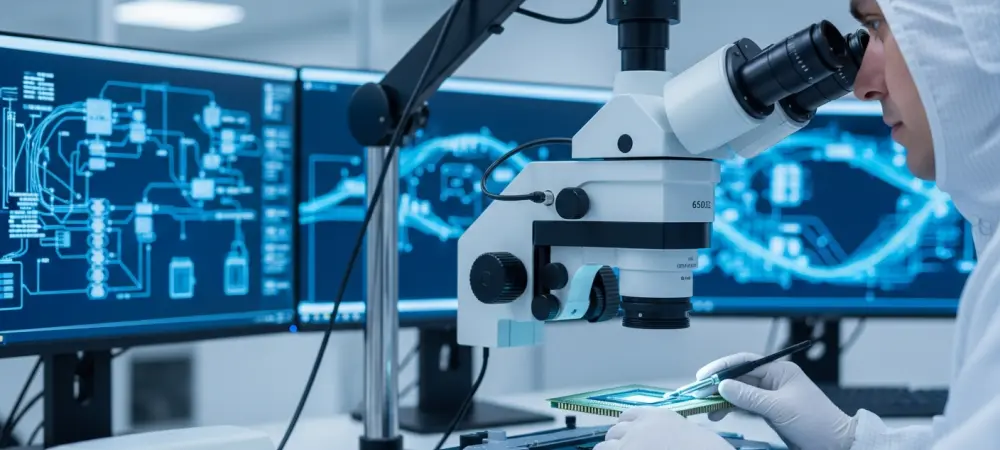
Beyond the clever marketing, the low cost of the 6502 was the result of genuine engineering breakthroughs spearheaded by Bill Mensch and a team of defectors from Motorola. They recognized that the industry was plagued by low manufacturing yields, where a single microscopic flaw on a silicon wafer could render an entire batch of chips useless. By streamlining the instruction set and refining the physical layout of the chip, the MOS team created a design that was significantly smaller and easier to produce than the competing 6800 or 8080 models. This increased the percentage of working chips per wafer, allowing the company to maintain profitability while undercutting the competition. This efficiency forced other semiconductor manufacturers to lower their prices, which accelerated the growth of the entire consumer electronics sector. The legacy of this lean design philosophy continues to influence how modern engineers approach the balance between raw power and manufacturing viability.
An Enduring Technological Legacy
Technological Reach: Modern Applications and Reliability
Even as we navigate the technological landscape of 2026, the 6502 architecture remains remarkably relevant through various updated iterations that are still in active production today. These modern versions of the classic design are frequently integrated into commercial embedded systems where high reliability and low power consumption are prioritized over raw processing speed. For instance, in industrial controllers and medical devices, the simplicity of the 6502 logic provides a level of predictability that is often missing from more complex, modern architectures. Furthermore, a dedicated community of retro-computing enthusiasts and educators continues to utilize the chip to teach the fundamentals of computer science. By working with a processor where every cycle can be tracked and understood, new generations of engineers gain a deep appreciation for the underlying mechanics of digital logic, ensuring that the foundational principles of the 8-bit era are preserved and utilized.
Cultural Icon: The Chip in Popular Media
The cultural influence of the 6502 is perhaps just as significant as its technical specifications, as it has secured a unique position as an icon of the golden age of computing. Its presence in popular media often serves as a nod to the era when technology felt personal and approachable. One notable example is the animated series “Futurama,” which revealed in a specific episode that the robot character Bender is actually powered by a 6502 processor. This cultural staying power highlights how the chip transformed the public perception of computers from cold, industrial machines into friendly tools for creativity and play. The enduring fascination with 8-bit aesthetics and logic demonstrates a collective desire to reconnect with the roots of the digital world.
The Foundation of Digital Society
Social Transformation: Democratizing Education and Creativity
The historical narrative of the 6502 is fundamentally a story of social change driven by the democratization of advanced digital tools across various sectors of society. By providing an affordable gateway to computing, the chip enabled the creation of early educational platforms like the BBC Micro, which introduced millions of students to the world of software development. This educational surge transformed a generation of users from passive consumers of technology into active creators and problem solvers. In the United Kingdom and North America, the availability of these low-cost machines in schools and libraries broke down the barriers that had previously restricted computer literacy to the elite. The chip acted as a vital catalyst, shifting the role of the computer from a specialized industrial calculation tool to a versatile instrument for artistic expression, academic research, and interactive entertainment, thereby reshaping the cultural fabric of the late twentieth century.
Future Insights: Minimalism as a Solution
When reflecting on its historical significance, many historians correctly identified the 6502 as a primary driver of the personal computing revolution that defined the modern era. The chip’s inclusion in the “Chip Hall of Fame” served as a formal recognition of its status as a disruptive innovation that permanently altered the trajectory of global technology. Without the unique combination of manufacturing efficiency and aggressive pricing offered by MOS Technology, the widespread adoption of personal computers might have been delayed by several years. To move forward, the industry should prioritize optimizing low-level instruction sets to reduce energy consumption in data centers, effectively applying the frugal logic of the 6502 to solve contemporary environmental and performance challenges in global computing infrastructure.