

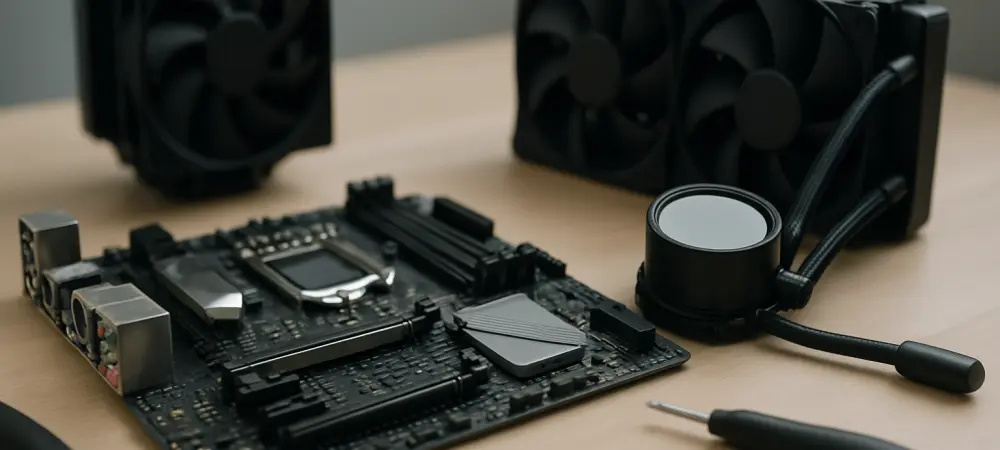
The pursuit of peak computing performance often leads enthusiasts to focus solely on the processor, yet the bedrock of any stable high-end system remains the quality of the motherboard. As the Ryzen 9 series continues to push the boundaries of multi-threaded workloads and gaming efficiency in 2026, finding a platform that can handle the extreme power demands while offering modern connectivity becomes a critical task for builders. COLORFUL has recently addressed this challenge with the release of the iGame X870E ULTRA-S V14, a motherboard that positions itself as a premium solution for the AM5 socket. By integrating the high-end X870E chipset, this board promises to unlock the full potential of Ryzen 7000, 8000, and 9000 series processors. It is not merely about raw power; it is about providing a cohesive ecosystem where high-speed data transfer, thermal management, and intelligent software tuning converge to create a seamless experience for users.
Advanced Hardware Infrastructure: Power and Connectivity
Achieving stability under heavy sustained loads requires a sophisticated electrical infrastructure, which is why the 16+2+1-phase power delivery system on this motherboard is so significant. Utilizing 80A DrMOS components, the board ensures that even the most power-hungry Ryzen 9 chips receive a clean and consistent flow of energy without thermal throttling at the VRM level. This robust setup is essential for creative professionals who engage in long-duration rendering tasks where system crashes are not an option. The aesthetic design further complements this technical rigor, featuring a black PCB with graffiti-style heatsink armor and customizable dot-matrix ARGB lighting that appeals to modern tastes. Furthermore, the inclusion of high-quality capacitors signifies a commitment to longevity, protecting the expensive internal components from voltage ripples. This engineering choice allows the system to maintain its efficiency even when the processor is operating at peak boost clocks, while the physical layout ensures the surrounding components remain cool.
In the current landscape of digital content creation, the speed of data access is just as important as the speed of the processor itself. The iGame X870E ULTRA-S V14 meets this demand by providing five M.2 slots, three of which utilize the cutting-edge PCIe 5.0 x4 standard for ultra-fast solid-state drives. This configuration allows for massive storage arrays that can handle 8K video editing or large dataset analysis without the bottlenecking seen in older PCIe generations. Beyond storage, the introduction of the X3D AI Turbo Mode marks a shift toward more intelligent hardware management. This feature works by automatically analyzing system telemetry to adjust voltage levels and power limits in real-time, specifically targeting the unique architecture of the Ryzen 9000 X3D processors. By maximizing frame rates and smoothing out performance dips, this automated optimization provides a major boon for users who want the benefits of a tuned system without the complexity of manual BIOS adjustments.
To successfully implement this motherboard in a 2026 workstation, builders prioritized the selection of high-performance PCIe 5.0 storage drives to utilize the available bandwidth effectively. It was essential to pair the system with a high-capacity power supply and a robust cooling solution to accommodate the 80A DrMOS power delivery and the heat generated by the Ryzen 9000 series. Enthusiasts also looked toward updating the BIOS immediately to leverage the latest X3D AI Turbo Mode optimizations for gaming. By focusing on these specific hardware pairings, users were able to create a future-proof environment that handled both creative production and high-fidelity gaming without compromise. The integration of Wi-Fi 7 and dual USB4 ports ensured that the system remained compatible with the next generation of peripherals and high-speed networking standards. Moving forward, the strategy involved monitoring firmware updates to further refine the efficiency of the AI-driven voltage adjustments.