

ASUS employs a fully automated Auto-Extreme manufacturing process to eliminate human error and enhance the structural reliability of the Radeon RX 9070 XT Onimusha Edition. This particular release represents a significant intersection between high-performance computing hardware and immersive digital artistry, launched as a tribute to the title OnimushWay of the Sword. This graphics card serves as a sophisticated bridge between the gritty historical fantasy of Edo-period Kyoto and modern computing power, appealing to enthusiasts who demand both aesthetic depth and raw processing capabilities. By integrating AMD’s latest RDNA 4 architecture into a custom-designed chassis, ASUS targets a specific niche of performance-driven gamers and dedicated hardware collectors. The collaboration demonstrates how specialized themes can transform traditional PC components into something far more significant than their individual parts. This approach ensures that the hardware is not just a tool for rendering, but a centerpiece of a gaming ecosystem.
Artistic Identity: A Convergence of Design and Performance
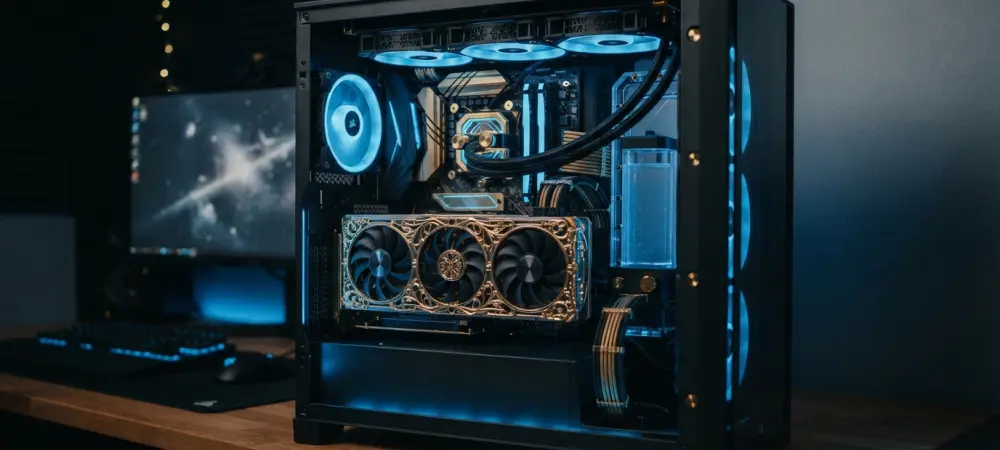
The aesthetic of this special edition departs significantly from the standard industrial look of the TUF series, embracing a dark artistry concept inspired by the legendary Oni Gauntlet. This shift in design philosophy incorporates a striking blue-and-gold color scheme that differentiates the card from the monochrome palettes often found in modern enthusiast builds. The shroud and backplate are meticulously detailed to evoke the haunting atmosphere of ancient Japan, mirroring the supernatural journey undertaken by the game’s protagonist. This level of detail extends to the intricate etchings and metallic finishes that capture light in a way that suggests traditional samurai armor. By moving away from generic RGB lighting in favor of thematic colorways, ASUS has created a component that feels anchored in the lore of the franchise it celebrates. This design choice highlights a growing trend where hardware becomes a canvas for storytelling while maintaining a professional and rugged appearance. Beneath its artistic exterior, the card is a powerhouse driven by the AMD RDNA 4 architecture, offering significant improvements in rendering efficiency and speed compared to previous generations. It is equipped with 16GB of high-speed GDDR6 memory on a 256-bit bus, providing the necessary bandwidth for high-resolution textures and expansive open-world environments. This memory configuration is specifically optimized to handle the intensive data streams required by the RE Engine, ensuring that the intricate details of ancient Kyoto are rendered without stuttering. The transition to RDNA 4 brings with it enhanced ray-tracing cores that allow for more realistic lighting and reflections, which are essential for maintaining the atmospheric tension of a dark fantasy title. These specifications ensure that users can achieve high frame rates at 4K resolution without sacrificing visual fidelity. With a boost clock reaching up to 3080MHz in OC Mode, the hardware maximizes frames in even the most demanding titles.
Operational Excellence: Thermal Engineering and Strategic Longevity
To maintain peak performance during intense gaming sessions, ASUS has implemented a massive 3.125-slot cooling solution that prioritizes heat dissipation through an increased surface area. This design allows the heatsink to absorb significant amounts of thermal energy from the GPU core, ensuring that temperatures remain within optimal ranges even during sustained workloads. The cooling array is powered by three Axial-tech fans that utilize dual-ball bearings, which significantly extend the hardware’s lifespan compared to traditional sleeve bearings. These fans are specifically tuned to provide higher static pressure, forcing air through the dense fin array more effectively while maintaining a low noise profile. This balance between cooling capacity and acoustic performance is crucial for gamers who prefer an immersive experience without the distraction of loud mechanical sounds. The physical size of the card reflects its commitment to thermal management, necessitating a spacious chassis to accommodate its substantial dimensions.
The evaluation of the ASUS TUF Radeon RX 9070 XT Onimusha Edition revealed a product that successfully prioritized both high-end performance and cultural thematic depth. It was determined that the integration of the RDNA 4 architecture provided a robust foundation for modern 4K gaming, while the thematic design elements successfully appealed to collectors. For those who sought a combination of modern processing capabilities and a unique visual aesthetic, the card provided a compelling alternative to conventional hardware. Builders were advised to verify their power supply capacity and chassis clearance before installation to ensure the 3.125-slot design functioned optimally. Furthermore, users were encouraged to maintain regular driver updates to leverage ongoing optimizations for the OnimushWay of the Sword title. Ultimately, the decision to invest in this hardware was justified by its unique position as a high-performance collectible that offered both immediate gaming value and long-term mechanical resilience.