

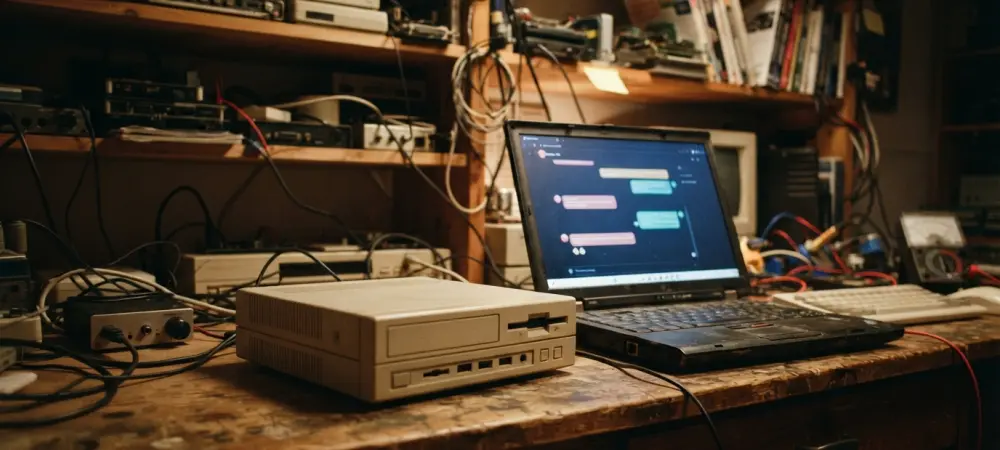
Repurposing a ten-year-old mini-PC for AI workloads requires a streamlined Linux environment to ensure that system overhead does not consume limited CPU resources. The rapid evolution of artificial intelligence has historically suggested that meaningful local execution is an exclusive privilege of those possessing massive computational budgets. Most tech enthusiasts currently operating in 2026 have been conditioned to believe that running a functional Large Language Model necessitates high-end specialized hardware, often costing thousands of dollars for dedicated GPUs and expansive video memory. This perceived financial barrier has deterred many hobbyists from exploring private AI applications, assuming their existing legacy equipment is fundamentally incapable of the task. However, IT specialist Gregory Gibson sought to dismantle this assumption by demonstrating that the AI revolution is far more accessible than industry marketing suggests. By utilizing a decade-old Zotac ZBOX C1325 nano as a primary testbed, Gibson proved that technical optimization and deliberate software selection can serve as effective substitutes for expensive, high-performance silicon. This experiment underscores a growing trend toward the democratization of AI, where the focus shifts from raw power to strategic implementation.
Hardware Constraints: Testing the Limits of Obsolete Silicon
The hardware profile of the machine utilized for this case study provides a stark contrast to the massive server clusters typically associated with modern neural networks. The Zotac ZBOX C1325 nano, a device originally released long before the current AI boom, features an Intel Celeron N3160 processor and 8 GB of RAM. This specific Celeron model is a low-power, quad-core chip that lacks the advanced architectural features found in 2026-era processors, such as dedicated AI acceleration or extensive vector instruction sets. Furthermore, the system relies on a budget-tier Solid State Drive, which, while faster than traditional mechanical disks, does not offer the high-speed data throughput found in modern NVMe interfaces. These limitations created a challenging environment where every bit of processing power had to be carefully managed to prevent system crashes or indefinite hang times during model loading and inference phases. Perhaps the most significant challenge in this setup was the complete absence of a dedicated Graphics Processing Unit. In the standard hierarchy of artificial intelligence workloads, the GPU is the primary engine of computation, handling the massive parallel processing required for complex matrix multiplications. By forcing the system to rely entirely on a low-end CPU for inference, the experiment established a scenario where accessibility and technical ingenuity were prioritized over raw speed. This “CPU-only” approach is increasingly relevant as users seek to reclaim and repurpose older hardware for private, local AI tasks that do not require instantaneous responses. The choice of this underpowered testbed served as a definitive stress test, proving that even a machine considered “obsolete” by modern standards can still participate in the sophisticated ecosystem of generative text and data analysis if the software environment is sufficiently lean.
Software Architecture: Orchestrating Efficiency with Linux
To transform the decade-old Zotac into a functional AI node, the implementation of a lightweight and stable operating system was a non-negotiable requirement. Ubuntu Server was selected as the foundation for the project due to its minimal resource footprint and lack of a demanding graphical user interface, which saved valuable CPU cycles and memory for the actual AI workloads. The core engine driving the experiment was llama.cpp, an open-source tool that has become the gold standard for running Large Language Models on consumer-grade and resource-constrained hardware. Unlike many enterprise-grade AI frameworks that require complex dependencies and massive storage, llama.cpp is designed for efficiency and portability. It allows for the local execution of models with minimal overhead, making it the ideal choice for a machine that lacks the luxury of modern hardware acceleration.
The technical configuration involved compiling the llama.cpp software directly on the target hardware, a process that allowed the binary to be optimized specifically for the Celeron’s limited instruction set. Because of the thermal constraints and the modest processing power of the N3160 chip, the compilation was restricted to two parallel jobs to prevent the system from overheating or becoming unresponsive. Once the build was complete, the deployment of a lightweight, browser-based chat interface allowed the machine to mimic the user experience of high-end AI services. This setup demonstrated that the complexity of local AI “plumbing” can be managed effectively without professional server rooms. By keeping all computations local to the Zotac-ai node, the experiment provided a blueprint for creating a secure and private AI laboratory using hardware that would otherwise be destined for a recycling center.
Model Optimization: The Vital Role of Quantization
A critical factor in bridging the gap between ancient silicon and modern AI is the process of quantization. In the world of Large Language Models, quantization involves reducing the numerical precision of the model’s weights—shifting from standard 16-bit floating-point numbers to 4-bit integers. This reduction drastically lowers the memory footprint required to store and run the model, as well as the computational intensity needed for processing. While this technique introduces a slight tradeoff in the nuance and accuracy of the AI’s responses, it is the fundamental mechanism that allows sophisticated models to operate within the narrow 8 GB memory window of older PCs. Without quantization, even the smallest modern models would exceed the physical limits of legacy hardware, leading to excessive disk swapping and effectively stalling the inference process.
For this specific project, several Small Language Models were selected in the 4-bit quantization format to balance functional utility with hardware limitations. The lineup included the SmolLM2 with 360 million parameters and the more robust Qwen3.5 models at both 0.8 billion and 2 billion parameter scales. These models represent the “edge” of 2026 AI development, where efficiency is prioritized for local execution. Testing across these different sizes allowed for a clear observation of how parameter density affects reliability on a low-power CPU. The smallest models occupied very little space but often struggled with complex instructions, while the 2B model pushed the limits of the Celeron’s capabilities. This strategic selection highlights that for legacy hardware enthusiasts, the choice of a model is not just about capability, but about finding the specific “sweet spot” where the hardware can still provide meaningful output without collapsing under the weight of the calculations.
Functional Benchmarking: Reasoning and Logic Assessments
The qualitative success of the experiment was measured through a series of real-world tasks designed to test the AI’s ability to provide practical assistance. In one test involving professional communication, the models were tasked with rewriting a blunt email to be more polite and professional while retaining specific details. The results confirmed that parameter count is a primary driver of reliability. The ultra-compact SmolLM2 model failed this test by hallucinating information and dropping critical deadlines, which rendered the output useless for professional use. In contrast, the Qwen3.5 2B model successfully navigated the nuances of the request, producing a contextually accurate and polite response that mirrored the quality of much larger, cloud-based AI systems. This outcome proved that even on a decade-old machine, high-quality text generation is possible if the user is willing to wait for the processing to complete.
Beyond text generation, the experiment explored the models’ capabilities in data extraction and logical reasoning. When presented with a disorganized note about office supplies, the larger Qwen models correctly identified and structured the data into a usable format, while the smallest model struggled with basic logic, such as confusing quantities with item names. The most surprising result occurred during a mathematical reasoning test, where the 2B model was tasked with solving a quadratic equation. The model successfully factored the expression and identified the correct roots, demonstrating that the logic of a 2 billion parameter model remains intact even when running on a low-end Celeron processor. This finding is particularly significant because it suggests that for analytical tasks where accuracy is more important than speed, legacy hardware can still serve as a powerful tool for logical deduction and structured problem-solving.
Performance Analysis: Measuring Latency and Generation Speed
While the quality of the AI responses was high, the quantitative analysis revealed the undeniable physical limitations of the Zotac’s aging architecture. The primary bottleneck was identified as “pre-fill” or input processing, which is the phase where the AI “reads” and digests the user’s prompt before it begins to generate a response. For the Qwen3.5 2B model, this phase required a staggering 202 seconds for a standard-length prompt. This delay is a direct result of the CPU having to perform massive amounts of serial calculations without the benefit of modern vector acceleration. During this time, the machine is fully occupied, making it impractical for users who require an interactive, real-time experience. This three-minute wait represents a significant “patience tax” that users of legacy hardware must be prepared to pay when engaging with larger models.
Once the initial processing phase was complete, the generation speed of the model provided a different perspective on performance. The 2B model produced text at a rate of approximately 1.23 tokens per second. While this is significantly slower than the instantaneous responses of high-end server clusters, it is roughly equivalent to a slow reading pace, making the output “tolerable” to watch as it appears on the screen. The smaller 0.8B model performed much faster, reaching generation speeds of 2.63 tokens per second with a significantly shorter initial wait time. Throughout the entire process, all four cores of the Celeron N3160 remained at 100% utilization, while the 8 GB of RAM proved to be surprisingly sufficient. The lack of modern instruction sets like AVX-512 was the clear limiting factor, as the system never reached its memory limits or relied on slow virtual memory, confirming that compute cycles, rather than RAM capacity, are the primary hurdle for legacy AI.
Strategic Takeaways: Scaling AI Down for Legacy Integration
The practical lessons derived from this experiment offer a roadmap for homelab enthusiasts looking to enter the world of local AI without significant capital investment. The most important takeaway is that the lack of a modern GPU is not an absolute barrier to entry; it is merely a constraint that requires a different approach to model selection and user expectations. For those utilizing equipment from the mid-2010s, focusing on models within the 1B to 3B parameter range provides the best balance of actual utility and manageable execution time. These models are sophisticated enough to handle professional tasks and logical reasoning while remaining small enough to run on a standard 8 GB or 16 GB RAM configuration. Furthermore, keeping prompts concise and focused is an essential strategy for minimizing the lengthy input processing times that plague older processors.
Beyond the immediate functional utility, the value of this approach lies in the deep technical understanding gained through the process of tinkering. Building an AI environment on “underqualified” hardware forces a user to engage with the core mechanics of the technology, such as software compilation, quantization formats, and resource management. This educational journey provides a level of insight into the “plumbing” of AI that is often lost when using streamlined, high-performance cloud APIs. By lowering expectations for speed and focusing on the underlying mechanics of Large Language Models, any tech enthusiast can transform a discarded or idle computer into a private, local laboratory. This sustainable approach to technology encourages the extension of hardware lifecycles and ensures that the benefits of the AI revolution are not limited to those with the most modern or expensive equipment.
Future Considerations: Sustaining Innovation Through Optimization
The experiment conducted by Gregory Gibson served as a definitive proof of concept for the viability of legacy hardware in the modern AI landscape. By successfully running sophisticated models on a decade-old Zotac mini-PC, the project demonstrated that software optimization can effectively compensate for hardware obsolescence. The use of llama.cpp and 4-bit quantized models allowed a low-power Celeron processor to perform tasks that were previously thought to be the exclusive domain of modern high-end GPUs. Although the speed of the system remained a significant limitation for real-time applications, the logic and accuracy of the output proved that the intelligence of the model was not compromised by the age of the silicon. This successful implementation provided a clear signal that the financial barriers to AI entry are lower than many in the tech community had initially assumed.
Practitioners who followed this project gained a unique perspective on the importance of matching specific workloads to the appropriate model architecture. The move toward local execution reflected a broader shift in 2026 toward data privacy and hardware independence. Those looking to replicate these results established that the key to success was not the raw clock speed of the processor, but the efficient management of system resources and the deliberate selection of small, dense language models. The project provided a practical framework for anyone interested in exploring the internal workings of AI without the need for expensive hardware upgrades. Ultimately, the initiative highlighted that the potential of technology is defined by the user’s willingness to optimize existing assets, proving that legacy hardware can still play a vital role in the ongoing evolution of artificial intelligence.