

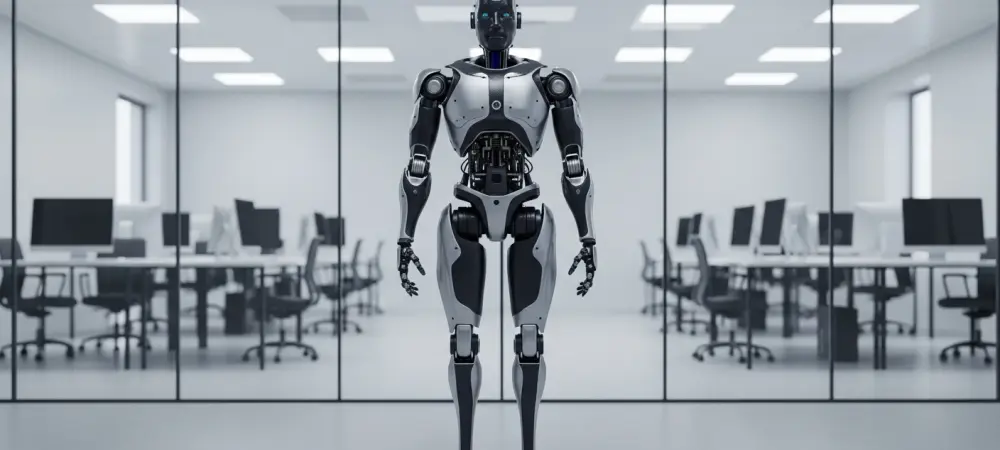
A slender, bipedal machine navigates a bustling hospital corridor with the grace of a seasoned professional, carrying delicate medical supplies while politely signaling its path to distracted pedestrians. This sight, once relegated to the imaginative realms of science fiction, is rapidly becoming a standard operational feature in the modern service landscape. The era of robots being confined behind safety cages on factory floors has ended. Today, a new generation of machines—equipped with articulated fingers, bipedal legs, and advanced facial recognition—is stepping into the chaotic environments of hospitals, hotels, and logistics hubs. This shift from repetitive mechanical tasks to nuanced human interaction represents a fundamental change in how the global economy functions. As these machines evolve to mimic human dexterity and social cues, they are no longer just tools for mass production; they are becoming essential participants in the service-oriented world.
The physical presence of these machines in shared human spaces signifies a departure from the “blind” automation of the previous century. Where industrial arms once swung with lethal force in restricted zones, humanoid units now utilize sophisticated arrays of LiDAR and tactile sensors to safely coexist with the public. This evolution allows for a level of integration that was previously impossible, enabling robots to perform tasks that require both mobility and a high degree of spatial awareness. Consequently, the distinction between a machine and a service provider is beginning to blur in the eyes of the consumer.
From Cold Industrial Arms to Responsive Service Partners
The transition toward responsive service partners is driven by the integration of large language models and computer vision, allowing robots to interpret and respond to the human environment in real time. Unlike their predecessors, these modern humanoids can understand verbal instructions and recognize emotional cues, making them suitable for roles that require a “soft” touch. This technological leap has moved automation from the periphery of the economy directly into the center of social infrastructure, where the quality of interaction is as important as the efficiency of the task performed.
Furthermore, the design philosophy of these machines has shifted toward anthropomorphism not for aesthetic reasons, but for functional necessity. Because our world is built specifically for the human form—with stairs, door handles, and narrow aisles—a humanoid shape is the most efficient configuration for navigating existing architecture. This inherent compatibility ensures that businesses do not need to overhaul their physical infrastructure to accommodate robotic help, facilitating a smoother and more cost-effective adoption process across various service industries.
Addressing the Looming Demographic Deficit
The surge in humanoid robotics is not merely a pursuit of technological novelty but a calculated response to a shrinking global workforce. With aging populations in major economies and a growing shortage of workers in high-pressure sectors, the demand for versatile automation has reached a critical tipping point. Unlike traditional robots designed for single, repetitive motions, humanoids provide the flexibility needed to navigate spaces built for people. This adaptability is essential for maintaining economic productivity in societies where there are simply not enough human hands to fill essential roles in caregiving, maintenance, and logistics.
As birth rates decline in developed nations, the reliance on automated labor becomes a structural necessity rather than a luxury. These machines act as a vital buffer against the economic stagnation that typically accompanies a dwindling tax base and a rising dependency ratio. By taking over physically demanding or monotonous roles, humanoid robots allow the existing human workforce to focus on high-value tasks that require empathy, creativity, and complex decision-making, thereby preserving the standard of living in an aging world.
Expanding the Reach of Automation Across Key Service Sectors
The versatility of humanoid technology allows it to penetrate industries that were previously considered “robot-proof” due to their complexity. In healthcare, robotic systems are moving beyond basic assistance to support high-stakes surgical procedures and diagnostic tasks, effectively reducing human error and physical exhaustion. Within the logistics sector, the focus has shifted from simple conveyor belts to autonomous humanoids capable of navigating cramped warehouses and handling diverse types of cargo with human-like precision. Even in hospitality, these machines are beginning to manage guest services, providing a seamless blend of efficiency and interaction that traditional automation could never achieve.
In the realm of elder care, the impact of this expansion is particularly profound. Humanoid assistants are now capable of helping patients with mobility, monitoring vital signs, and even providing companionship through advanced AI-driven conversation. This alleviate the burden on healthcare systems that are currently stretched thin, ensuring that vulnerable populations receive consistent and high-quality attention. The ability of these robots to operate twenty-four hours a day without fatigue makes them an indispensable asset in any sector where reliability is paramount.
The Global Value Chain and the Strategy of Human Augmentation
Strategists like Billy Leung of Global X point out that the current robotics revolution is defined by its ability to enhance human capability rather than replace it entirely. This “borderless” innovation relies on a sophisticated global network of suppliers providing high-performance semiconductors, sensors, and actuators. No single firm dominates this space; instead, the industry’s success is built upon a diverse ecosystem of companies specializing in high-capacity batteries and rare earth mineral processing. This interconnectedness ensures that as AI becomes more sophisticated, the hardware components—the “body” of the robot—keep pace with the digital “brain.”
The synergy between hardware and software is what allows for true human augmentation. For example, in a logistics setting, a humanoid robot does not just move boxes; it works alongside human supervisors to optimize the flow of goods, utilizing its onboard processing power to solve routing problems on the fly. This collaborative model increases the overall output of the facility while reducing the risk of workplace injuries for the human staff. The global nature of this supply chain means that breakthroughs in one region, such as a more efficient motor design, can quickly be integrated into robotic platforms worldwide.
Navigating the Robotics Market Through Specialized Investment
For those looking to engage with this transformative economic force, understanding the landscape requires a systematic approach to the entire value chain. Specialized investment vehicles, such as the Global X Humanoid Robotics ETF (HMND), provide a framework for capturing the growth of international firms involved in everything from AI development to sensor manufacturing. Investors and industry observers should focus on diversified exposure that includes both the software developers and the hardware manufacturers. By monitoring funds that offer regular rebalancing, stakeholders can stay aligned with the rapid pace of innovation while supporting the infrastructure that will integrate humanoid robots into the fabric of daily life.
The emergence of these specialized funds signaled a maturation of the robotics market, moving it from a niche venture capital interest to a pillar of the broader thematic investment world. These vehicles allowed capital to flow into the most promising technological bottlenecks, such as battery density and actuator precision, which in turn accelerated the deployment of robots into the field. This financial support created a virtuous cycle where increased investment led to more affordable and capable machines, further driving adoption across the global service economy.
Ultimately, the successful integration of humanoid robotics into the service sector required a shift in both technical capability and public perception. As the technology matured, the focus moved toward creating machines that could seamlessly augment human efforts in increasingly complex environments. This transition was supported by a robust global supply chain and strategic investment models that recognized the long-term necessity of automated labor. By addressing the challenges of aging populations and labor shortages, these machines became foundational to the stability of the modern economy, proving that the future of service was built on a partnership between human ingenuity and robotic precision.