

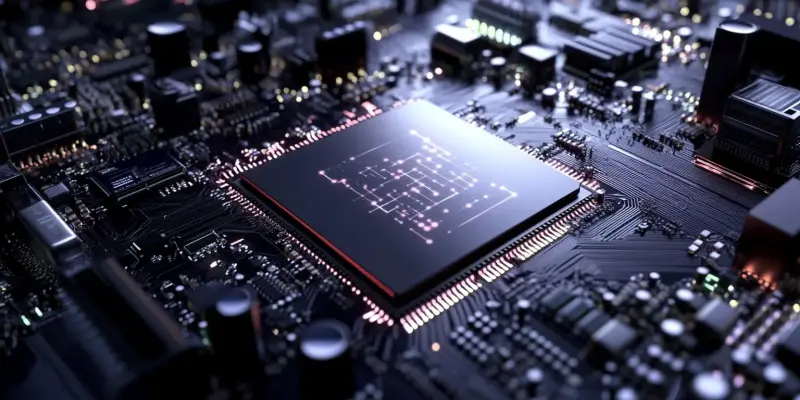
In a groundbreaking development in the world of artificial intelligence, Nvidia has unveiled two state-of-the-art AI chip designs, named Vera Rubin and Feynman, marking a significant pivot toward advancing AI and robotics. This move signals Nvidia’s strategic shift from its celebrated history in graphics card manufacturing to setting new benchmarks in the AI and data center arenas. The prospects of these chips, expected to launch in succession starting from 2026, are set to revolutionize the computational landscape and fortify Nvidia’s dominance in this burgeoning sector.
Advancements in Chip Design and Performance
The Vera Rubin chip, set to debut in the latter half of 2026, represents a leap forward in memory capacity and processing power. Boasting up to 75 terabytes of high-speed memory and leveraging HBM4 technology, this chip can achieve an unparalleled bandwidth of 12 terabytes per second. With its integration of two GPUs per die, the Vera Rubin is poised to deliver an astounding performance exceeding 50 petaflops of FP4 computations. Nvidia envisions that a full rack of these chips will offer a stunning 3.6 exaflops, greatly surpassing the current capabilities of existing Blackwell hardware.
The technological prowess of the Vera Rubin chip is augmented by its custom Vera CPU, designed with 88 ARM cores to handle 176 concurrent threads efficiently. This synergy between the GPU and CPU is further enhanced by Nvidia’s high-speed NVLink interface, providing an impressive inter-component bandwidth of up to 1.8 terabytes per second. These advancements collectively position the Vera Rubin chip as a transformative force in the realm of AI and data processing, setting new standards for performance and efficiency.
The Road Ahead with Rubin Ultra and Feynman
Following the Vera Rubin’s launch, Nvidia plans to introduce an enhanced version, the Rubin Ultra, in the subsequent year. This iteration will incorporate HBM4e memory, significantly elevating the memory capacity to 365 terabytes and boosting performance by four times compared to its predecessor. The Rubin Ultra aims to cater to the growing demands for more robust and efficient AI computations, pushing the boundaries of what is achievable within server architecture and data processing capabilities.
Looking further into the future, Nvidia’s Feynman chip, expected to hit the market in 2028, promises to be a game-changer. Named after the legendary physicist Richard Feynman, this chip is anticipated to surpass the capabilities of Rubin Ultra significantly. It will incorporate the advancements made with the Vera CPU during the Vera Rubin era, epitomizing a new epoch of computational power and efficiency. The introduction of Feynman will mark yet another milestone in Nvidia’s strategic vision of transforming data centers into advanced “AI Factories,” manufacturing the computational power necessary for the most sophisticated AI applications.
Nvidia’s Strategic Vision and Impact
In a significant leap forward for artificial intelligence, Nvidia has introduced two cutting-edge AI chip designs, named Vera Rubin and Feynman. This announcement marks a noteworthy shift for Nvidia, moving from its acclaimed legacy in graphics card production toward setting new standards in AI and data centers. These advancements signal Nvidia’s strategic emphasis on pushing the boundaries of AI and robotics. The new chips, which are anticipated to begin rolling out in 2026, promise to bring revolutionary changes to the computational landscape. By doing so, they aim to solidify Nvidia’s leadership in the rapidly growing AI sector. This move underscores Nvidia’s determination to innovate and retain its influential presence within the tech industry. As the demand for advanced AI solutions increases, these chips are expected to play a crucial role in addressing complex computational needs, ensuring Nvidia remains at the forefront of technological evolution.