

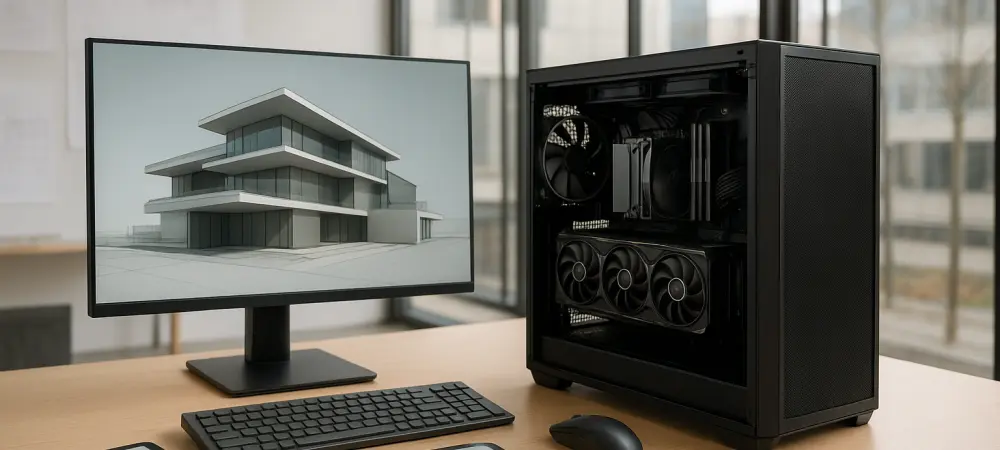
Organizations focused on deep learning often require specialized enterprise hardware designed specifically for parallel computing and high-density thermal efficiency. This requirement has fundamentally reshaped the landscape for creative professionals who now find themselves navigating a market where the lines between workstation-grade performance and consumer accessibility are increasingly blurred. In the current 2026 technological climate, a graphics card is no longer just a peripheral for displaying images; it is the vital engine powering sophisticated generative AI models, high-bitrate video streams, and real-time ray-traced environments. Selecting the right hardware requires a departure from traditional metrics like clock speed in favor of a holistic view that considers how silicon architecture interacts with specific software pipelines. By prioritizing the unique demands of modern creative suites, editors and designers can secure a system that remains responsive even under the most taxing computational loads, ensuring that the hardware facilitates rather than hinders the creative process in a professional setting.
Prioritizing Memory for Uninterrupted Workflows
The Critical Role: VRAM Capacity
Within the realm of high-fidelity video production and complex 3D simulation, Video Random Access Memory (VRAM) has emerged as the most critical factor for maintaining fluid operation. As projects from 2026 to 2028 continue to scale in complexity, having a substantial 32GB buffer of GDDR7 memory has become the baseline for top-tier cinematic work where high-resolution textures and massive geometry data sets are common. This massive capacity ensures that the entire project remains within the GPU’s immediate reach, preventing the catastrophic performance drops that occur when the system is forced to swap data with slower system RAM. For specialists working in Unreal Engine or DaVinci Resolve, this headroom is not merely a luxury but a necessity to prevent crashes during the final render stages. Furthermore, the increased bandwidth provided by the latest memory standards allows for near-instantaneous feedback during iterative design, allowing creators to make fine adjustments to lighting and shaders without waiting for the viewport to catch up with their creative vision.
Memory Standards: Performance Beyond Capacity
While the highest tiers of production demand extreme buffers, the broader community of graphic designers and photographers typically finds that a 16GB VRAM configuration provides an ideal balance of cost and capability. This capacity allows for the simultaneous operation of multiple heavy-duty applications, such as running a high-resolution export in the background while continuing to work on intricate vector illustrations or large-scale photo composites. The move toward higher memory standards has been driven by the increasing integration of AI-assisted tools within standard design software, which utilize the GPU to accelerate tasks like intelligent object removal and neural filters. By selecting a card that offers at least 16GB of dedicated memory, professionals can future-proof their workstations against the inevitable increase in software requirements over the coming years. This strategic choice avoids the pitfall of investing in raw speed that cannot be utilized because the available memory is saturated by the base assets of a modern, high-definition project.
Balancing Processing Power and Physical Design
Computational Speed: Workstation Integration
Processing power remains the primary driver behind the speed of final deliveries, making the choice of core architecture vital for time-sensitive studio environments. Creative tasks in 2026 rely heavily on specialized cores designed for tensor mathematics and ray-tracing acceleration, which drastically reduce the time needed for rendering light-transport simulations and denoising high-resolution frames. It is essential to differentiate between raw teraflops and the actual throughput achieved in specific creative applications, as some architectures are better optimized for the sequential processing tasks common in video encoding than others. Furthermore, the physical evolution of hardware has introduced new considerations for workstation integration, such as 2.5-slot cooling designs that allow for multi-GPU configurations in professional racks. By choosing a card with a blower-style or streamlined axial cooler, studios ensure that heat is managed efficiently, preventing thermal throttling from slowing production during long render sessions that push the silicon to its limits.
Strategic Selection: The Professional Conclusion
Ultimately, the selection process was defined by a shift from chasing raw benchmarks to understanding the nuances of professional production cycles. Organizations and independent creators alike discovered that the best results came from matching the specific hardware tier to their primary creative output, whether that involved flagship 32GB cards for cinematic effects or balanced 16GB models for graphic design. This strategic alignment allowed for the seamless integration of AI-accelerated features and high-efficiency video encoders, which fundamentally altered how quickly high-quality content could be produced and delivered. By prioritizing hardware stability and thermal performance, studios ensured that their machines remained operational through the most demanding periods. This analytical approach in hardware procurement provided a roadmap for future technical upgrades, emphasizing that the value of a GPU is best measured by its ability to disappear into the workflow, serving as a reliable foundation for the most ambitious digital projects.