

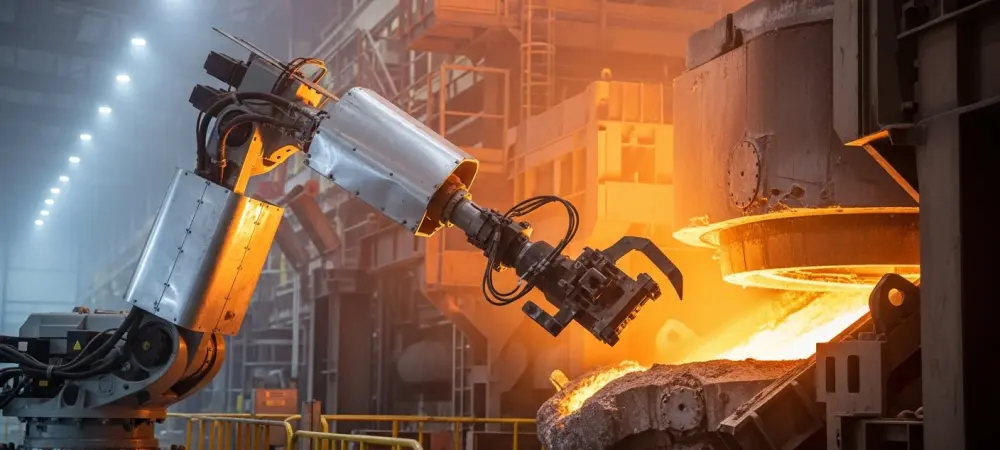
Inside the humming labyrinth of a modern potline, workers navigate an environment where electromagnetic forces are powerful enough to pull a wrench from a pocket and molten aluminum glows with the terrifying radiance of an artificial sun. The aluminum smelting floor remains one of the few places on Earth where industrial operations require routine proximity to 1,650-degree Fahrenheit molten metal and magnetic fields strong enough to interfere with life-saving medical devices. With more than 140 reported industrial explosions recorded in 2024 alone, the metal production industry is rapidly moving past the era of manual intervention toward a future defined by mechanical resilience. As global demand for lightweight, sustainable metals surges in this mid-decade landscape, the conversation is no longer about the feasibility of automation but rather how quickly robotics can neutralize the lethal risks of the “red zone.”
Beyond the Melting Point: The High-Stakes Evolution of the Potroom
The modern aluminum smelter is a theater of extremes where the margin for error is measured in centimeters and milliseconds. For decades, the potroom was a place of grueling manual labor, characterized by workers in heavy aluminized suits braving oppressive heat to manage the electrolytic cells. However, the operational landscape of 2026 reflects a profound shift in priorities, as facility managers recognize that human biology is fundamentally incompatible with the intensifying demands of high-output smelting. The “red zone,” that immediate perimeter around the reduction cells, is being systematically depopulated of human presence to prevent the catastrophic injuries that have historically plagued the sector.
This evolution is driven by more than just a desire for safety; it is an economic necessity in a world where supply chain reliability is paramount. The surge in demand for aluminum, fueled by the transition to electric vehicles and renewable energy infrastructure, has forced smelters to operate at peak capacity for longer durations. When a facility relies on manual labor for critical tasks like anode changing or crust breaking, it introduces a degree of variability that can lead to hazardous instabilities. By integrating advanced robotics, companies are seeking to create a buffer between the volatile chemical reactions occurring in the pots and the workforce tasked with maintaining them.
Moving toward a roboticized potroom represents the final frontier of industrial safety, where the goal is to transform the role of the smelter worker from a front-line laborer to a remote systems operator. This transition addresses the primary vulnerability of the aluminum industry: the high-stakes nature of the smelting process itself. In an environment where a single splash of molten metal or a localized electrical arc can lead to a multi-million-dollar shutdown or a loss of life, the deployment of autonomous and semi-autonomous systems is the only logical path forward. The industry is currently witnessing a massive technological overhaul that aims to ensure that no human ever has to stand within the direct line of fire of a reduction cell again.
The Hall-Héroult DilemmWhy Smelting Is Inherently Dangerous
To appreciate the gravity of the safety challenge, one must understand the hostile chemistry of the Hall-Héroult process, which has remained the standard for aluminum production for over a century. This energy-intensive electrochemical reaction involves dissolving alumina in a bath of molten cryolite and passing a massive electric current through the mixture. The result is a continuous production of liquid aluminum, but the side effects include the generation of corrosive gases, intense heat, and powerful magnetic fields. This environment is inherently unstable; any deviation in temperature or chemical balance can cause the pot to “heave” or lead to an anode effect, which produces significant greenhouse gases and localized thermal spikes.
Beyond the immediate threat of thermal burns, the workforce faces a gauntlet of “silent killers” that compromise long-term health and safety. Chronic exposure to hydrogen fluoride and sulfur dioxide fumes, even at low levels, has historically led to a high incidence of “potroom asthma” and other debilitating respiratory conditions. Furthermore, the extreme heat stress of working near pots that operate at nearly 1,000 degrees Celsius places an immense physical toll on the heart and kidneys. As regulatory bodies tighten occupational health standards, the financial liability associated with these long-term health risks has become a primary motivator for companies to accelerate their automation roadmaps and remove personnel from these hazardous zones.
The economic imperative for automation is further sharpened by the cost of operational instability caused by geopolitical volatility. Many of the world’s major smelting hubs are located in regions where power grid stability can be threatened by regional conflict or extreme weather events. If a potline loses power for more than a few hours, the molten metal inside can “freeze,” essentially destroying the cells and requiring a massive, dangerous recovery effort. Robotic systems are now being designed to maintain potline integrity during these critical windows, performing emergency crust breaking and thermal management that would be too dangerous for humans to attempt during a power crisis. This shift toward automation is viewed as a $100 billion strategic hedge against the inherent risks of manual potline management.
Engineering Out the Risk: Key Robotic Applications in Modern Smelters
The most significant breakthrough in engineering out risk has been the automation of the high-risk anode replacement cycle. Historically, removing a spent carbon anode and inserting a new one was a 25-minute window of extreme exposure, requiring operators to work directly over the open, molten bath. In 2026, automated anode-changing vehicles and overhead robotic systems have reduced this exposure window significantly. These systems can perform the exchange in roughly 15 minutes, with the entire process being monitored by a technician located in a climate-controlled, shielded control room. This removes the risk of “blowouts” or metal splashes reaching the operator, effectively neutralizing one of the most common causes of potroom injuries.
Precision maintenance in these extreme environments is another area where robotics are proving indispensable, particularly in the realm of superstructure repair. Companies like Rio Tinto have led the way in utilizing height-sensing and seam-detection robots to perform complex welding tasks on the electrolytic cells. These robots can operate in temperatures and magnetic fields that would render standard electronics useless, allowing for the repair of corrosive damage without requiring a pot to be taken offline. This capability not only protects the workers from the intense heat and fumes of the welding process but also ensures the structural integrity of the facility, preventing the volatile electrical arcs that occur when equipment begins to degrade.
Automated molten metal handling has also seen a radical transformation, with remote-controlled tapping and pouring systems becoming the industry standard. Tapping—the process of siphoning molten aluminum from the pot—is a delicate task where equipment failure can lead to catastrophic spills. Modern robotic tapping systems utilize advanced sensors to monitor flow rates and temperatures in real-time, adjusting the vacuum pressure to prevent turbulence and splashes. By eliminating the need for a human to stand at the edge of the crucible, the industry has addressed the most direct path of exposure to liquid metal, significantly lowering the frequency of severe industrial burns and equipment damage.
From the Front Lines: Expert Perspectives on the Robotic Shift
Industry leaders are increasingly adopting what experts like Jan Biti call the “Red Zone Philosophy,” which posits that the ultimate safety metric is the total number of human hours spent within five meters of an active pot. According to Biti, removing humans from the potroom is not just about efficiency; it is a moral obligation for an industry that has historically accepted high levels of risk. He notes that the transition to robotics allows for a level of data collection and environmental monitoring that was previously impossible. When a robot performs a task, it records thousands of data points regarding the health of the cell, providing an early warning system for leaks or surges that could lead to an explosion long before a human operator would notice the signs.
Reliability over labor is another recurring theme among facility managers like Matt Fisher, who emphasizes that robotic consistency is the key to preventing the “human error” lag that often compromises facility safety. In a manual environment, a slight misalignment of an anode or a failure to properly break the bath crust might not be noticed for 72 hours, by which time the pot has become unstable and dangerous. Fisher points out that robots do not suffer from fatigue or heat exhaustion, ensuring that every task is performed with surgical precision. This consistency stabilizes the electrical draw of the facility, reducing the likelihood of the catastrophic voltage spikes that can trigger a chain reaction of failures across the potline.
The global landscape of robotic adoption shows a clear gradient between different industrial philosophies. While European and North American smelters are primarily driven by safety mandates and the need to reduce high labor costs, other regions, notably China, are pursuing “black potroom” ambitions. These are facilities designed to operate in total darkness without any human presence on the floor during standard production cycles. This shift is also transforming the workforce itself; operators who once performed back-breaking physical labor are now being retrained as robotic technicians and data analysts. This evolution is viewed positively by many in the industry, as it replaces hazardous manual roles with high-level technical positions that offer better longevity and safety for the employees.
Implementing Autonomy: Strategies for a Safer Smelting Future
Achieving full autonomy in a smelter requires the development of “hardened” hardware capable of surviving the most punishing conditions on the industrial spectrum. Sensor suites must be engineered to withstand 900-degree Celsius temperatures while operating in the presence of massive electromagnetic interference that would scramble a typical smartphone. Manufacturers are now utilizing specialized ceramic shielding and liquid-cooling loops to protect the “brains” of their robotic units. These hardware frameworks are essential for moving beyond simple automation toward true autonomous decision-making, where a robot can detect an impending pot leak and initiate an emergency shutdown sequence without waiting for human confirmation.
For the vast majority of the industry, the path to a safer future lies in the “retrofitting roadmap,” which involves integrating robotic cells into legacy facilities that were never designed for automation. This is a complex logistical challenge, as smelting is a 24/7 operation that cannot be easily paused for upgrades. Successful implementations often involve a phased approach, where the most dangerous tasks, such as anode changing, are automated first. By creating modular robotic systems that can be installed on existing overhead crane rails or mobile platforms, companies are finding ways to modernize their safety protocols without the prohibitive costs of building entirely new facilities from the ground up.
The final hurdle in the robotic transition is bridging the AI gap to handle unpredictable scenarios like pot surges or structural failures. While a robot can easily be programmed to perform a repetitive task, responding to a crisis requires a level of situational awareness that the industry is still perfecting. Future strategies involve training machine learning models on decades of smelting data to help robots recognize the subtle acoustic and thermal signatures of a pot about to go “unstable.” This move toward predictive autonomy will likely define the next decade of the industry, ensuring that when an emergency does occur, the response is instantaneous and perfectly executed by a machine that is impervious to the heat and fear of the moment.
The transition toward automated aluminum smelting reached a critical milestone as companies successfully integrated these advanced robotic systems into their daily operations. The heavy industry once defined by the physical endurance of its workers evolved into a high-tech sector where safety was guaranteed by mechanical precision. By depopulating the high-risk areas of the potroom, the sector proved that industrial growth did not have to come at the expense of human well-being. The operators who once braved the heat transitioned into technical roles, overseeing the autonomous systems that managed the volatile chemistry of the pots. This fundamental shift provided the stability and resilience needed to meet the world’s growing demand for metal while establishing a new global standard for occupational safety. The successful implementation of these technologies demonstrated that even the most hostile environments could be mastered through engineering. The industry moved toward a future where the “red zone” was no longer a place of danger but a showcase of robotic efficiency. As the data from these early autonomous facilities became available, it confirmed that the reduction in human error and exposure led to a significant decrease in catastrophic incidents. Ultimately, the aluminum smelting industry secured its place as a pillar of the sustainable economy by proving it could protect its most valuable asset: its people.