

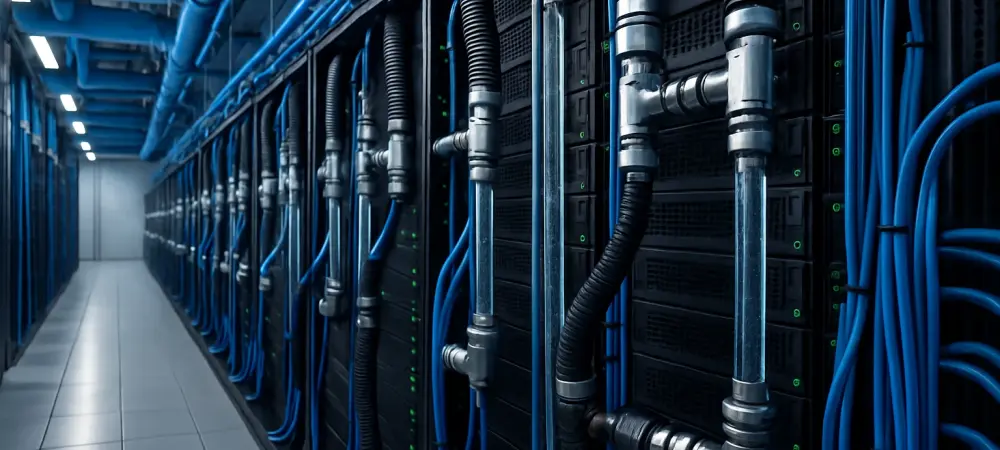
In the rapidly evolving landscape of technology, data centers are grappling with unprecedented challenges as artificial intelligence (AI) workloads push infrastructure to its limits with rack densities soaring past 100 kW and, in extreme cases, reaching up to 600 kW. Traditional air-based cooling systems, once the backbone of thermal management, are increasingly unable to keep pace with these intense demands. This escalating need for efficient heat dissipation has thrust liquid cooling into the spotlight as a game-changing solution. Industry projections indicate that liquid cooling is the fastest-growing segment in the data center cooling market, with a robust Compound Annual Growth Rate of 20%. As AI continues to redefine computational requirements, the adoption of advanced cooling technologies is not merely an option but a necessity, paving the way for a fundamental shift in how data centers are designed and operated to ensure performance and sustainability.
The Architectural Shift Driven by AI Workloads
Redesigning Data Centers for High-Density Computing
The surge in AI-driven workloads has necessitated a complete overhaul of data center architecture to accommodate the extraordinary heat generated by next-generation accelerators. Unlike older facilities that relied on air cooling and now face expensive retrofitting hurdles, modern data centers built for AI are integrating liquid cooling solutions right from the blueprint stage. This involves rethinking heat rejection mechanisms, plumbing systems, power distribution networks, and even rack designs that deviate from standard dimensions to house larger GPU setups. Such changes disrupt conventional airflow and containment approaches, especially in hybrid environments where cooling needs vary across racks. As a result, flexible systems capable of adapting to diverse configurations are becoming essential. Thermal management has evolved into a core pillar of facility planning, ensuring that the infrastructure can support the intense demands of AI computing without compromising efficiency or reliability.
Evolving Rack Formats and Cooling Integration
Beyond the foundational redesign, the evolution of rack formats is another critical aspect of adapting to AI’s thermal challenges. Modern racks are being engineered to integrate liquid cooling technologies like cold plates and direct-to-chip systems directly into their structure, a stark contrast to the air-cooled setups of the past. This shift allows for more efficient heat capture at the source, enabling data centers to handle significantly higher densities. Additionally, the move toward larger, non-standard rack sizes to accommodate powerful GPU systems is reshaping spatial planning within facilities. Hybrid cooling setups, which combine liquid cooling for high-heat components like GPUs and CPUs with air cooling for less demanding hardware, are still common but are gradually giving way to fully liquid-based solutions. This trend not only boosts operational capacity but also aligns with broader goals of energy efficiency by minimizing wasted heat and enhancing overall system performance.
Liquid Cooling as a Mainstream Solution
From Niche to Necessity in Thermal Management
Liquid cooling, once a specialized technology reserved for high-performance computing environments, has now emerged as a mainstream necessity in the face of AI’s escalating demands. Technologies such as direct-to-chip cooling and cold plates are being incorporated during the manufacturing process for rack-scale AI deployments, ensuring seamless integration and optimal performance. This transition marks a significant departure from the days when liquid cooling was considered a niche application. The ability to manage heat directly at the component level allows data centers to push rack densities to new heights, far beyond what air cooling can achieve. Moreover, the efficiency gains from liquid cooling are substantial, reducing energy consumption and operational costs. As the industry moves toward full liquid heat capture, the focus is on creating systems that not only address current needs but also anticipate future scalability, positioning liquid cooling as a cornerstone of modern data center strategy.
Sustainability and Energy Recovery Benefits
A compelling advantage of liquid cooling lies in its contribution to sustainability, a pressing concern amid rising energy costs and stringent regulatory pressures, particularly in regions like Europe. Unlike traditional cooling methods that often waste heat, liquid cooling systems enable innovative heat reuse strategies, such as district heating or energy recovery for nearby facilities. This capability transforms a byproduct of computing into a valuable resource, aligning data center operations with environmental goals. Additionally, the reduced energy footprint of liquid cooling supports compliance with climate targets and resource constraints, making it an attractive option for operators. The push for sustainability is further amplified by the integration of AI-driven thermal regulation, where real-time data optimizes cooling efficiency. As data centers face increasing scrutiny over their environmental impact, adopting liquid cooling offers a dual benefit of enhancing performance while demonstrating a commitment to responsible energy use.
Collaborative and Strategic Innovations
Cross-Disciplinary Thermal Management Approaches
Thermal management in the era of AI is no longer the sole responsibility of facilities teams but a cross-disciplinary endeavor that demands collaboration across IT, compute, and software groups. This integrated approach ensures that energy use and performance are optimized at every level, from hardware design to operational workflows. Advanced data centers are leveraging AI itself to self-regulate thermal conditions, using real-time data to adjust cooling dynamically and maintain efficiency. Such innovations are becoming indispensable as rack densities climb and heat loads intensify. The complexity of managing these environments requires a holistic perspective, where thermal strategies are aligned with broader operational goals. By fostering collaboration among diverse teams, data centers can address the multifaceted challenges of AI workloads, ensuring that thermal management evolves in tandem with technological advancements and supports long-term operational stability.
Strategic Planning for Future Constraints
Looking back, the journey of adapting to AI-driven demands revealed that thermal constraints significantly reshaped data center strategies across workload placement, site selection, and sustainability reporting. Operators had to carefully balance performance and cost with resource availability, such as access to water and opportunities for heat reuse, while navigating strict compliance requirements in energy-limited regions. Early coordination among facilities, IT, and finance teams proved crucial for securing investment and ensuring viability. Moving forward, the focus should be on proactive design that embeds liquid cooling and integrated thermal strategies from the outset. Emphasizing innovation in heat management will serve as a competitive edge, enabling data centers to meet rising compute densities and external pressures. As the industry continues to evolve, prioritizing scalable, sustainable solutions will be key to addressing future challenges and maintaining leadership in an increasingly regulated landscape.