

Dominic Jainy is a seasoned IT professional with deep-rooted expertise in artificial intelligence, machine learning, and the evolving landscape of enterprise hardware. As the industry shifts toward AI-integrated workstations and ARM-based computing, his insights provide a bridge between complex technical specifications and practical business implementation. This conversation explores HP’s latest hardware innovations, the security implications of local AI processing, and the future of autonomous workplace agents.
The following discussion centers on the strategic shifts in enterprise computing, specifically examining the nuances of the EliteBook 6 G2q, the security benefits of TPM Guard, and the operational challenges of pooling GPU resources in high-performance environments.
The EliteBook 6 G2q is being positioned as a highly configurable Arm-based PC with various 5G and core options. What specific performance trade-offs should enterprise buyers consider when choosing between these Qualcomm-based systems and traditional x86 architectures for a hybrid workforce?
Enterprise buyers must weigh the impressive efficiency of the Snapdragon X2 platform against the raw compatibility of x86. The EliteBook 6 G2q offers a compelling 12-core X2 Elite option, which provides exceptional battery life and integrated 5G connectivity that is ideal for a mobile, hybrid workforce. However, while ARM-based systems excel in thermal management and “always-on” connectivity, certain legacy enterprise applications may still require the traditional instruction sets found in Intel’s Core Ultra Series 3 for peak performance. Buyers should look at their specific software stack to ensure that the 15% thinner chassis and cellular mobility don’t come at the cost of software emulation overhead for specialized tools.
HP IQ utilizes on-device models for tasks like summarization and proximity-based file sharing through the NearSense framework. How does moving AI processing from the cloud to the local NPU change the security profile of a workstation, and what steps must IT teams take to manage these local agents?
Shifting AI processing to the local NPU is a game-changer for data privacy, as sensitive information used for summarization or transcription never leaves the physical device. This drastically reduces the attack surface associated with cloud data leaks, but it necessitates a more robust endpoint management strategy via platforms like HP’s Work Experience Platform (WXP). IT teams must establish clear policies for local agent control to ensure these “agentic” tools don’t inadvertently access unauthorized local files. Because HP IQ is an HP-exclusive feature, administrators also need to prepare for managing a fragmented ecosystem if their fleet consists of hardware from multiple vendors.
New workstation designs now feature expandable side panels to accommodate larger GPUs and enhanced cooling. When configuring a high-end system like the Z8 Fury G6i with multiple GPUs, what are the primary thermal challenges, and how does this extra internal volume impact long-term hardware reliability?
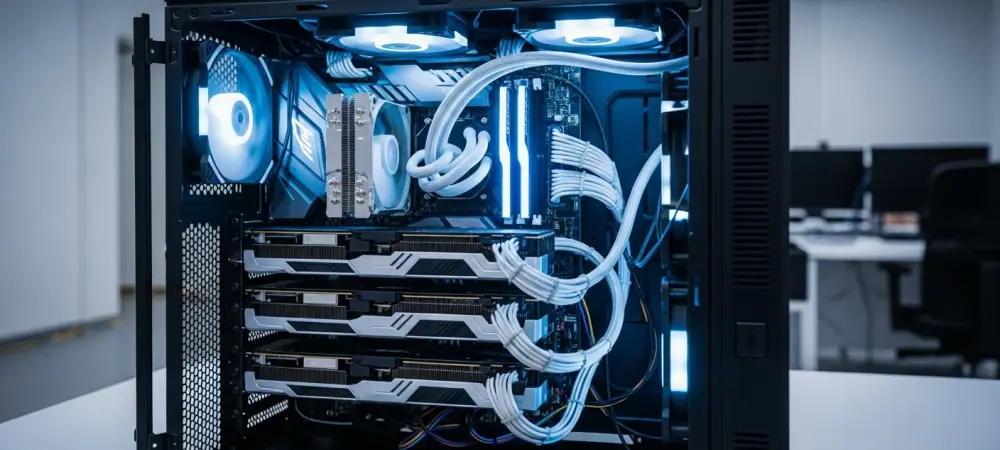
When you pack up to four Nvidia RTX Pro 6000 GPUs into a single chassis like the Z8 Fury G6i, the heat density is immense. The optional side panel, which increases internal volume by 15%, is a critical engineering response to prevent thermal throttling, which can significantly degrade performance during intensive rendering or training tasks. By providing more “breathing room” and optimized airflow paths, HP is effectively extending the lifespan of these high-value components. Long-term reliability is improved because the system can maintain lower ambient temperatures, reducing the cumulative stress on the silicon and preventing the premature failure of cooling fans and power delivery modules.
The ZBoost software allows organizations to pool idle GPU resources across a network for intensive rendering and AI workloads. What are the practical deployment hurdles when implementing distributed computing in a mixed-hardware environment, and how do you measure the resulting gains in workflow efficiency?
The primary hurdle in distributed computing is the latency and bandwidth of the local network, as moving heavy rendering data for applications like Catia or Siemens NX requires a very stable infrastructure. In a mixed-hardware environment, ensuring that different GPU architectures can talk to each other through the ZBoost software requires meticulous configuration and updated drivers across all nodes. To measure efficiency, organizations should track the “time-to-completion” for complex AI training or rendering jobs before and after pooling. If a 10-hour render job is reduced to 2 hours by utilizing idle workstations at night, the ROI on existing hardware is immediately apparent.
TPM Guard addresses vulnerabilities in BitLocker by encrypting communication between the CPU and the Trusted Platform Module. Beyond preventing hardware-level data interception, how does this integration with AI-driven malware detection tools change the way organizations should approach their endpoint security strategy?
The integration of TPM Guard with AI-driven tools like Intel DTECT represents a move toward “Zero Trust” at the silicon level. By encrypting the bus between the CPU and the TPM, HP is closing a physical gap that low-cost hardware tools previously exploited to intercept encryption keys. Organizations should now view endpoint security as a real-time, hardware-assisted process rather than just a software layer; DTECT uses the NPU and GPU to scan for malware patterns without taxing the main processor. This means the security strategy shifts from reactive scanning to proactive, real-time threat detection that is baked into the very heart of the workstation’s architecture.
Connecting a PC automatically to conference room hardware upon entry relies on device-to-device infrastructure standards. What are the interoperability risks when using proprietary software platforms for these “seamless” interactions, and how can companies avoid vendor lock-in while trying to improve the meeting experience?
The main risk is the “walled garden” effect, where HP’s NearSense and Poly Studio integration might not play well with equipment from other manufacturers. While these features are built on Google’s D2DI standard to promote some level of infrastructure consistency, the full automation often requires a specific software stack like HP IQ. To avoid lock-in, companies should prioritize hardware that supports open standards while using vendor-specific features as “value-adds” rather than foundational requirements. It’s essential to evaluate whether the productivity gains of a 30-second faster meeting start justify the potential difficulty of switching hardware providers three years down the line.
Modern workstations are shifting from being simple productivity tools to acting as proactive AI assistants. What is your forecast for the evolution of autonomous agents in the workplace over the next three years?
Within the next three years, we will see a shift from AI being a tool you “query” to an agent that “anticipates.” We are moving toward a reality where your workstation, powered by its own NPU, will autonomously organize your files based on proximity using NearSense or prep your meeting notes before you even sit down in a conference room. I expect autonomous agents to handle roughly 30% of administrative overhead, such as scheduling and cross-referencing documents, directly on the device. As local models become more sophisticated, the PC will transition from a passive workstation into a collaborative partner that proactively manages the digital workflow of the user.