

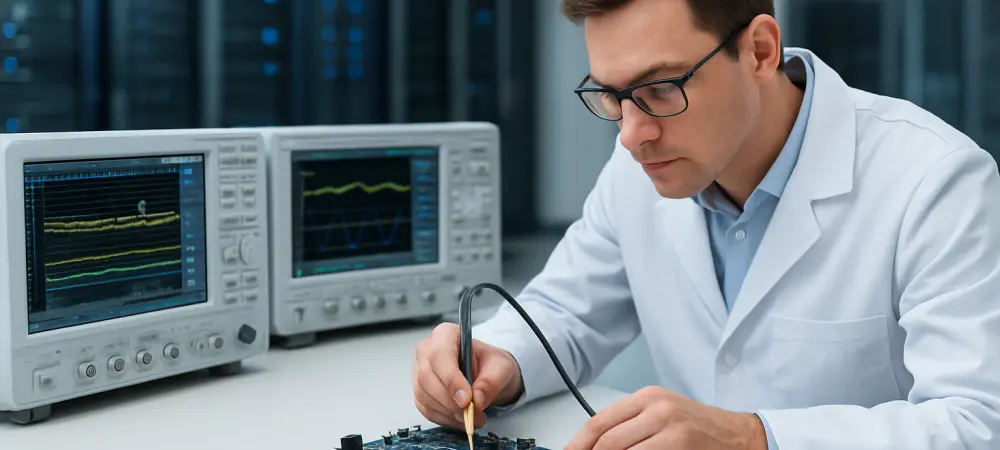
When a cornerstone of the testing and measurement industry records a 56% surge in orders to nearly $3 billion in a single quarter, the tremors signify more than a simple financial gain—they mark a fundamental shift in how the digital world is constructed. Keysight Technologies, a firm long associated with the precise calibration of laboratory instruments, has been pulled from the quiet corridors of research and development into the frantic center of the global artificial intelligence build-out. This transition is not merely about selling more hardware; it represents the moment when the physical limits of data transmission began to dictate the pace of human innovation.
The narrative of Keysight’s recent growth serves as a bellwether for the entire technology sector. As data centers evolve to support increasingly heavy generative AI workloads, the traditional boundaries between design and manufacturing have blurred. We are witnessing an era where the specialized tools required to verify a system’s performance have become as essential as the processors themselves. This story is about more than a company’s balance sheet; it is about the “test intensity” required to keep the lights of the modern internet from flickering under the weight of a trillion parameters.
The Massive Order Surge That Redefined a Testing Giant
The sudden influx of capital into Keysight’s order books underscores a massive industrial pivot. While the company has historically catered to the steady requirements of the telecommunications sector, the current demand is characterized by a “burst” of activity from hyper-scalers and semiconductor giants. This surge to a nearly $3 billion order level indicates that the industry is no longer satisfied with standard validation; it is frantically securing the capacity to test the next generation of 800G and 1.6T systems before they even hit the production floor. This financial milestone has effectively repositioned Keysight as an infrastructure partner rather than a mere vendor. In the current environment, a delay in obtaining high-precision testing equipment can stall the deployment of an entire data center cluster. Consequently, the company’s role has expanded from providing diagnostic tools to serving as a critical gatekeeper in the global supply chain, ensuring that the hardware supporting the world’s intelligence remains stable under unprecedented pressure.
Why Test Intensity Is the New Metric for Success
The industry has entered a phase where “test intensity” has replaced raw throughput as the primary concern for hardware architects. In the past, engineering margins were wide enough that performance could often be predicted with high confidence. However, as we move toward the edge of physics with ultra-high-speed signaling, those margins have evaporated. Every microscopic tolerance and signal fluctuation now carries the risk of total system failure, making rigorous validation an non-negotiable step in every stage of development.
This evolution means that the volume of testing required for a single component has increased exponentially. Manufacturers are no longer testing a sample of their output; they are moving toward comprehensive, packet-level emulation for every unit. Keysight has capitalized on this by offering solutions that simulate real-world AI traffic, allowing designers to see exactly how their hardware behaves when pushed to the breaking point. This shift ensures that “good enough” is a relic of the past, replaced by a mandate for absolute precision.
Breaking Down the AI Transformation: From Wireline to Chiplets
A historic shift occurred recently when Keysight’s wireline technology revenue eclipsed its wireless segment for the first time. This flip is the direct result of the urgent need for interconnectivity within AI data centers, where the physical cabling must handle data rates that were unthinkable just a few years ago. As commercial communications revenue surpassed the $1 billion quarterly mark, it became clear that the “plumbing” of the AI world—the high-speed wires and optical links—is where the most intense innovation is currently focused.
Beyond simple connectivity, the rise of heterogeneous computing has forced a change in how chips are designed and verified. The industry is moving away from monolithic processors toward “chiplets”—smaller, specialized chips that are packaged together. This complexity requires Keysight to provide tools that can stress-test diverse architectures, such as GPUs and DPUs, under extreme power conditions. By ensuring these disparate components can communicate without core instability, the company has become the glue that holds these fragmented hardware environments together.
Insights from the Front Lines: Expert Perspectives on Growth
Despite the overwhelming demand, the path forward is not without its hurdles. Chief Financial Officer Neil Dougherty has pointed out that the company’s near-term revenue is currently limited by what he calls a “governor”—the physical capacity of the supply chain. It is a rare paradox in the business world: the market’s appetite for Keysight’s specialized hardware is so vast that the primary challenge is not finding customers, but rather sourcing the complex components needed to build the testers themselves.
This supply-side bottleneck highlights the critical nature of early engagement. Expert analysis suggests that Keysight’s true competitive advantage lies in its “first-to-market” partnerships. By working with innovators during the earliest stages of the 1.6T and 3.2T technology lifecycles, the company establishes itself as the standard-bearer. This strategy allows them to secure a dominant position long before a technology reaches the mainstream, creating a roadmap that extends from 2026 to 2028 and beyond.
Frameworks for Adapting to High-Speed Infrastructure Demands
To navigate this high-stakes environment, organizations are increasingly adopting a “test-early, test-often” framework. This approach involves integrating validation at every step of the product lifecycle, from initial silicon design to final assembly. By moving away from “one-and-done” checks, companies can identify potential failures in signal integrity or thermal management before they become costly production errors. Keysight’s emulation tools have made this continuous validation possible, allowing for a more resilient hardware ecosystem.
Looking toward the horizon of 2027 and 2028, the focus is already shifting to AI-native networks and 6G integration. Future connectivity will require integrated sensing and non-terrestrial network simulations to handle the data demands of an autonomous world. Organizations that begin validating these candidate technologies now will be the ones to lead the next wave of infrastructure. By prioritizing interoperability stress-testing today, the industry is laying the groundwork for a post-5G world where intelligence is embedded into the fabric of the network itself.
The transition toward AI-centric infrastructure proved to be a defining moment for the measurement industry. Leaders recognized that as hardware complexity grew, the margin for error effectively disappeared. Organizations that integrated high-intensity testing into their production lines successfully mitigated the risks of the 1.6T rollout. Ultimately, the industry moved toward a model where precision was the only viable path to scalability, ensuring that the foundations of global computing remained robust.