

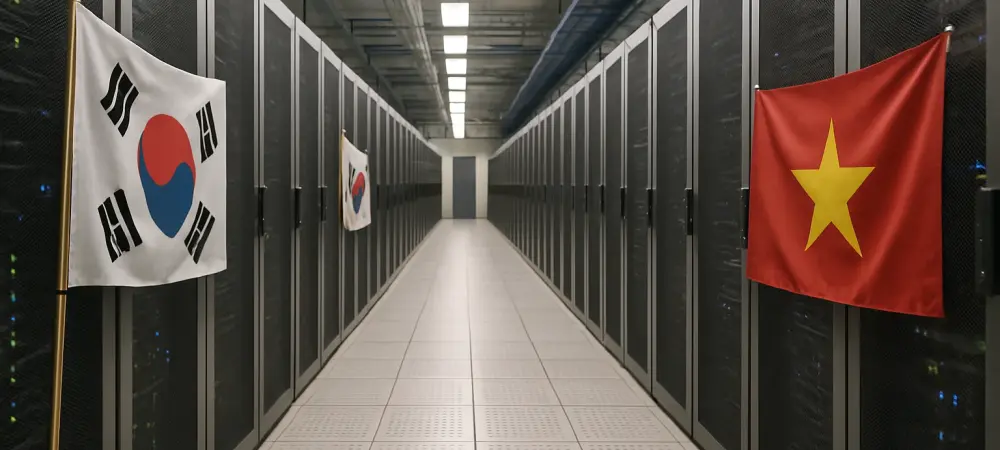
What happens when two Asian powerhouses combine their strengths to tackle the digital demands of a booming region? South Korea and Vietnam have embarked on a groundbreaking partnership to build state-of-the-art data centers, a move poised to redefine Southeast Asia’s technological landscape. Unveiled at a high-profile forum in Seoul, this collaboration promises to fuel the region’s digital economy with cutting-edge infrastructure. This alliance isn’t just about hardware—it’s about creating a foundation for innovation in cloud computing and artificial intelligence (AI).
A Bold Step into Tech Collaboration
At the Korea-Vietnam Business Forum held at the Lotte Hotel Seoul, attended by dignitaries such as Vietnam’s Communist Party General Secretary To Lam and South Korea’s Prime Minister Kim Min Seok, a new chapter in bilateral relations unfolded. The event saw the signing of 52 memoranda of understanding (MoUs) across multiple sectors, with data centers emerging as a centerpiece of technological cooperation. This partnership reflects a shared vision to address the escalating need for digital infrastructure in a region hungry for connectivity.
The significance of this collaboration lies in its potential to bridge gaps in digital access. Vietnam, with its rapidly expanding tech sector and young, tech-savvy population, represents an ideal market for growth. South Korea, a global leader in innovation, brings expertise and resources to the table. Together, these nations aim to create a robust network of data centers that can support everything from e-commerce to AI-driven solutions, setting a precedent for regional tech alliances.
The Critical Role of Data Centers in This Alliance
Data centers form the backbone of modern economies, powering everything from streaming services to complex AI algorithms. In Vietnam, where digital transformation is accelerating, the demand for reliable, high-capacity infrastructure has never been higher. South Korea, with its advanced tech ecosystem, views Southeast Asia as a strategic frontier for expansion, making this partnership a perfect match of needs and capabilities.
This collaboration goes beyond mere construction projects. It addresses pressing issues like data security and energy efficiency, crucial for sustainable growth in the digital age. By pooling resources, both nations stand to gain—Vietnam accesses world-class technology, while South Korean firms tap into a dynamic, emerging market. The forum in Seoul highlighted this mutual benefit, positioning data centers as a catalyst for broader economic progress.
Inside the Game-Changing Data Center Deals
Two landmark agreements stole the spotlight at the forum, showcasing the depth of this tech alliance. Samsung C&T Corporation, a titan in construction and engineering, partnered with Vietnam’s CMC to develop a 130MW data center in Ho Chi Minh City’s High-Tech Park. With an initial investment of $250 million for a 30MW first phase, the project is set to scale up to $1 billion, expanding capacity to 120MW. Samsung’s track record with iconic projects like the Burj Khalifa lends credibility to this ambitious venture.
In a parallel deal, LG CNS, the AI and cloud computing arm of LG, joined forces with Vietnam Posts and Telecommunications Group (VNPT) and Korea Investment Real Asset Management to build a hyperscale data center. While details on location and timeline remain under wraps, LG’s experience with a 220MW facility in Jakarta, Indonesia, signals its readiness for this challenge. VNPT’s existing infrastructure, like the 23,000-square-meter IDC Hoa Lac near Hanoi, further bolsters the project’s foundation.
Additionally, other partnerships, such as Korean telco KT’s $94.6 million agreement with Viettel for AI-ready data centers and GPU server clusters, underline a broader trend. These deals collectively aim to create future-proof infrastructure capable of handling the region’s digital surge. The scale of investment and involvement of industry giants suggest a transformative impact on Vietnam’s tech landscape.
Expert Voices Weigh In on the Partnership
Insights from industry leaders at the forum shed light on the strategic importance of these initiatives. A spokesperson from Samsung C&T emphasized, “This isn’t just about building facilities; it’s about embedding sustainable innovation to prepare Vietnam for the AI era.” Such statements reflect a commitment to long-term value over short-term gains, aligning with global trends in eco-friendly tech.
Analysts based in Seoul have also noted that South Korea’s focus on Vietnam mirrors a larger strategy of engaging emerging markets with high digital demand. Meanwhile, VNPT’s established presence, with facilities like IDC Hoa Lac, proves Vietnam’s capacity to scale operations with foreign support. These perspectives reinforce the notion that this alliance is built on a foundation of mutual trust and shared goals.
A further layer of depth comes from the diversity of collaborations. Beyond infrastructure, CMC’s additional 14 MoUs with South Korean entities, including educational institutions, hint at a holistic approach. This focus on knowledge transfer and skill development ensures that the benefits of these projects extend into local communities, fostering innovation at every level.
Strategies for Building a Digital Future Together
For nations or companies looking to replicate this model of international tech collaboration, several key lessons emerge from the South Korea-Vietnam partnership. Combining local market insights with global expertise stands as a primary pillar of success—Vietnam’s understanding of its unique needs pairs seamlessly with South Korea’s technological edge. This synergy allows for tailored solutions that resonate with regional demands.
Scalability also plays a critical role, as demonstrated by Samsung’s phased investment plan, which ensures projects can adapt to growing requirements over time. Sustainability remains another priority, with innovations like immersion cooling offering energy-efficient alternatives. Finally, extending cooperation beyond physical infrastructure—through initiatives like educational partnerships—builds a skilled workforce ready to sustain technological advancements. These strategies provide a blueprint for others aiming to forge similar alliances in the tech space.
The broader implications of this approach highlight the importance of long-term planning. By focusing on adaptability and innovation, both nations are positioning themselves as leaders in the digital economy. Other regions could benefit from adopting a similar mindset, prioritizing partnerships that balance immediate needs with future growth.
Reflecting on a Milestone in Tech Cooperation
Looking back, the Korea-Vietnam Business Forum in Seoul marked a pivotal moment in the journey toward a connected Southeast Asia. The agreements signed between South Korean giants like Samsung and LG and Vietnamese counterparts such as CMC and VNPT laid the groundwork for transformative digital infrastructure. These partnerships transcended mere business deals, embodying a shared vision for technological progress.
The path forward calls for sustained commitment to these initiatives. Both nations must continue to invest in innovation, ensuring that the data centers built in this collaboration meet evolving global standards. Monitoring energy efficiency and scalability will be key to maintaining relevance in a fast-changing digital landscape.
Moreover, expanding educational and skill-sharing programs could amplify the impact of these projects. By nurturing local talent alongside infrastructure development, South Korea and Vietnam can create a lasting legacy of empowerment. This alliance serves as an inspiring example for other countries, proving that strategic cooperation can turn digital challenges into opportunities for growth.